


Investing in people as new lens to view building Healthy China
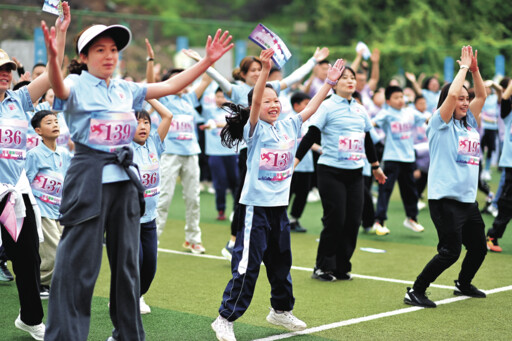
Parents and students participate together in an outdoor fitness program at school. Actively developing public sports and cementing the concept of health through widespread participation in sporting activities is an essential component of building a Healthy China. Photo: IC PHOTO
The construction of a Healthy China, a central task of the national health system, involves expanding medical services, improving insurance coverage, and strengthening disease prevention and control. As China moves into high-quality development stage, health has become a decisive factor influencing population quality, labor productivity, family resilience, and the nation’s long-term developmental capacity. Today, the Healthy China initiative must be seen not merely as access to medical care, but as part of China’s broader shift toward investing in people.
Health as a development issue
Viewing health through the lens of development or economics does not reduce it to a mere tool. Instead, it positions health within the framework of modern development priorities. Historically, health discussions have been framed in terms of consumption and welfare, but this narrow view underestimates its critical role in labor supply, learning capacity, and social engagement. Without foundational health, workforce stability falters, educational and skills investments yield less, and families are more vulnerable to income shocks and caregiving pressures. Unlike general welfare spending, health investment extends beyond disease reduction and life expectancy; it enhances labor productivity, stabilizes family resources, and lowers overall social operating costs. Its economic significance is particularly pronounced in an aging society.
By the end of 2025, China’s population aged 60 and above reached 323 million, representing 23% of the total population, with 223 million aged 65 and older. In 2024, average life expectancy reached 79 years. Chronic non-communicable diseases—including cardiovascular and cerebrovascular conditions, cancer, chronic respiratory diseases, and diabetes—accounted for 88% of deaths and more than 70% of the total disease burden. Health risks have thus shifted from acute infectious threats to chronic disease, aging-related challenges, and long-term management needs. Consequently, health challenges are no longer purely medical; they influence labor supply, family caregiving capacity, public finances, and social operating costs. The central question is no longer whether medical care exists but how health can be strategically integrated into development governance.
In this context, the construction of a Healthy China embodies a dual approach: investing in both physical assets and human capital. Since the reform and opening up, China’s growth strategy has historically emphasized infrastructure, industrial capacity, and the accumulation of various tangible assets. While these measures were appropriate for that stage of development and laid a solid material foundation for future growth, the marginal returns from relying solely on physical capital expansion have now diminished. Changing demographics, rising labor costs, and the demands of high-quality development elevate the importance of health, skills, and capabilities. As a result, building a Healthy China should be understood as a life-cycle investment in human capital, oriented toward the entire population and aligned with China’s broader development logic.
From total volume improvement to structural optimization
Economic theory highlights the inherent insufficiency of health investment. Health is not an “ordinary good” automatically provided by markets or families, and its systematic underinvestment stems from several factors. First, the benefits of investing in health are long-term and cross-generational, whereas costs are immediate, leading to a behavioral bias toward treatment over prevention. Second, health-related expenditures are subject to clear liquidity and risk constraints, and do not occur in isolation. They often compete with other household priorities such as eldercare, childcare, and other essential spending. For resource-constrained families, these constraints make timely front-end investment particularly difficult. Third, health exhibits clear externalities and public-good characteristics: infectious disease prevention, immunization, maternal and childcare, mental health services, environmental management, primary-level chronic disease management, and health education generate benefits that extend to families, communities, and society at large. Finally, health investment benefits accrue across sectors and generations, and the investors are not always the direct beneficiaries, which can lead to marginalization in segmented departmental assessments and short-term evaluations.
Taken together, these features mean that building a Healthy China requires systemic, coordinated institutional responses that address market failures and family constraints, rather than being treated as the responsibility of a single department.
Overall, progress in building a Healthy China is looking strong. By the end of 2024, basic medical insurance covered 1.327 billion people (approximately 95% participation rate), supported by 1.09 million medical institutions and 15.78 million healthcare personnel nationwide. Outpatient services totaled 6.689 billion visits and inpatient services totaled 292 million admissions, together demonstrating that China’s medical service system and medical insurance coverage already rest on a solid institutional foundation. Looking toward the 15th Five-Year Plan (2026–30), advancing the building of a Healthy China requires optimizing the system to adapt to evolving health risks, with particular emphasis on three key areas of optimization and adjustment: preventive care, primary-level capacity, and integrated institutional coordination to strengthen the system in line with changing disease and demographic patterns.
First, front-end investment should be increased, in order to establish a prevention-oriented approach. Despite widespread insurance coverage and strengthened treatment capacity, significant attention must be given to front-end health promotion, lifestyle interventions, chronic disease screening, community follow-up, and long-term disease management to fully address population health needs. Second, primary-level institutions must consolidate capacity to enhance health governance effectiveness. Many health issues emerge in daily life and rely on continuous local services; expanding primary care capability, including community clinics, family doctors, and basic public health services, helps alleviate structural pressures from an overburdened back end. Third, the “over-medicalization” of health governance should be de-emphasized by enhancing synergistic institutional coordination. Insurance is critical, yet a Healthy China requires more than simply expanding coverage and increasing reimbursements.
Overall, this requires further strengthening of the systematic connection between medical insurance and public health, primary care, elderly care, long-term care, rehabilitation, and mental health services. Governance should shift from reactive care—“what to do when sick”—toward proactive and preventive health strategies: preventing illness, delaying disability, reducing family caregiving burdens, and supporting functional independence and healthy aging among the elderly.
From treatment to investing in health
Future progress on building a Healthy China relies not on simply increasing spending but on reorienting institutional logic from disease treatment to strategic health investment. Three transformations are essential.
First, prevention must be prioritized in resource allocation, not merely promoted rhetorically. In the era of chronic disease, the most costly outcomes are the preventable consequences of delayed screening, inadequate lifestyle management, and insufficient long-term health interventions. The importance of investment lies not only in improved health, but rather in alignment with the return structure of human capital investment: the earlier the investment, the greater the return; the more forward the preventive threshold, the more back-end costs are avoided. Here, particular emphasis should be placed on children and adolescents, the working-age population, high-risk chronic disease groups, and the elderly.
Second, primary-level institutions must transition from being simple diversion points for large hospitals to full governance platforms, taking responsibility for risk identification, health education, ongoing management, elderly follow-up checks, family doctor contracting, and rehabilitation support. Without this expanded capacity, the building of a Healthy China cannot effectively shift governance from disease-centered to health-centered.
Third, health governance should be placed within a broader social policy framework rather than relying solely on internal circulation within the health sector. Medical insurance addresses financial risk, public health tackles externalities, social security mitigates income shocks, and long-term care addresses disability and aging issues. Only with connected systems can a Healthy China evolve from a medical security initiative to a comprehensive life-cycle capacity-building program. This approach operationalizes the meaning of investing in people: creating forward-looking, cohesive institutional arrangements to enhance health, labor, and living capacity across society.
Huang Wei is a professor from the National School of Development at Peking University.
Editor:Yu Hui
Copyright©2026 CSSN All Rights Reserved