


Academic bars redefine public intellectual exchange through sincere dialogue
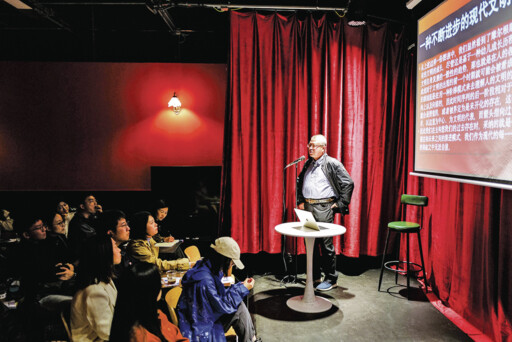
A professor from a prestigious university delivers a lecture on anthropology topics at a bar in the Sanlitun, Chaoyang District, Beijing. Photo: IC PHOTO
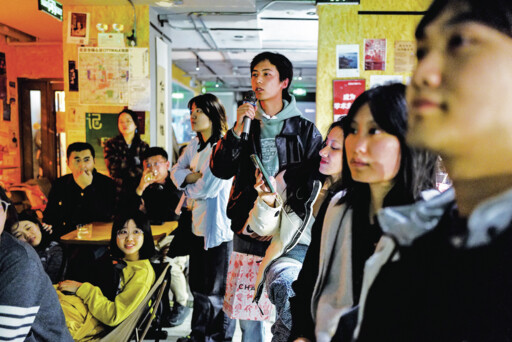
A young attendee raises a question at the lecture venue. Photo: IC PHOTO
As a quintessential youth cultural phenomenon, “academic bars” are increasingly capturing public attention and sparking discussion. In these spaces, audiences no longer listen to pop music but attend lectures with substantive intellectual content. Typically hosted by young scholars and PhD candidates, events in these spaces focus on the humanities and social sciences, with free and candid exchange as their most defining feature. In a relatively short period of time, the phenomenon has gained traction on social media while also spreading offline from Shanghai to major cities such as Beijing, Guangzhou, and Nanjing, forming a cross-regional cultural trend. Even Xiaohongshu—one of China’s most influential lifestyle-oriented social media platforms—has invited well-known scholars and online influencers to host similar events, further expanding the public visibility of academic bars.
At the same time, discussion and analysis of this phenomenon have proliferated. Some voice skepticism about the pairing of “academic” and “bar”—two seemingly contradictory settings. Is what is discussed in bars truly academic? Critics argue that academic bars merely mask drinking and socializing with a veneer of knowledge, reducing scholarship to performance or pretext. Participants, however, tend to take a more affirmative view, arguing that this format differs from traditional academic lectures and goes beyond the bar’s conventional social function. What, then, accounts for the sense of meaningful engagement that participants report experiencing in academic bars?
SciBar and academic bars
Academic bars are not an entirely new phenomenon. In the United Kingdom, SciBar (Science in a Bar) began operating in a more systematic form as early as 2004, using bar-based lectures as a means of public science communication. Until 2019, SciBar functioned as a non-profit project of the British Association for Science, with the aim of making STEM knowledge accessible to a wider audience through innovative formats.
In this sense, SciBar represents a highly organized and goal-oriented model of science outreach. Chinese academic bars, however, differ markedly from SciBar in ways that go beyond format alone. In terms of organization, SciBar follows a goal-first, top-down model driven by volunteer coordination, whereas academic bars in China operate more as localized “social experiments,” in which individual ideas take shape within specific venues, without predetermined objectives or a systematic structure. Content-wise, SciBar concentrates on STEM topics—from genetics to sustainable architecture—and rarely engages with the humanities or social sciences, while academic bars place much greater emphasis on the latter. Even so, academic bars share SciBar’s participant-friendly orientation: both seek to create distinctive public spaces for open and diverse exchange, stimulating public curiosity about specialized topics and generating new knowledge and perspectives.
Organizers aim for ‘sincere utopia’
The emergence of academic bars began with a spontaneous, impromptu spark of inspiration. In the heart of Shanghai, a 20-square-meter craft beer bar departs from conventional business models by occasionally hosting informal, small-scale subcultural events. In the summer of 2024, a Yale University PhD candidate in political science served as the bar’s interim curator. His job was to organize events in keeping with the bar’s usual practice—no commercial ambitions and no pursuit of profit attached.
Drawing on his disciplinary sensitivity, he noticed the near absence of humanities and social science lectures held in bar settings. Through personal connections, he invited scholars and PhD candidates to share their research and perspectives, with the deliberately open-ended aim of “maintaining a diverse space for dialogue.” These lectures came with no speaking fees, no admission charges, and no requirement to purchase alcohol, making the initiative resemble a kind of utopian social experiment.
The scholars and PhD candidates who initially agreed to participate shared a similar aspiration: to cultivate “genuine communication” in a more relaxed and informal environment. One speaker observed that academic interactions are often constrained by time pressures and professional hierarchies, resulting in polite but superficial exchanges that make sincere feedback difficult to obtain. Online platforms, meanwhile, tend to amplify polarization, hindering nuanced discussion. Face-to-face conversations about social issues and academic perspectives in bar settings, participants suggested, may offer a way to address the limitations of both contexts.
Participants share experience
Based on participatory observation and interviews with selected attendees, it becomes clear that despite wide variation in participants’ backgrounds and motivations, their post-event experiences were strikingly similar—and overwhelmingly positive.
One lecture on “social anxiety” later became a trending topic on Xiaohongshu, effectively marking the start of the academic bar’s online–offline surge in popularity. The bar had simply posted basic event information on its WeChat public account and Xiaohongshu page, originally intended as a routine update for regular patrons and a modest promotional effort. Unexpectedly, the post gained momentum even before the lecture took place, quickly turning the event into a new traffic hotspot.
On the night of the lecture, the bar counter and surrounding corridors were already packed, yet attendees continued to arrive in a steady stream. Some participants were students from related disciplines, who took the opportunity to exchange contact information with the speaker and continue discussions online afterward. In their view, such animated interaction is relatively rare at formal academic conferences. Many others had no academic background at all, attending simply because they identified as being socially anxious or were personally interested in the topic. This group included a substantial number of working professionals who had long since left academia. Although much of the content was unfamiliar—and at times difficult to follow—for these participants, the opportunity to step away from daily routines and engage with topics rarely encountered in everyday life became a valued experience, one that helped break the monotony.
The diverse motivations of participants from various professions and academic backgrounds suggest that academic bar exchanges aren’t inherently academic in nature. The true value of such interactions lies in the sincerity of everyone involved—speakers, questioners, and listeners alike—who signal their commitment to knowledge simply by showing up and expressing their aspirations for self-improvement. In this context, the purpose of attending academic bars is less about acquiring specific knowledge than about cultivating an open mindset, broadening one’s horizons, and sustaining the motivation to keep learning.
Emergent subjectivity in public discourse
Academic bar exchanges typically unfold through four interrelated phases: sharing, understanding or verification, inspiration, and dialectical engagement. Each phase depends on the active participation of both speakers and attendees. Participants without specialized backgrounds tend to focus on understanding the content of the lecture, while those with relevant expertise are more inclined toward verification. The impulse to share stems from a belief in the public value of knowledge and discussion, while understanding is driven by interest, trust, and curiosity. Processes of verification, inspiration, and dialectical exchange, in turn, reveal the close connection between academic inquiry and lived experience.
The ultimate aim of academic bar exchanges is not to produce “showy” scholarship, but to bring academic discourse back into the everyday lives of ordinary people. This mode of communication carries dual significance: It offers authentic, vicarious experiences that help ease social anxiety arising from utilitarian pressures and intensified competition, while also responding to a growing appetite for diverse forms of knowledge. As global uncertainty intensifies, the experiential knowledge of individuals or small social circles alone is no longer sufficient to navigate an increasingly complex world.
Perspectives from the humanities and social sciences offer alternative lenses through which to understand the world, enabling different groups to find coherent explanations within an accelerating society. The rise of academic bars has indeed brought relatively scarce academic resources and content to audiences beyond the university campus. Yet the deeper reason for the strong engagement of both speakers and participants lies not in the transmission or acquisition of specialized knowledge. Knowledge gained in any setting is often the easiest to forget, while moments of sincere communication and emotional connection tend to leave a more lasting impression. In this sense, informal academic exchanges generate emotional value and a feeling of shared ideals and sincere interaction—qualities that have become increasingly scarce in the everyday lives of young people.
At its core, sincere communication is a form of public social integration. In academic bars, participants experience a sense of moving beyond individualistic and utilitarian frameworks, which allows them to articulate questions and ideas they perceive as genuinely their own. The acts of questioning and responding in these settings enable people to experience thinking as human beings, rather than as performers fulfilling roles defined by social identity. Through listening and debate, individuals can arrive at self-awareness and reflection regardless of whether they have a direct stake in the social issues under discussion. This process—rooted in public reason and carried back into everyday life through practice—offers a concrete expression of human subjectivity.
As spaces for sincere communication, academic bars foster authenticity through their distinctive and engaging format—even though sincerity is not exclusive to them. Their particular value lies in bridging academic systems and social interaction: they transcend the formal constraints often associated with public spaces, while sustaining rational discussion beyond the typical boundaries of bar environments. In doing so, academic bars create a space situated between the public and the private, one that makes genuine communication possible.
How spaces like academic bars can be sustained—allowing people to experience connection with others and with society while preserving sincerity, and enabling genuinely open and diverse intellectual exchange—remains a question that calls for continued exploration by organizers, participants, and researchers alike. More broadly, how sincere forms of public communication might be made more accessible in everyday life—without relying solely on bar-based lectures—warrants deeper reflection.
Huang Siyi is a lecturer from the School of Social and Public Administration at East China University of Science and Technology.
Editor:Yu Hui
Copyright©2023 CSSN All Rights Reserved