


Digital nomadism as survival experiment of contemporary youth
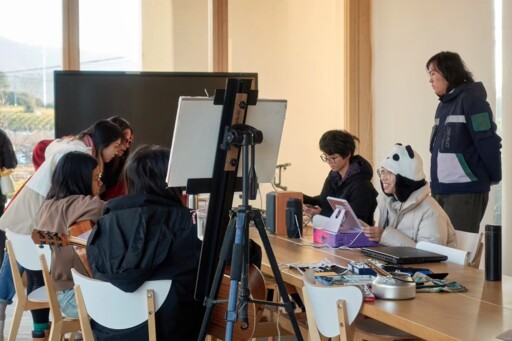
Young people join a sharing session at the Anji Digital Nomad Community in Zhejiang Province. Photo: IC PHOTO
The concept of “digital nomadism” did not appear overnight. Rather, it is a social phenomenon shaped by the evolution of digital technology, the transformation of work patterns, and the evolution of youth culture. With the widespread adoption of remote collaboration tools, the rise of the gig economy, and the romanticization of nomadic lifestyles on social media, a survival landscape characterized by mobility through digital work is becoming either a practical choice or an intellectual aspiration for a growing number of Chinese young people.
The rise of digital nomadism is shaped by the convergence of several social forces. On the employment front, a challenging job market, intensifying workplace competition, and the spread of “involution” culture have prompted some young people to seek alternatives beyond conventional career paths. Technological developments—particularly cloud computing, high-speed internet, and collaborative software—have made such choices increasingly feasible. At the cultural level, popular ideas such as “experience first” and “life is a wilderness” have helped legitimize attempts to step outside conventional life trajectories. In this context, digital nomadism is often viewed both as a response to contemporary pressures and as a romantic attempt to carve out space within a highly structured society.
However, has this breakthrough truly delivered human liberation? What realities confront those who embark on a nomadic journey? And where do they go after nomadism? To address these questions, this study draws on fieldwork conducted over the past two years in digital nomad communities in Anji in Zhejiang Province, Dali in Yunnan Province, and Huangshan in Anhui Province, along with in-depth interviews with 38 nomads. Moving beyond surface-level depictions, it examines the internal contradictions and struggles of digital nomadism, exploring how nomadic practices reshape the boundaries between work and life, self and technology, and freedom and constraint in today’s deeply mediated social environment.
Survival experiment
In recent years, an increasing number of young people have begun pursuing geographic mobility through digital work, working remotely from different cities, rural areas, or even while traveling. They move among digital nomad communities across the country, forming temporary social networks that share workspaces and living arrangements. These locations—often featuring lower living costs, appealing natural environments, and relatively reliable internet infrastructure—have become attractive hubs for digital nomads.
This phenomenon of digital nomadism represents not only a localized adaptation of Western digital nomad culture, but also a collective survival experiment shaped by the pressures facing Chinese youth. As a rapidly growing group, Chinese digital nomads come from diverse backgrounds, including entrepreneurs, freelancers, online content creators, remote employees, and students taking gap years. Digital nomad communities have sprung up in rural areas, county-level towns, and suburban spaces around major cities.
Within these communities, traditional professional identities tend to blur, and connections form around shared values and lifestyles. Unlike the standardized meeting rooms of urban office buildings, sharing sessions here occur almost daily and can unfold in nearly any public space. A few tables pushed together, scattered cushions, or simply sitting on the floor—young people from across the country gather to exchange life dilemmas, work experiences, dreams, and stories. Such offline communities not only provide emotional support but also foster new forms of social connection. Here, individuals can redefine themselves and explore different possibilities.
Price of freedom
The digital nomad lifestyle may seem carefree and romantic, yet beneath that allure lies persistent uncertainty. Chen Yu (pseudonym), 27, holds three part-time jobs: writing articles for WeChat public accounts, managing corporate social media, and occasionally taking on brand copywriting projects. Work comes and goes, and her monthly income fluctuates. “You have to constantly worry about where next month’s money will come from,” she says with a bitter smile. “This uncertainty keeps people in a constant state of anxiety.”
An even more significant challenge is the sense of suspended identity. Without a fixed employer, stable social relationships, or regular routines, digital nomads like Chen often lack a stable sense of belonging.
Figures like Chen rarely match the idealized image of the digital nomad. Many lack sustainable, monetizable digital skills or stable income sources, and instead rely on fragmented platform-based work, resembling digital gig workers. While this lifestyle offers a form of freedom from traditional careers, it also brings a new set of vulnerabilities.
The inadequacy of social security constitutes another major concern. Without formal coverage, digital nomads must shoulder risks related to healthcare, retirement, and other uncertainties on their own. Evaluating commercial insurance options and exploring stable investment strategies to introduce some certainty into an unstable lifestyle has become routine. Beyond these individual risks, institutional constraints cannot be overlooked. The Chinese household registration system still binds the provision of public services—such as education and healthcare—to specific locations. For mobile digital nomads, this creates practical barriers, from enrolling children in school to cross-regional medical reimbursement or even routine banking services. These practical constraints effectively function as “dealbreakers,” limiting the feasibility of nomadic life.
Tension-filled reality
The difficulty of sustaining digital nomadic life largely stems from the institutional pull of broader social structures. This pull arises from economic pressures, values and expectations deeply rooted in cultural traditions, and the paradoxes inherent in technological empowerment.
China’s traditional emphasis on stability, together with family obligations, forms a cultural framework that makes long-term nomadic practices difficult to sustain. In many parents’ eyes, stability necessitates not only steady income but also a predictable life trajectory and social status. As a result, many young people approach nomadism as a temporary experiment rather than a lasting identity transformation. Family values continue to shape personal choices today; rather than dissolving traditional social networks, rising youth autonomy often involves renegotiating them, so that in digital nomadic practice these relationships function both as constraints and as sources of support.
Technologies influence digital nomadic practices. Digital tools provide unprecedented connectivity and mobility, allowing work, life, and social interaction to merge in motion, seemingly realizing the ideal that “life is a wilderness.” Yet each step of this mobility depends heavily on digital infrastructure. Digital nomads resemble USB drives plugged into the internet: their physical bodies move across locations, while their digital identities remain anchored within platform systems. In this sense, technological freedom often entails deeper dependence on digital systems.
Self-restructuring in a mediated society
The phenomenon of digital nomadism reflects contemporary youth’s reconsideration of the relationship between work and life, prompting broader reflection on concepts such as success and happiness. More broadly, digital nomadic practices reveal the tensions contemporary Chinese youth face between tradition and modernity, individual agency and institutional structures. Practitioners attempt to break free from traditional frameworks such as fixed workplaces and stable careers, yet remain entangled in family expectations, marriage pressures, and concerns about long-term security. They build cross-regional communities through digital technology, yet often struggle with the demands of maintaining a constant online presence. Nomadism thus becomes not only a spatial practice but also an ongoing negotiation of identity and a continuous experiment in anchoring oneself in a deeply mediated society.
In such a society, media no longer functions as a tool external to life; it has become the infrastructure and organizing logic of social action. The geographical mobility and professional autonomy promised by digital nomadism depend heavily on digital systems. As individuals attempt to escape physical constraints, they become more deeply embedded in the temporal, spatial, and social orders reconstructed by digital platforms. Thus, the pursuit of freedom becomes dependent on deeper integration with media logic. Job opportunities, social connections, and daily rhythms all require platform mediation. In this sense, the capacity for nomadic life is built upon individuals’ own datafication, algorithmic calculability, and constant immediate responsiveness.
This ongoing experiment in digital nomadism continues. Every day, more optimistic young people strap on their backpacks and set out on their own nomadic journeys, while others conclude their travels and return to cities. As digital technology continues to evolve, digital nomadism may take on new forms. Its true value lies not in offering an ideal life template, but in revealing the complex conditions of existence in a deeply mediated world. In an era where social operation is increasingly dominated by media logic, reconstructing a form of subjectivity that balances critical awareness with practical possibility is not only a challenge for digital nomads, but for all individuals navigating a mediated society.
Ma Yikun is a PhD candidate from the School of Journalism and Communication at Nanjing University.
Editor:Yu Hui
Copyright©2023 CSSN All Rights Reserved