


‘Harness’ as new division of labor in human–machine era
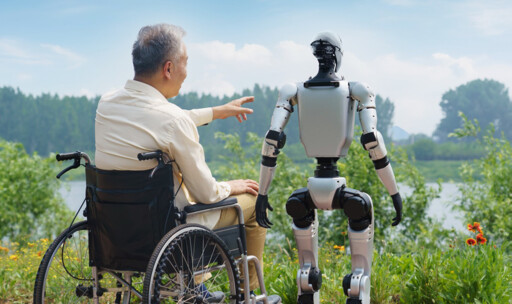
Harnesses could represent a new division of labor in the human-machine age. Photo: TUCHONG
In AI engineering, an agent-orchestration architecture known as a “harness” is emerging as a response to this question. The significance of the harness extends beyond software engineering. It represents a new form of the division of labor: For the first time, non-human entities are incorporated into a division-of-labor system, and the position of human beings within labor is being redefined.
In 1776, Adam Smith opened The Wealth of Nations with his famous description of a pin factory: The production of pins is broken down into 18 process steps—drawing out the wire, straightening it, cutting it, sharpening the point, and so forth. With labor divided among more than a dozen workers, daily output increases from fewer than 20 pins to 48,000. This example has been cited so often that one of its implicit premises is easily overlooked: All those performing these procedures were human. Over the next two centuries, theories of the division of labor shifted their focus several times, from émile Durkheim to Frederick Winslow Taylor and then to Harry Braverman. Durkheim was concerned with social order, Taylor with production efficiency, and Braverman with managerial control. Different as their concerns were, none questioned the human worker as the basic unit around which labor was divided. Machines played the role of tools—whether steam-powered looms or assembly-line conveyors, they extended human physical capacity but did not independently undertake complete working procedures.
By around 2025, that assumption had begun to break down. Large language models (LLMs) acquired capacities for planning, reflection, and tool use, becoming “agents” capable of independently executing complete tasks. A software development agent can decompose requirements, write code, run and debug it, and deliver results on its own. Such a system can no longer be understood merely as a tool. Agents have become executors of labor, giving rise to a question that traditional theories of the division of labor have not addressed: How should labor be divided among agents? And how should it be divided between humans and agents?
New form of division of labor
A harness is an engineering system that enables AI to work reliably and autonomously. It typically includes tools, which give the model “hands”; observation, which gives it “eyes”; knowledge, which gives it “experience”; memory and pacing control, which give it a “hippocampus”; and permissions and guardrails, which give it “boundaries.” Put simply, traditional software functions as a tool, whereas an agent functions as an executor.
The capacity to execute tasks does not itself guarantee reliability. At their core, agents are built on LLMs, which are essentially probabilistic systems. They generate the next token based on statistical patterns, without an inherent fact-checking mechanism or fixed behavioral boundaries. An unconstrained agent may fabricate nonexistent facts, become trapped in logical loops that consume large amounts of computing resources, or carry out dangerous operations. It may be capable of completing tasks independently, but that does not mean it can be trusted to complete them reliably.
Harnesses have emerged as an engineering solution to this problem. In AI engineering, one widely used formula is “Agent = Model + Harness.” If the model supplies the basic cognitive capacity, the harness defines how that capacity is to be used. This includes security sandboxes, permission controls, prompt templates, memory management, rules for calling external tools, and the insertion of human approval checkpoints.
A harness constitutes a division of labor on at least two levels. The first is the internal division of labor among agents. In current multi-agent systems, the harness assigns parts of a complex task to agents with different roles, enabling them to collaborate. The second is the external division of labor between humans and agents. The harness establishes clear boundaries within the system: which tasks agents may complete automatically, and which steps must pause for human approval.
There is, however, a fundamental difference between harness-based division of labor and earlier forms. Historically, the division of labor has been a matter of organizational design, while its execution took the form of managers issuing instructions to workers. By contrast, the division of labor in a harness is specified in advance through engineering codes. Its rules are embedded in software: Role definitions, permission boundaries, and approval checkpoints are all codified rather than conveyed through verbal instructions or management manuals. As a result, execution gains a kind of mechanical precision, but at the cost of flexibility. A harness can manage only the divisions of labor anticipated in its preset scenarios, and has limited ability to adjust to situations outside them. This differs from the division of labor in human organizations, which, though also governed by institutional rules, always leaves room in practice for negotiation, improvisation, and temporary adjustment.
Debates surrounding harness
Harnesses have sparked debate along several lines. The first concerns their nature. In the field of software engineering, most practitioners regard harnesses as a form of architectural scaffolding, akin to micro services or middleware. From this perspective, describing them as a form of the “division of labor” amounts to an overextension of a sociological concept. Agents are not workers, and a code is not a management system; the analogy, they argue, lacks a sufficient basis. Scholars who disagree point out that the core of the division of labor does not lie in whether the participating entities possess personhood, but in whether a mode of functional differentiation produces efficiency gains and structural interdependence. If a multi-agent system improves task performance through role differentiation and process orchestration, then in functional terms it constitutes a division of labor, regardless of whether the participants are human beings or algorithms. Excluding machines from social arrangements, they contend, often obscures the actual role of technology in organizational practice.
The second debate concerns the degree of “human-in-the-loop” involvement. From the standpoint of AI safety, retaining human approval checkpoints in high-risk decision-making is generally viewed as a necessary condition of controllability. The EU Artificial Intelligence Act has also institutionalized human oversight as a legal requirement for high-risk AI systems. Critics, however, point out that in scenarios requiring real-time responses—such as defense against zero-day vulnerabilities in cybersecurity—the speed of human approval itself becomes a bottleneck. They therefore advocate replacing “human-in-the-loop” with “human-on-the-loop”: Humans define the rules and boundaries, agents operate autonomously within those boundaries, and humans monitor system behavior through ex post audits rather than case-by-case approval. At its core, this disagreement concerns the granularity of human intervention in the human–machine division of labor.
The third line of debate comes from the tradition of labor process theory. Extending Braverman’s deskilling thesis, some researchers argue that once AI systems take over coherent segments of a complete task—such as information gathering, proposal drafting, or code writing—what remains for humans is fragmented exception handling: reviewing large volumes of AI-generated semi-finished work and deciding which outputs to accept and which to reject. Humans may nominally be “managers,” but their actual role increasingly resembles that of quality inspectors. Under such arrangements, opportunities for humans to accumulate end-to-end work experience decline, potentially weakening their long-term competence in the relevant fields. Proponents of the augmentation view, by contrast, argue that AI’s takeover of routine cognitive labor frees humans to undertake work that requires greater judgment and creativity. From this perspective, the change in the division of labor points toward upgrading rather than degradation.
The fourth debate concerns the reliability of the harness itself. Multi-agent systems commonly use a “model-evaluates-model” mechanism for quality control, in which one agent assesses the output of another. Yet this approach is subject to several forms of bias, including position bias, verbosity bias, and self-reinforcement bias. The problem, however, extends beyond bias to the equally difficult challenge of error propagation. Once an upstream agent generates plausible but incorrect information, downstream evaluators often fail to detect the error and instead continue to build upon it in subsequent outputs. Using one probabilistic system to validate another entails inherent epistemological limits. Harness-based division of labor may structurally imitate hierarchical review, but its reliability is not equivalent to hierarchical review in human organizations.
The division of labor is one of the few foundational concepts in the social sciences that simultaneously engages efficiency, order, power, and other key dimensions of social life. Over more than two centuries, the scope of the concept has continued to expand, from factories to society at large and from manual labor to cognitive labor. Yet it has consistently treated human beings as the only subjects of the division of labor. The emergence of agents marks the first time that non-human entities have entered the labor process as executors rather than as mere tools, and harnesses represent one of the earliest organized responses to this new form of division.
Whether harnesses constitute a “division of labor” in the strict sense remains open to debate. After all, they consist of rules written in code, not institutions that evolve through social interaction. Yet the problems they address—how tasks are decomposed, how roles are assigned, how boundaries are drawn, and how responsibility is allocated—are closely aligned with the central concerns of classical theories of the division of labor. At the very least, this suggests that in an era when machines are shifting from tools to executors, existing theories of the division of labor must expand their understanding of actors to incorporate non-human entities into their analytical framework. This theoretical work has only just begun.
Qiu Zeqi is director of the Digital Governance Research Center at Peking University.
Editor:Yu Hui
Copyright©2023 CSSN All Rights Reserved