


Family-centeredness, urban-rural integration: rural migrants’ ‘stable mobility’
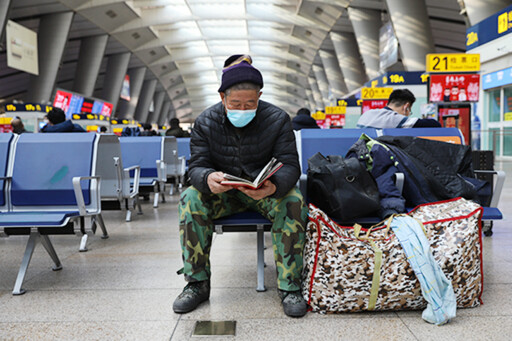
A migrant worker waits for his train back home for Chinese New Year. Photo: IC PHOTO
China’s urbanization process since the launch of Reform and Opening Up can be divided into three stages: industrial urbanization (1980–94), land urbanization (1994–2012), and population urbanization (2012–present). Data from the Seventh National Population Census, conducted in 2020, indicates that large-scale rural-to-urban migration remains a defining feature of China’s urbanization, with migrant workers constituting the majority of this population. The orderly, sustained circulation of such a vast population—with predictable patterns of departure and return—has significantly enhanced both the flexibility and resilience of China’s economy. At present, China’s rural migrant population has developed a pattern that may be described as “stable mobility.”
How should the persistence of population mobility on such a large scale—and over such a long period—be understood? Existing research has largely overlooked a crucial factor: a family-centered ethical orientation, whereby individuals regard the security, development, continuity, and prosperity of their families as a personal responsibility and life mission. This ethic serves as an important bond sustaining a dual engagement with both urban and rural life, while also reflecting a distinctive cultural feature of China’s urban–rural relationship. Building on Chinese social theory that takes the family as its analytical starting point, this article introduces the concept of a family-centered ethical orientation into the study of urban-rural relations.
The analysis draws primarily on population census data, statistical yearbooks, and micro-level survey data, as well as household surveys conducted by the research team since 2022 in Midu, Yunnan Province; Qianshan, Anhui Province; and Jiangyin, Jiangsu Province. Interviews were carried out in four villages across these three locations and involved more than 100 rural households.
Overall pattern of ‘stable mobility’
Statistical data shows that China’s rural migrant population peaked at more than 270 million in 2014 and has remained relatively stable at around 250 million over the subsequent decade. The number of migrant workers employed away from their home regions has likewise remained broadly stable since 2014. Living in cities for extended periods while regularly traveling between urban workplaces and their rural hometowns, migrant workers have become enduring “bridges” linking urban and rural China. This stability allows them to be treated as a relatively coherent group for analyzing patterns of mobility and the underlying logic of their actions.
Household migration arrangements among migrant workers can be categorized into six types: individual migration, couple migration, two-generation migration (adults with minor children), two-generation migration (adults with parents), three-generation migration, and skip-generation migration. Among these, the combined share of individual migration, couple migration, and two-generation migration with minor children has exceeded 90% in most years for which data is available.
We argue that China’s rural migrant population has entered an era of stable mobility, characterized by two key features. First, in terms of group composition, migrant workers constitute a relatively stable population that remains continuously engaged in migration over long periods. Second, in terms of migration patterns, they do not primarily seek permanent settlement or local household registration in destination cities; rather, they engage in regular, relatively stable circulation between places of employment and their hometowns. For migrant-worker households, different stages of the family life cycle correspond to different migration arrangements, and each migration arrangement fulfills particular family needs and responsibilities. Explaining why these arrangements emerge therefore requires analyzing migration from the perspective of migrant workers themselves and examining the family-centered logic underlying their decisions.
Causes of ‘stable mobility’ pattern
The decisions of migrant workers can only be fully understood through the lens of a family-centered ethical orientation. Decisions about migration, remaining behind, and returning home are made at the household level, and individual migration decisions are consistently subordinated to family considerations. For migrant workers, four major long-term decisions are particularly important: where to reside, where to purchase housing (anticipated future settlement), whether to obtain urban household registration (hukou), and whether to return home.
One direct driver of the stable mobility pattern is the family-centered logic that governs decisions about residence and return migration. Among young migrant workers, the primary reason for remaining in cities is the greater scope they offer for personal development. For middle-aged migrant workers, children’s education is the principal consideration. Among older migrant workers, the main reasons include family members’ adaptation to local urban life, higher urban incomes, and better welfare and living conditions. Similarly, the three most important reasons for returning home—caring for elderly parents or young children, employment considerations, and age- or health-related factors—correspond broadly to middle-aged, younger, and older migrant-worker groups, respectively.
Another direct factor is the tendency of migrant workers to remain in cities without being formally settled there through hukou conversion. Under current policies, rural residents may obtain an urban hukou while retaining the “three rights” associated with rural status: land-contracting rights, homestead-use rights, and rights to collective-income distribution. Yet migrant workers’ willingness to obtain an urban hukou has not increased significantly. Even with the retention of these rights, migrant workers generally express a willingness to transfer their hukou only when stable employment and substantially higher incomes are available. This suggests that the key determinant of urban settlement decisions is not the removal of purported institutional barriers in rural areas, but the availability of stable employment opportunities and sustained urban economic prosperity.
Family-centered ethical orientation
When migrant workers consider urban settlement, employment and income are evaluated from the perspective of the family as a whole rather than that of the individual. This helps explain the apparent paradox between urban residence and reluctance to obtain an urban hukou. The immediate purpose of urban residence is employment and income generation, but these in turn serve broader family goals, particularly children’s education and housing acquisition.
In contemporary China, the marriage of adult children, the arrival of grandchildren, and the transition to parenthood often initiate a period of frequent interregional mobility for the older generation—a pattern that differs markedly from that of traditional society. At this stage, young couples face the dual pressures of wage labor and childrearing, prompting many families to reorganize the division of labor. A common arrangement involves one or both grandparents returning home to care for grandchildren, while the younger generation migrates for work. By the time grandchildren complete secondary education and reach adulthood, grandparents are often approaching their seventies and may no longer be able to contribute substantially to the family. Where they will live at that stage cannot be inferred solely from stated residential preferences; it requires an interpretation grounded in migrant workers’ family-centered ethical orientation.
The first generation of migrant workers typically devoted themselves to helping their children establish a foothold in urban life and achieve upward mobility. Living in factory dormitories or inexpensive rental housing, they practiced extreme frugality, remitted earnings to their hometowns, financed their children’s education, and helped them purchase homes. After grandchildren were born, they moved repeatedly between workplaces and hometowns to provide intergenerational childcare. This practice of “lifting up” the next generation embodies one of the most fundamental ethical orientations in Chinese society: parents support their children’s upward mobility, often enabling them to purchase homes in county seats, while those children in turn support their own children’s advancement into larger cities. This family-centered ethic fosters a spirit of self-sacrifice and unwavering commitment to the well-being and future development of one’s family and descendants, representing an everyday expression of Confucian ethics among migrant workers.
The relatively stable number of migrant workers employed outside their home townships over the past decade reflects the balancing effects of two opposing forces: the entry of new migrant workers and the return of aging migrant workers to their hometowns. The life trajectories of the second generation of migrant workers differ substantially from those of the first. Owing to educational opportunities and family migration, they often leave their hometowns earlier, integrate more fully into urban life, and are more likely to establish permanent urban residence. Consequently, the current pattern of stable mobility may gradually change as generational succession unfolds in rural China.
Seen in this light, the causes of the stable mobility pattern among migrant workers become clear. Having devoted much of their lifetime savings to financing their children’s education, marriage, and family formation, first-generation migrant workers are often left with few options other than to return to rural land and ancestral homes for their later years. Second-generation migrant workers, meanwhile, are approaching the stage of financing their own children’s marriage and childrearing. Lacking the resources to fully support aging parents, they frequently regard rural hukou status as a form of security and a potential fallback option for both their parents and themselves.
This perspective also reveals that the common view that migrant workers are reluctant to obtain an urban hukou primarily because they wish to retain the “three rights” is overly simplistic. The “three rights” are individual entitlements, whereas the hukou system is fundamentally a family-based institution. After an individual’s death, these rights cannot necessarily be passed on to descendants who lack the corresponding rural hukou status.
The family-centered ethical orientation has not only shaped the contemporary pattern of stable mobility among China’s rural migrant population, but also offers important insights into the future direction of China’s urban–rural integration. Since the foundation of social life in China is the family, urban–rural integration is not merely a matter of spatial planning or institutional design—it is also a modern expression of the long-standing Chinese tradition in which family and state form interconnected moral and social orders. Policies aimed at promoting urban–rural integration should recognize and accommodate the objective realities of stable mobility. On the basis of respecting the choices made by rural households, they should provide appropriate institutional support and public services for families at different stages of the life cycle.
Fan Xinguang (tenured associate professor) and Zhou Feizhou (professor) are from the Department of Sociology at Peking University. This article has been edited and excerpted from Social Sciences in China, Issue 12, 2025.
Editor:Yu Hui
Copyright©2023 CSSN All Rights Reserved