


Oral history through a sociological lens: a decade of empirical and theoretical accumulation
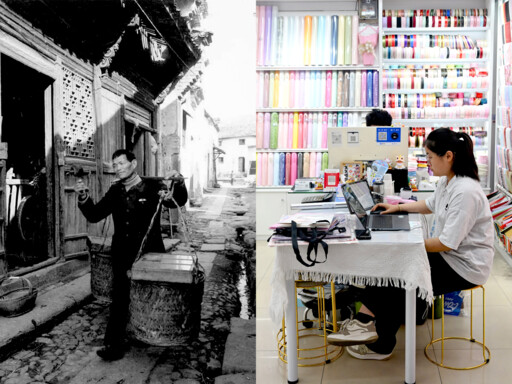
Oral history research traces Yiwu’s transformation from a small-commodities market into a global digital-trade hub, showing how private enterprise became woven into local development during reform and opening up. The image pairs a traditional street vendor with present-day online merchants. Photo: IC PHOTO
Over the past decade, oral history research has attracted growing scholarly attention in China. The establishment of the Oral History and Social Memory Committee of the Chinese Sociological Association, together with related annual conferences, academic forums, and collective fieldwork projects, has ushered the field into an important period of transition—from data collection to thematic research and, increasingly, theoretical self-awareness. Sociology, as a discipline, is deeply engaged with the historical trajectories of Chinese social transformation and the civilizational foundations embedded within them. Guided by the integration of the basic tenets of Marxism with China’s specific realities and fine traditional culture, sociologists have used oral history to enter a new stage of inquiry centered on understanding the internal logic of China’s social modernization and exploring the social foundations of modern China’s transformation.
Oral history practice, holistic perspectives, and the historical process of China’s social modernization
Oral history entered the intellectual domain of Chinese sociology as both a research method and a paradigm in the mid-1990s. At the time, sociologists launched projects to collect oral accounts of rural China in the second half of the 20th century. Using oral history as their principal method and the micro-level mechanisms and practical forms of communist civilization as their central concern, they examined the structural transformation of rural Chinese society since the 1950s. Their research addressed the collective mentalities and patterns of memory formed by ordinary people in everyday life and specific historical settings, as well as the mechanisms through which new conceptions of the state took shape among them.
Beginning in the late 1990s, sociologists built on this earlier work by conducting oral history research on the educated youth generation. These studies broadened theoretical understanding of the mechanisms through which the spirit of an era emerges and of the social foundations that give it substance and continuity. Since 2019, the launch of two major projects—Oral History of Industrial Construction in New China and Oral History of Representative Figures in New China—has brought together researchers from different disciplines and universities in nationwide interdisciplinary collaboration. Through organized, large-scale research, they have studied industries, organizations and work units, and major social groups that occupied structurally significant positions in the course of China’s social modernization.
The industrialization process initiated under the leadership of the Communist Party of China is an essential component of Chinese modernization. Starting from a weak industrial base at the founding of the People’s Republic of China, the nation followed a path of industrial development markedly different from the routes taken elsewhere. Within these new theoretical perspectives and methodological approaches, industrial enterprises and their specific institutional practices—including the China Yituo Group Co., Ltd., the Luoyang Mining Machinery Factory, and the Daqing Oilfield—along with Third Front Construction have become major subjects of scholarly inquiry. Research on industrial development from a sociological perspective and through oral history methods has important implications for deepening our understanding of the distinctive course of China’s social modernization.
Oral history research on industrialization first offers a holistic understanding of China’s social transformation. Over the past decade, sociologists have interviewed several hundred individuals who personally experienced these historical processes, systematically addressing a fundamental question: How did a traditionally agrarian country rapidly achieve national industrialization despite numerous adverse conditions and structural constraints□ The interviewees’ plainspoken accounts do more than fill gaps in the historical record. They also convey the life experiences that this period left with ordinary people—experiences that formed an important core of the era’s defining ethos, including a spirit of being masters of the country. Amid the broader renewal and transformation of society, these experiences became an irreplaceable part of the new social foundations taking shape.
People are the agents of historical activity, and a people-centered perspective is an essential concern for Chinese sociological research. Accordingly, sociological oral history has devoted particular attention to major groups in China’s modernization—from veterans of the War to Resist U.S. Aggression and Aid Korea and model workers from different periods to educated youth, the “Iron Girls,” “barefoot doctors,” and rural teachers. Through organized research programs, scholars have collected and systematically preserved materials concerning these groups. This work represents not only an urgent effort to rescue and preserve valuable historical sources, but also an important attempt to return concrete individuals, with their lived experiences, to the center of sociological inquiry.
Oral historians are now extending the chronological reach of their research in a more systematic and deliberate manner. They have begun collecting accounts of the reform and opening-up period and conducting detailed studies of the Yiwu International Trade City, a representative model of that era. By distilling Yiwu’s development experience from the perspective of ordinary people, these studies also reveal how private enterprises entered and became integrated into the broader course of local social development during reform and opening up. Sociologists have likewise used oral history to study scholars who played a major role in rebuilding Chinese sociology. Through life-course analysis, these studies illuminate the logic of knowledge production within the discipline.
Paradigmatic debates, theoretical innovation, and the social foundations of modern China
Oral history was once widely regarded primarily as a means of collecting historical source material. Because of the distinctive nature of oral testimony, the method was also frequently questioned on grounds of authenticity and objectivity. Yet as oral history became part of Chinese sociological research—and oral accounts gained prominence in studies of China’s social transformation—it moved well beyond its original methodological role. In the Chinese academic context, it has had far-reaching effects on debates over disciplinary paradigms and the development of indigenous theory. In particular, theoretical discussions of collective mentality and the social foundations of Chinese society, developed through the practice of oral history, carry important theoretical value for building an independent Chinese sociological knowledge system.
Compared with historians, sociologists focus less on the authenticity of an oral account in isolation than on who recounts the past, under what circumstances, and in what manner—and on what the act of narration itself reveals. This shift in emphasis has prompted wider debate over what counts as truth in social and historical research. Some researchers have revisited the classical traditions of French sociologist Maurice Halbwachs’s theory of social memory and German scholar Jan Assmann’s theory of cultural memory, while also drawing on the intellectual legacy of the Durkheimian school. Combining these intellectual traditions with their own experience of oral history research, they have proposed the concept of “social force.” In this view, ordinary people’s oral narratives reveal how the past is remembered; the forms through which memories are expressed and organized are themselves manifestations of the social and part of the historical process. Other scholars, working at the methodological level, have introduced the concept of “triple reality” in social science research to clarify the different dimensions of authenticity at the theoretical level. The emergence of these interdisciplinary paradigm debates from oral history research is significant: They can foster understanding and consensus across academic traditions, break down disciplinary barriers, and ultimately support genuinely interdisciplinary scholarship.
Oral history has also raised new methodological challenges. Since most interviewees are ordinary people rather than trained chroniclers, their recollections often overlap, become disordered, or blend together in the course of an interview. Drawing on Chinese experience in oral history practice, sociologists have introduced the empirical concept of the “glimmer of memory,” which calls for a comprehensive, in-depth examination of the relationship between an interviewee’s circumstances and the way that person gives expression to the past. The social facts captured by this concept actually reveal a form of collective unconscious and a set of shared assumptions within society as a whole. They reflect the historical effects that social structures, cultural traditions, and broader historical processes exert on particular individuals and their ways of remembering.
Oral history research has also deepened understanding of social foundations. Over the past decade, scholars have conducted extensive empirical research into social memory and collective lived experience. Some have proposed the concept of “déjà vu” in collective memory, arguing explicitly that, from a sociological standpoint, oral accounts themselves are shaped by the social structures and cultural contexts in which they arise. This concept both reconsiders and challenges the long-dominant analytical paradigm of state–society relations. Researchers have also developed a range of theoretical concepts such as “memory communities,” emphasizing that ordinary people who share a common living environment, cultural traditions, and experiences of a common historical fate achieve social solidarity precisely through memory and its expression.
In this sense, sociological oral historians have continued Chinese sociologist Fei Xiaotong’s later reflections on the “humanistic orientation” and “intellectual world” of sociological research, using oral history as a means of accessing the inner worlds and broader worldviews of ordinary people. At the same time, they have further expanded the conceptual boundaries of notions such as “social foundations” and “social solidarity.” Whether at the level of a single community or an entire nation, ordinary people’s social memories and collective unconscious are, in essence, shared systems of meaning. Oral history research brings these shared systems into view in ways that are simultaneously holistic and concrete.
Overall, oral history research over the past decade has made important advances in several areas: extending the temporal and spatial scope of its research topics, encouraging debate and integration across methodological paradigms, and sharpening its problem consciousness while developing new theoretical concepts. Drawing on the rich civilizational experience embedded in China’s history and culture, as well as the vivid practical experience of its socioeconomic development, Chinese sociologists are building an independent sociological knowledge system that embraces a global perspective, interprets Chinese civilization, remains rooted in Chinese society, addresses Chinese issues, and integrates empirical inquiry with theoretical reflection.
Meng Qingyan is a professor from the School of Sociology at China University of Political Science and Law.
Editor:Yu Hui
Copyright©2023 CSSN All Rights Reserved