


What makes good qualitative research?
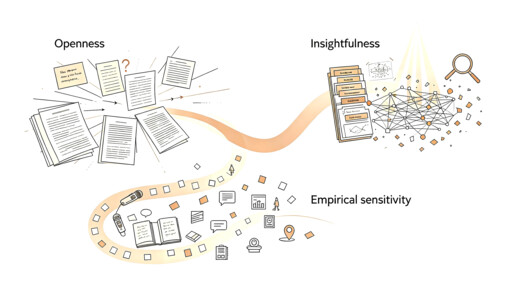
Good qualitative research entails three core elements: openness, empirical sensitivity, and insightfulness. Image generated by AI
Research methodology is a perennial and continually contested topic in sociology, one that also cuts across disciplinary boundaries. In recent years, qualitative research has gained increasing social visibility. Alongside translated works, an increasingly rich body of original scholarship grounded in the Chinese context has emerged. Specific methods, including case studies, grounded theory, oral history, interviews, and narrative, have become focal points of discussion, while attention to everyday life and holistic knowledge production have repeatedly been affirmed as two important methodological directions. An academic ecology is thus taking shape in which methods are regarded not only as tools but also as objects of inquiry. What, then, makes good qualitative research? Approaching the question from the perspective of process methodology, this article focuses on three key concepts: openness, empirical sensitivity, and insightfulness.
Openness: defining characteristic of qualitative research
Openness is one of the principal characteristics distinguishing qualitative research from conventional quantitative research. It is both a fundamental attitude and perspective for qualitative researchers and a flexible capacity that must be continually strengthened. As a mode of thinking and a principle, openness takes different forms at different stages of research and runs through the entire process, from formulating questions and collecting data to analysis and writing.
Good qualitative research remains open, actively engaging with the possibilities of the unknown. From a process perspective, this is reflected in the breadth of the questions posed, the surprises that emerge from the data, the insights generated through analysis, and the broader research horizons and additional ways of understanding the world opened up by the conclusion. Rather than producing a definitive answer or closing off interpretation, this kind of “openness” operates at the level of information as well as thought and cognition. It also leaves researchers in different fields ample room for dialogue and reflection, allowing new lines of thought and further insights to emerge.
If this describes an idealized goal, it can at least be translated into several practical considerations. First, the formulation of research questions should itself be understood as an open-ended process. Second, openness is reflected in the selection of specific field sites and interviewees. Finally, openness is conditional and dynamic.
Openness requires researchers to gradually cultivate several capacities through academic training and personal growth, including the psychological resilience and practical capacity to respond to “uncertainty” and “the unexpected,” the ability to integrate the complex connections and tensions among different types of information and knowledge, and the reflexive capacity to remain aware of, and temporarily suspend, their own positions and cognitive limitations. These capacities are by no means easy to develop. Openness is therefore better understood as a flexible continuum rather than a fixed standard. It is itself a process-oriented criterion that must be consciously cultivated and refined over time, rather than something that can be achieved all at once.
Empirical sensitivity: foundation of qualitative research
If openness is a defining characteristic of qualitative research in contrast to quantitative research, empirical sensitivity is what distinguishes it from purely theoretical inquiry and underpins its status as “empirical research.” It is also the foundation of the researcher’s insightfulness. The empirical sensitivity of a research question is reflected in at least two ways. First, a good research question must be grounded in reality—in lived experience, social observation, and the emotional and ethical concerns that arise from them. Second, before moving into abstract theoretical discussion, qualitative research should at minimum be able to answer a basic empirical question, one that addresses the researcher’s curiosity about and doubts concerning social reality. Together, these two dimensions require researchers to adopt an academic attitude of “looking at reality with their eyes open,” giving qualitative research questions a stronger grounding in everyday life and social reality.
At the stage of data collection, empirical sensitivity is first reflected in the sense of presence and richness conveyed by the material. Richness is not a matter of word count; it lies in the tensions and connections among details and materials—people, stories, events, and so forth. Details create a “sense of scene,” resonating with contemporaries while also forging connections across generations. Evocative details, contradictions across different settings, the multiple threads of events, and the intricate relationships among people—including the tacit understandings and imaginings prompted by silences and gaps that resist expression—all contribute to the “complexity” of people, life, and society.
Among the many specific methods, fieldwork is particularly capable of generating a sense of presence and richness. Scholars, especially anthropologists, have written extensively about the practical application and methodological characteristics of this essential craft. In addition to direct observation, listening in, informal conversation, participation, engaging multiple senses, and drawing on first-hand materials alongside historical documents and objects, even the familiar in-depth interview requires researchers to consider what constitutes genuine depth, while remaining mindful of its temporal and spatial limitations and alert to conventional narrative patterns.
If a basic condition of a good research question is that it should “open up new possibilities,” “think what others have not thought,” or engage with a genuine puzzle, then the sense of presence and richness discussed here is also closely related to the “originality” expected of good qualitative research—both in the data itself and in how it is perceived and interpreted. For researchers, data collection is where empirical sensitivity is most directly cultivated; for readers and reviewers, however, it ultimately reveals itself in the writing, especially in the analysis of data. Analysis runs through the entire research process. Real-time analysis during data collection can guide the acquisition and enrichment of new materials by following emerging leads, while more comprehensive and multidimensional analysis in the middle and later stages becomes increasingly intertwined with writing. The discussion of empirical sensitivity therefore focuses on two aspects: tracing and organizing the empirical thread and its underlying logic through comprehensive analysis, and selecting and presenting data in the writing itself.
The empirical thread, or narrative thread, is understood in contrast to the theoretical, or analytical, thread. In the final presentation of a thesis, the explicit organizing thread may be primarily empirical and narrative or theoretical and analytical, depending on the researcher’s interests and what they seek to convey. As a component of the research process, however, tracing and organizing the empirical thread is indispensable to good qualitative research. Neglecting it can leave the material fragmented, severely dissected, or taken out of context. Ultimately, the material may become little more than a prop for pre-existing assumptions and positions, undermining the very foundation of empirical research.
Like openness, empirical sensitivity must be consciously cultivated and developed through sustained practice. If openness is primarily an attitude and capacity for confronting and handling “uncertainty,” empirical sensitivity necessarily presupposes the researcher’s long-term embodied engagement with the field. Qualitative research that lacks empirical sensitivity often relies too heavily on established theories or discourses. Although it may appear sophisticated, it can seem detached from reality, with experience and theory operating on separate tracks. It may even leave readers feeling that “the conclusions could have been reached without doing the research.” Empirical sensitivity also requires openness toward the lifeworld. Whether the empirical thread and the logic of everyday life can ultimately be grasped in a compelling way depends on insightfulness.
Insightfulness: challenge of qualitative research
Insightfulness refers to the capacity to move beyond appearances and develop a deeper understanding of things. In our view, it comes closest to what Charles Wright Mills called the “sociological imagination”: It is rooted in the empirical world and social reality while also incorporating imagination and perceptual depth. The concept also bears some resemblance to American sociologist Andrew Abbott’s “heuristics in the social sciences”: The social sciences need more resourceful and imaginative practitioners, combining rigor with imagination. Compared with openness and empirical sensitivity, insightfulness carries a stronger local cultural sense of what can be “understood but not fully articulated.” It presupposes openness, is grounded in empirical sensitivity, and is also a capacity that can, to some extent, be examined through the research process and gradually cultivated over time.
At the stage of selecting a topic, whether a question can generate inspiration and insight first requires an open attitude. Yet the extent to which it constitutes a “real question” itself touches upon an understanding of the situation and context, or an insight into the real world. In the interpretation and analysis of data, insightfulness puts the researcher’s abilities to an even greater test. Analysis concerns not only the literal meaning of the material; it also requires researchers to read between the lines and interpret what is left unsaid by considering the immediate context, broader sociocultural circumstances, and the dialogic setting involving multiple actors. Exploring the logic of everyday life, social mechanisms, or even the social foundations that have attracted increasing attention in recent years is neither easier nor more elementary than the abstract refinement of theory. All of this bears on whether the researcher can ultimately tell a good story—regardless of whether its explicit thread is primarily narrative or analytical.
Regarding the direction of insight, scholars have repeatedly discussed issues such as the logic of everyday life, the invisible, and the relationships among cases, situations, and contexts. What we would like to add here is that moving beyond “what is said” to analyze the invisible principles at work beneath the visible requires a core capacity: the ability to connect and integrate dispersed materials, whether near or distant, and to link “this moment” with countless “other moments.” Connection and integration involve comparing, distinguishing, relating, and thinking across information, experiences, and existing accounts from different sources and at different levels. This is not merely a matter of connecting points into lines, assembling them into a larger picture, or considering the nature of relationships and the interweaving of networks. It also requires confronting the dynamic and temporal nature of social life.
If qualitative research can accomplish all of the above, that is already no small achievement. Yet the greater challenge of good research may lie in making the leap between levels—whether delving deep into the texture of experience or rising to a higher vantage point—through the judicious exercise of imagination, informed by accumulated experience, knowledge, and sensitivity. A good story is rooted in the empirical world, but it can open up the imagination and reveal multiple possibilities, ultimately bringing new understanding and insight.
Huang Yingying (professor) and Zou Zihan are from the School of Social Research at Renmin University of China. This article has been edited and excerpted from Zhejiang Academic Journal, Issue 3, 2026.
Editor:Yu Hui
Copyright©2023 CSSN All Rights Reserved