


Symposium marks 75th anniversary of China-Indonesia ties
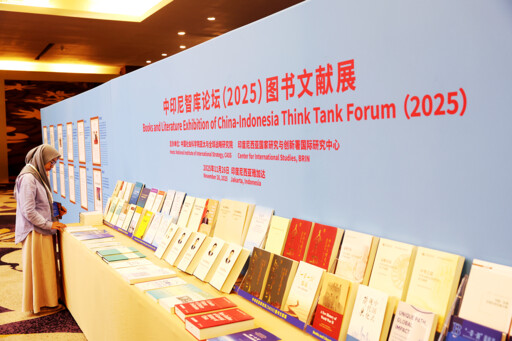
The Books and Literature Exhibition of the China-Indonesia Think Tank Forum (2025) Photo: Zhu Gaolei/CSST
JAKARTA—On Nov. 26, the China-Indonesia Think Tank Forum (2025): International Symposium Celebrating the 75th Anniversary of the Establishment of Diplomatic Relations between China and Indonesia was held in Jakarta, Indonesia. Gao Xiang, president of the Chinese Academy of Social Sciences (CASS), and Amarulla Octavian, deputy head of the National Research and Innovation Agency (BRIN) of Indonesia, attended the event and delivered remarks. Wang Siping, cultural counsellor of the Chinese Embassy in Indonesia, addressed the symposium on behalf of Chinese Ambassador to Indonesia Wang Lutong.
Gao noted that 2025 marks the 75th anniversary of diplomatic relations between China and Indonesia, as well as the 70th anniversary of the Bandung Conference. Seventy-five years ago, Indonesia was among the first Southeast Asian nations to establish diplomatic ties with the newly founded PRC—a milestone that helped set a regional precedent for building constructive relations with new China. Seventy years ago, delegations from 29 Asian and African countries and regions gathered in Bandung, Indonesia, for a conference that crystallized what later came to be known as the Bandung Spirit of solidarity, friendship, and cooperation—a defining moment in Asia-Africa cooperation and an early catalyst for shifts in the international order.
Today, Gao continued, as the world grapples with the fundamental questions of what kind of international order to build and how to build it, China’s vision of a community with a shared future for humanity—together with the Global Development Initiative (GDI), Global Security Initiative (GSI), Global Civilization Initiative (GCI), and Global Governance Initiative (GGI)—carries forward and renews the Bandung Spirit for the contemporary era. They not only respond to the common aspirations of developing countries in the current era but also offer Chinese insights for them to unite, cooperate, and jointly address global challenges.
Gao emphasized that the Recommendations of the CPC Central Committee for Formulating the 15th Five-Year Plan for National Economic and Social Development, adopted at the recently concluded Fourth Plenary Session of the 20th CPC Central Committee, outlines a forward-looking strategic blueprint for China’s development over the next five years. During the 15th Five-Year Plan period (2026–30), China will further focus on cultivating new quality productive forces, promoting high-quality development, and expanding high-standard opening up, sharing development opportunities with the world.
Gao added that China stands ready to deepen exchanges and mutual learning on governance and modernization experience with Indonesia and other Global South partners, contributing jointly to a more stable and equitable global future. This symposium brings together experts and scholars from leading think tanks of both countries to discuss cooperation and development. Elaborating on its significant practical importance, he said that it is not only a warm celebration of the 75th anniversary of China-Indonesia diplomatic relations but also a practical measure to implement the important consensus of the two countries’ leaders and facilitate the overall development of bilateral relations.
Gao called for carrying forward the millennial friendship of the “Maritime Silk Road” to solidify the foundation for building a China-Indonesia community with a shared future; promoting the contemporary value of the “Silk Road Spirit” to enable deeper and more substantive pragmatic cooperation between the two sides; and deepening people-to-people and cultural exchanges and cooperation to contribute wisdom and strength to the building of the community.
Octavian remarked that Indonesia and China share a long-standing and deeply rooted bilateral relationship. Guided by the broader framework of the Belt and Road Initiative and the spirit of the Indonesia-China comprehensive strategic partnership, BRIN and CASS have engaged in long-term and in-depth academic exchanges and cooperation, injecting new vitality into the friendship between the two countries. The theme of this symposium, “Carrying Forward Friendship and Sharing the Future,” resonates strongly with the present era, offering a purposeful forum for strengthening Indonesia-China academic cooperation.
Wang Lutong pointed out that China-Indonesia relations are grounded in mutual respect, mutual benefit, and the shared aspirations of both peoples for better lives—principles that align closely with broader global trends toward peace and development. As two major developing countries and significant forces in the Global South, China and Indonesia share similar stances on international and regional affairs. Both are steadfast supporters of multilateralism, upholders of fairness and justice, and promoters of the Bandung Spirit. The two countries maintain close communication and coordination on multilateral platforms such as the United Nations, ASEAN, and BRICS, jointly advancing the GDI, GSI, GCI, and GGI. Together, they strive to build a community with a shared future for humanity, demonstrating a strong sense of global responsibility.
Wang highlighted that universities, research institutions, and think tanks on both sides have long maintained close cooperation—from joint studies and scholar exchanges to sustained policy dialogue—providing expert input for government decision-making and serving as vital platforms for enhancing mutual understanding between the two societies.
During the symposium, Chinese and Indonesian experts and scholars held in-depth discussions on a range of issues, from strengthening pragmatic bilateral cooperation to assessing the broader regional and global significance of their joint efforts. They provided insights and recommendations for advancing high-quality Belt and Road cooperation between the two countries, deepening the China-Indonesia comprehensive strategic partnership, and building a China-Indonesia community with a shared future in the new era.
On Nov. 25, CASS and BRIN officially signed a memorandum of understanding and an agreement to jointly establish a center for China studies. This marks the formal establishment of an institutionalized partnership between the two organizations, creating a high-level think tank platform to promote people-to-people and cultural exchanges as well as deepen inter-civilizational mutual learning.
Editor:Yu Hui
Copyright©2023 CSSN All Rights Reserved