


‘Digital China’ ushers in new stage
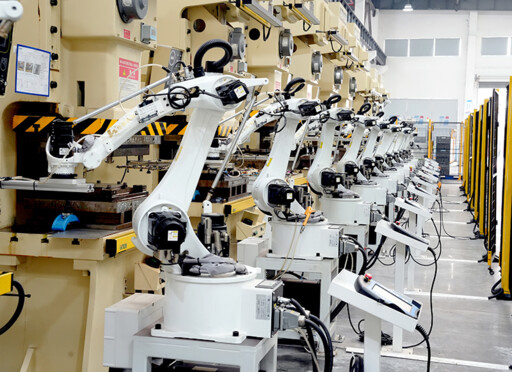
Photo taken on Dec. 1 shows an automated production line at the workshop of a technology company in Huayingshan Economic Development Zone, Sichuan Province. Photo: IC PHOTO
In smart manufacturing workshops, robotic arms work in close coordination with millimeter-level precision, showcasing the latest advances in industrial intelligence. On the national integrated government services platform, billions of data points flow seamlessly across provincial boundaries, demonstrating the efficiency and synergy of digital governance. At hubs of the “East Data, West Computing” project—designed to process data generated in the eastern regions using computing resources in the west—vast computing power drives the rapid iteration of AI models, unlocking new possibilities for technological innovation. Across China today, the digital wave continues to gather momentum, profoundly reshaping production and everyday life and propelling the construction of a “Digital China” into a new phase of systemic integration and comprehensive deepening.
The Recommendations of the CPC Central Committee for Formulating the 15th Five-Year Plan for National Economic and Social Development identifies “advancing the Digital China Initiative” as a strategic priority. This signals a shift in the digital transformation from localized experimentation to holistic coordination, and from a primarily technology-driven approach to one guided by value creation. Many scholars believe that by focusing on key issues such as the market-oriented allocation of data resources, the AI Plus Initiative, and improvements to digital governance systems, China is reconstructing competitive advantages and cultivating new drivers of economic growth with a more systemic strategic mindset.
From exploration to deep cultivation
During the 14th Five-Year Plan period (FYP, 2021–25), China’s digital industry has achieved leapfrog development. Data shows that the number of data enterprises nationwide has surpassed 400,000, the digital transformation of 5A-level scenic areas has been completed, and daily AI computing power consumption has reached the scale of trillions of tokens. These achievements have laid a solid foundation for advancing the Digital China Initiative during the 15th FYP period (2026–30).
Compared with the 14th FYP’s call to “build a Digital China,” the Recommendations emphasizes the need to “advance” it—a shift with important implications. Wang Xiangnan, a research fellow from the Institute of Finance and Banking at the Chinese Academy of Social Sciences, notes that as a key driver of new quality productive forces, digital technology can break through traditional growth bottlenecks and generate fresh momentum through deep integration with the real economy.
Sun Xiaohua, a professor from the School of Economics and Management at Dalian University of Technology, observes that the digital economy is undergoing three profound transformations. The first is a move from a technology-oriented to a value-oriented approach, with greater emphasis on addressing real-economy challenges. The second is a shift from isolated pilot efforts to ecosystem-wide collaboration, strengthening coordinated innovation along industrial chains. The third is a transition from relatively extensive regulation to comprehensive governance, aimed at building a system that balances development with security.
The explicit directive to “steer the transformation of scientific research paradigms with AI” underscores the role of innovation-driven development as a fundamental force behind far-reaching changes in the industrial system. Zhang Guosheng, a professor from the School of Economics at Yunnan University, argues that AI will not only rapidly generate new industries, business formats, and models—gradually replacing traditional industries as leading sectors—but will also drive institutional-level shifts in technological and economic paradigms, shaping new rule systems suited to the digital era.
It is also notable that the Recommendations juxtaposes key points such as “data as a factor of production,” the “AI Plus Initiative,” “full integration between the real economy and the digital economy,” as well as “governance over AI” and “regulation of the platform economy,” forming an interconnected and mutually reinforcing whole. Li Ping, a professor from the Institute of Beijing Digital Economy Development at the Capital University of Economics and Business, explains that these elements together constitute the systemic framework for building a Digital China. Data factors provide the foundation, supplying high-quality “fuel” for AI. The AI Plus Initiative functions as the core engine, whose new applications can in turn stimulate data development. Full integration creates a closed value loop, while governance and regulation establish essential safeguards.
Addressing challenges
Despite steady progress, the development of the digital economy is accompanied by challenges and potential risks. Li points out that there remains room for improvement in core technologies and governance capacity, that development remains uneven, and that a significant digital infrastructure gap persists between urban and rural areas. Many small and medium-sized enterprises face the dual pressures of high transformation costs and shortages of skilled professionals. At the same time, the lack of uniform global rules on data governance places external constraints on the growth of China’s digital economy.
Chen Haiqiang, vice dean of the Wang Yanan Institute for Studies in Economics at Xiamen University, notes that current applications of data factors are concentrated in a limited number of areas, such as financial risk control and precision marketing. While these uses have improved efficiency, they may also intensify competitive pressures on small and medium-sized financial institutions and generate new social risks. He suggested expanding data applications into areas with strong growth potential—including healthcare, transportation, elderly care services, and the low-altitude economy—so that data factors can empower the real economy more broadly.
Editor:Yu Hui
Copyright©2023 CSSN All Rights Reserved