


Economists interpret priorities outlined in central conference
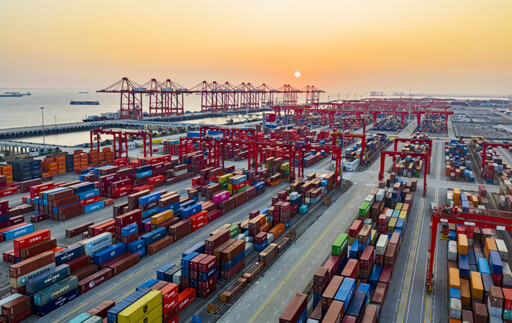
A busy yet orderly scene at the container terminal in the Taicang Port Area of Suzhou Port, Jiangsu Province, on Dec. 18 Photo: IC PHOTO
At this pivotal historical juncture—when the goals and tasks of the 14th Five-Year Plan (FYP, 2021–25) are nearing completion and the curtain is about to rise on the 15th FYP (2026–30)—the Central Economic Work Conference was held in Beijing on Dec. 11. Xi Jinping, general secretary of the CPC Central Committee, attended the conference and delivered an important speech, reviewing economic work in 2025, analyzing the current economic situation, and outlining key priorities for economic work in 2026.
Scholars agree that the systematic approach and strategic measures set out at the conference have injected strong confidence and momentum into consolidating and strengthening the upward trajectory of economic recovery and advancing high-quality development. They provide fundamental guidance for effectively carrying out next year’s economic work and for ensuring a solid start and steady progress under the 15th FYP.
Since the beginning of 2025, amid a complex and challenging international environment and demanding domestic tasks related to reform, development, and stability, China’s economy has continued to move forward with resilience, making steady progress in high-quality development. In the first three quarters, the GDP grew 5.2% year-on-year, total annual output is expected to exceed 140 trillion yuan (approximately $19.87 trillion), and major development targets for the year are on track to be met.
A deep understanding of the guiding principles articulated at the conference is the prerequisite for grasping the direction of next year’s economic work. Ouyang Yao, a Qiushi distinguished professor from the School of Economics at Zhejiang University, summarized the conference’s core message as emphasizing “domestic demand-driven, innovation-led, and reform-focused approaches, alongside open cooperation for mutual benefit.”
In Ouyang’s view, adhering to a domestic demand-driven approach and building a robust domestic market constitute the strategic foundation for leveraging China’s advantage as a super-large market. On this basis, it is essential to fully unleash innovation momentum by deepening the integration of industrial and innovation chains, thereby promoting industrial upgrading and advancing high-level technological self-reliance.
Reform, Ouyang added, must be mobilized to establish institutional mechanisms that both energize the market and ensure effective regulation. This includes accelerating the development of a nationally unified market, alleviating pressures from rat-race competition, and stimulating the endogenous dynamism and innovative vitality of all types of market entities. At the same time, the momentum of opening up should be further harnessed by steadily expanding institutional opening up, enabling China to secure new advantages in international competition and cooperation through higher-standard openness.
Several key concepts highlighted at the conference—such as the prominent contradiction of “strong supply and weak demand” in the domestic market, “making the most of our strengths,” “enhancing the efficacy of macroeconomic governance,” and “allowing a reasonable rise in prices”—also carry significant implications. Chen Yanbin, director general of the Institute of Industrial Economics at the Chinese Academy of Social Sciences, observed that while China’s production and supply systems are robust and comprehensive, the structural challenge of insufficient effective domestic demand remains pronounced. Addressing this contradiction, he argued, rests on confidence rooted in the advantages of the socialist system with Chinese characteristics, China’s vast market, complete industrial system, and abundant talent pool—advantages that can reinforce one another and be translated into concrete drivers of development and competitive strength.
Chen further noted that enhancing the efficacy of macroeconomic governance represents a critical methodological principle for economic work in the new era, which requires adopting a systemic perspective, moving beyond short-term thinking, and strengthening the integration and coordination of stabilization, growth-oriented, and structural policies, with a focus on resolving deep-seated structural issues. Ultimately, these efforts should contribute to allowing a reasonable rise in prices, laying the groundwork for improved corporate profitability and rising household incomes, and thus forming a key pillar of a virtuous economic cycle.
Editor:Yu Hui
Copyright©2023 CSSN All Rights Reserved