


China wins respect from international community
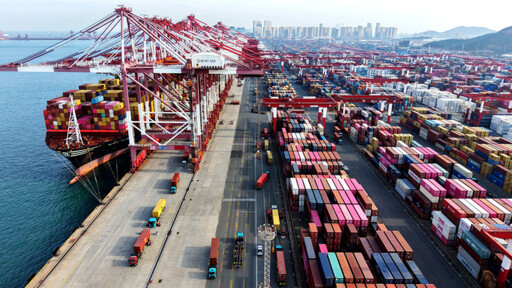
A container terminal at Qingdao Port in Shandong Province bustled with activity on Jan. 1, 2026, the first day of China’s 15th Five-Year Plan. Photo: IC PHOTO
Since its conclusion, the Fourth Plenary Session of the 20th Central Committee of the Communist Party of China has attracted sustained attention both at home and abroad. Looking back over the past five years, China has navigated an extraordinary and eventful period; looking ahead to the next five years, the country is entering a critical stage focused on consolidating foundations and advancing development on all fronts. To interpret the multiple signals released by the Plenary Session, CSST interviewed Stephan Ossenkopp, a researcher at the Schiller Institute in Germany, and Humphrey Moshi, director of the Center for Chinese Studies at the University of Dar es Salaam in Tanzania. As both scholars observed, China has a clear understanding of its future modernization path, and through concrete actions has earned growing respect from the international community.
China’s governance system sets an example
The five-year plan is a governance tool that has been tested by time and proven effective through practice. In the view of some observers, it strikes a balance between long-term strategy and immediate priorities, serving as both a reference point and an institutional framework for decision-making.
“China’s economy has performed quite well in the last five years. Indeed, its GDP growth was about five percent per annum on average in the last years. This growth was achieved in spite of the severe shocks of the COVID-19 pandemic and the US’s trade war and tariff war,” Moshi told CSST. More importantly, during this period China achieved its goal of eradicating poverty on schedule.
As Ossenkopp noted, the Recommendations of the CPC Central Committee for Formulating the 15th Five-Year Plan for National Economic and Social Development constitute a comprehensive set of guiding principles and overarching objectives, aimed at upgrading national strength across a wide range of fields. From achieving greater self-reliance and strength in science and technology to building a beautiful and harmonious countryside, the Recommendations span multiple sectors and function as both a timetable and a roadmap for maintaining a medium- and long-term strategic perspective.
Moshi spoke highly of China’s adoption of five-year planning within its governance system, arguing that it sets an example for other countries. “It is quite true that the world is very uncertain,” Moshi noted. Even so, effective planning remains the appropriate tool for protecting countries against the adverse effects of global turbulence. Uncertainty brings both challenges and opportunities, but addressing the former and capitalizing on the latter requires a planning system that is continuously monitored and periodically evaluated. This, he argued, is precisely what China’s governance system does: It systematically reviews “what worked, what didn’t work and why, what were the challenges faced and chart the way forward.”
Modernization is a progressive process
“I have no doubt, whatsoever, that the proposed goals set for the 15th Five-Year Plan period will be achieved,” Moshi said, noting that China understands modernization as a gradual and cumulative process, one that avoids an excessive focus on speed or an overemphasis on industrial expansion.
China’s modernization efforts have consistently placed people’s well-being at the center, while recognizing that people themselves are the principal drivers of development. Without sustained improvements in health, education, skills, housing, and equitable access to economic resources, development efforts lose their substance. According to Moshi, China’s leadership has clearly grasped this logic and demonstrated to the world that poverty is not an inevitable destiny. It can indeed be eradicated with effective leadership, firm determination, strong commitment, and public trust.
Increasing its global footprint
Many international scholars argue that in a world marked by turmoil and geopolitical tensions, China has emerged as a pioneer in charting its own development path. “Currently, China is the second largest economy in the world,” Moshi noted, adding that in several sectors—including manufacturing and green technologies—China has already become a global leader. The country has also established a range of international cooperation platforms, which have not only reshaped the global geopolitical landscape but have also introduced alternative development paradigms. In Moshi’s view, these initiatives have created a more favorable environment for Global South countries, including those in Africa, to pursue their own development aspirations. China’s initiatives, he emphasized, take into account differences in culture, levels of development, and ecological conditions, rejecting “copy-paste” and “one-size-fits-all” approaches.
Moshi concluded that China has made it clear it cannot be coerced or intimidated—the country has expanded its global footprint by pursuing a non-discriminatory and self-reliant foreign policy.
Editor:Yu Hui
Copyright©2023 CSSN All Rights Reserved