


Innovative Party theories lead frontiers of Chinese scholarship
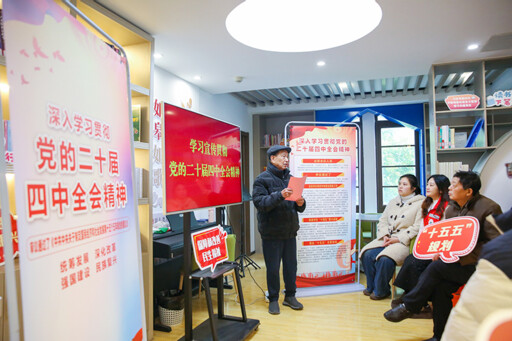
On Dec. 17, 2025, at a community reading room in Rugao City, Jiangsu Province, resident Party members study the spirit of the Fourth Plenary Session of the 20th CPC Central Committee. Photo: IC PHOTO
Marking the conclusion of the 14th Five-Year Plan (FYP, 2021–25), 2025 has been a year of intense scholarly activity and innovative research outcomes for China’s philosophy and social sciences community. Drawing on a nationwide questionnaire survey of the social sciences sector, together with expert recommendations, data analysis, and scholarly review, CSST has identified the top 10 theoretical research hotspots of the year: Xi Jinping Thought on Culture, Chinese modernization, building an independent knowledge system for Chinese philosophy and social sciences, the spirit of the Fourth Plenary Session of the 20th CPC Central Committee and the 15th FYP, high-quality development, developing new quality productive forces, the Global Governance Initiative (GGI), the 80th anniversary of the victory of the Chinese People’s War of Resistance Against Japanese Aggression and the World Anti-Fascist War, modern cities of the people, and humanistic economics. Together, these focal areas reflect the latest developments in the Party’s innovative theories and underscore a strong sense of responsibility to contemporary realities and a clear practical orientation that characterizes current theoretical research in China.
Xi Jinping Thought on Culture: Fundamental guidelines for leading cultural development in the new era
Xi Jinping Thought on Culture distills the practical experience accumulated by the CPC in leading cultural development in the new era, further enriching and advancing Marxist cultural theory. Kang Zhen, a member of the Standing Committee of the Party Committee of Beijing Normal University and vice president of the university, noted that research in 2025 focused on several interrelated themes. These include the scientific connotations and internal logic of Xi Jinping Thought on Culture, the cultural genes and value pursuits of Chinese modernization, new forms of popular literature and art, shifts in the theoretical paradigms underpinning digital cultural production, the mechanisms and pathways for achieving common prosperity in people’s cultural and ethical life, and innovations in cultural paradigms associated with the new form of human advancement. According to Kang, research in this area has sought to balance theoretical interpretation with systematic construction, while linking historical depth with contemporary frontiers, advancing both local concerns and international perspectives.
Chinese modernization: Enriching and developing a new form of human advancement
Grounded in China’s own practice, General Secretary of the CPC Central Committee Xi Jinping has creatively proposed and systematically elaborated the major proposition of “Chinese modernization,” forming a set of interrelated and internally coherent new ideas, viewpoints, and conclusions that have remained at the forefront of theoretical research. Lin Jianhua, secretary of the Party Committee of the National Academy of Chinese Modernization at the Chinese Academy of Social Sciences (CASS), observed that in 2025 scholarly work in this area has focused on clarifying the historical trajectory and generative logic of Chinese modernization, identifying the fundamental drivers of China’s economic and social development, and explaining why Chinese modernization represents a major achievement forged through long-term exploration by the Chinese people. He further emphasized that this path of modernization is socialist in nature, guided by the leadership of the CPC, and embodies the advanced qualities of scientific socialism.
Building an independent knowledge system for Chinese philosophy and social sciences: A strategic task for academic development in the new era
In 2022, General Secretary Xi Jinping emphasized that “the priority of developing the philosophy and social sciences with Chinese characteristics is to establish an independent knowledge system,” a task that has become a sustained focus of theoretical research. Zang Fengyu, dean of the School of Philosophy at Renmin University of China, remarked that in 2025 the academic community took the distinctive concepts embedded in the Party’s innovative theories as the foundation for constructing such a system. Research explored the connotations, theoretical origins, basic principles, logical pathways, and methodological approaches involved in building an independent knowledge system for Chinese philosophy and social sciences, while promoting epistemic, theoretical, and methodological innovation. These efforts aimed to “properly address the relations between China and the West, as well as the interplay between ancient and modern civilizations,” and to present, through interdisciplinary integration, a knowledge system rooted in the achievements of Chinese modernization, characterized by cultural subjectivity, and capable of exerting international influence.
The spirit of the Fourth Plenary Session of the 20th CPC Central Committee and the 15th FYP: Charting a new blueprint for national development
The Recommendations of the CPC Central Committee for Formulating the 15th Five-Year Plan for National Economic and Social Development, adopted at the Fourth Plenary Session of the 20th CPC Central Committee, sets the course for China’s development over the next five years. Scholars have actively studied the spirit of the plenum and contributed theoretical insight to its implementation. Hong Xianghua, deputy director of the Research Office at the Party School of the CPC Central Committee (National Academy of Governance), observed that current research has focused on elucidating key propositions emphasized at the plenum, including the core principles of upholding the Party’s overall leadership, putting the people first, pursuing high-quality development, comprehensively deepening reform, promoting both an efficient market and a well-functioning government, and ensuring both development and security; Chinese modernization; and fostering a thriving socialist culture, as well as policy analyses of the strategic objectives and key tasks of the 15th FYP. Particular attention has been paid to its alignment with major national strategies such as high-quality development, common prosperity, and national security, and to exploring how institutional advantages can ensure the plan’s implementation and promote the steady and long-term advancement of Chinese modernization. Related research outcomes are characterized by a clear political orientation, strategic focus, and strong concern for practical implementation.
High-quality development: Primary task in building a modern socialist country in all respects
High-quality development is an original and distinctive concept within Xi Jinping Thought on Economy. As China has entered the new development stage associated with the 15th Five-Year Plan, high-quality development is framed not only as a primary task and long-term theme, but also as a strategic response to increasingly complex domestic and international conditions. Fang Ying, vice president of Xiamen University, noted that in 2025 the economics community aligned its research closely with the major requirements of promoting high-quality development, examining issues such as economic restructuring and industrial upgrading, green development and ecological civilization construction, social equity and improvements in people’s livelihoods, and coordinated regional development. In emerging fields such as the digital and green economies, he added, research has produced a number of substantive results, contributing to the development of an independent knowledge system for Chinese economics and strengthening the field’s capacity to explain real-world economic dynamics.
Developing new quality productive forces: Driving revolutionary leaps in social productivity
The concept of new quality productive forces represents the adaptation and further development of Marxist theories of productive forces in the contemporary Chinese context. Since General Secretary Xi Jinping advanced a series of important expositions on this topic, it has remained a focal point of theoretical research. Liu Gang, director of the Nankai Institute of Economics, observed that in 2025, research on developing new quality productive forces focused on promoting industrial innovation through scientific and technological innovation, particularly the new industries, models, and drivers generated by disruptive and cutting-edge technologies. Pertinent studies feature an emphasis on theoretical innovation, problem-oriented approaches, systems thinking, and global perspectives.
GGI: China’s contribution to improving the global governance system
At the “Shanghai Cooperation Organization Plus” meeting in September 2025, President Xi Jinping proposed the Global Governance Initiative, which scholars have viewed as an important contribution to ongoing efforts to improve the global governance system following earlier proposals such as the Global Development Initiative, Global Security Initiative, and Global Civilization Initiative. Zhang Zhenjiang, a professor from the School of International Studies and Academy of Overseas Chinese Studies at Jinan University in Guangdong Province, explained that in 2025, scholars focused on rethinking the theoretical frameworks of global governance research and the roles of governance actors against the backdrop of the GGI. They raised core questions for global governance theory and sought to address them, particularly by clarifying the objects and conceptual boundaries of global governance from a problem-oriented perspective.
The 80th Anniversary of the Victory of the Chinese People’s War of Resistance Against Japanese Aggression and the World Anti-Fascist War: Remembering history and creating a better future
The year 2025 marks the 80th anniversary of the victory of the Chinese People’s War of Resistance Against Japanese Aggression and the World Anti-Fascist War. Historical research focused on upholding an accurate and well-grounded understanding of both the War of Resistance and WWII, with renewed attention to the significance of China’s wartime experience, the importance of the Chinese theater in the World Anti-Fascist War, and the pivotal role of the CPC. Wu Minchao, a research fellow from the Institute of Modern History at CASS, underscored that research on the history of the War of Resistance has remained highly active. Among the various lines of inquiry, studies of the CPC’s role in the war have been especially in-depth and productive. Scholars have undertaken comprehensive, multi-dimensional research on topics such as the Party’s wartime strategic policies, the Chinese united front against Japanese aggression, the development of backstage battlefields, and the construction of base areas, generating a substantial body of high-quality scholarship across military, political, economic, and cultural perspectives.
Modern cities of the people: Composing a new chapter in urban development with Chinese characteristics
In July 2025, General Secretary Xi Jinping addressed the Central Urban Work Conference, defining the goal of urban modernization with Chinese characteristics as the development of modern cities of the people that are innovative, desirable to live in, beautiful, resilient, culturally advanced, and smart. Liu Shilin, director of the Urban Science Research Institute at Shanghai Jiao Tong University, stated that in 2025, theorists developed a multidisciplinary theoretical framework for modern cities of the people and applied it to areas such as urban renewal, urban–rural integration, social governance, public services, and institutional reform. They also refined and synthesized case studies and exemplary practices in people’s city development from across the country. Research in this area has been marked by an emphasis on interdisciplinary integration, collaborative innovation in urban planning, public administration, and digital technologies, stronger problem-oriented approaches and systems integration, and the emergence of a new “theory–practice–policy” paradigm characterized by a more coherent internal cycle.
Humanistic economics: Exploring new pathways for the integrated development of the economy and humanities
The proposition of “humanistic economics” put forward by General Secretary Xi Jinping has been framed as a major innovative development in adapting Marxist political economy to China’s context and the needs of the times, highlighting the theoretical foundations of integrating economic activity with humanistic concerns. Hong Yinxing, former Party secretary of Nanjing University, noted that in 2025 scholars working on humanistic economics explored practical pathways for Chinese modernization that advance both material development and cultural and ethical life. This perspective not only places greater humanistic demands on economic development, but also opens new avenues for generating economic value through the humanities. Related research examined the deeper logic and internal mechanisms through which the economy and the humanities interact, further clarifying—from the perspective of Chinese modernization—their interdependent and mutually reinforcing relationship.
Editor:Yu Hui
Copyright©2023 CSSN All Rights Reserved