


Opening ‘window of thought’ to understand China
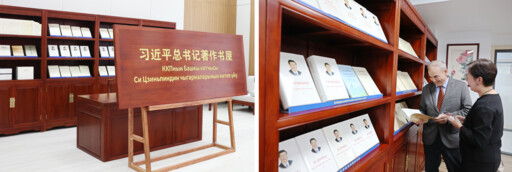
Book houses dedicated to the works of General Secretary Xi Jinping in Bishkek, Kyrgyzstan (left), and Tashkent, Uzbekistan Photo: Zhu Gaolei/CSST
Kyrgyz, Uzbekistani scholars hail book houses dedicated to the works of General Secretary Xi Jinping
Since the 18th CPC National Congress, a number of works authored by General Secretary of the CPC Central Committee Xi Jinping have been translated into multiple languages and published overseas, reaching many countries and regions around the world. As authoritative texts on China’s governance philosophy in the new era, these works are regarded by readers abroad as a “window of thought” through which to understand China. On Jan. 28 and 29, two book houses dedicated to the works of General Secretary Xi Jinping were inaugurated in Kyrgyzstan and Uzbekistan. The book houses serve as an important platform for both countries to deepen their understanding of Xi Jinping Thought on Socialism with Chinese Characteristics for a New Era, as well as the history and theories of the CPC, and to strengthen exchanges on governance experience. To mark the inauguration of the book houses, CSST interviewed several scholars from Kyrgyzstan and Uzbekistan, inviting them to share their perspectives on General Secretary Xi Jinping’s works and the book houses.
Receiving wide acclaim
On Jan. 28, following the inauguration of the book house for the works of General Secretary Xi Jinping, a student majoring in world economy at Kyrgyz National University (KNU) was reading in one corner of the space. He told CSST that, as a student focused on China studies, simply stepping into the book house made him want to read one volume after another. Many titles he had long hoped to read were now within easy reach, including Up and Out of Poverty. “Some may ask why such a book house was established here. There is a widely admired saying in China: ‘Reading is always beneficial.’ The light brought by the books will not only illuminate the Chinese students studying here but will also benefit many Kyrgyz students,” said Gulbara Sydykova, vice rector of KNU.
Upon entering the book house, visitors are immediately greeted by a prominent display of General Secretary Xi Jinping’s major works, including Volumes I–V of Xi Jinping: The Governance of China, On Building a Human Community with a Shared Future, the first volume of selected works of Xi Jinping on economy, and the first volume of selected works of Xi Jinping on ecological civilization, among others. To the left, a series of titles elaborating on Xi Jinping Thought on Socialism with Chinese Characteristics for a New Era are arranged in sequence, including The Communist Party of China and the New Leap in the Adapting Marxism to the Chinese Context, The Path of China’s Peaceful Development, China’s Democracy Path, and The Rule of Law in China.
“Regarding this book house, I would like to take this opportunity to emphasize that China has developed rapidly in recent years and has become one of the world’s major economies. Therefore, our young people should pay attention to the dynamic pace and direction of China’s development,” Sydykova stated. “This book house will serve as a new starting point and platform for cooperation between Kyrgyzstan and China. The leaders of our two countries are advancing along the same path—the Belt and Road Initiative. This is not only a consensus in words but also an alignment in essence, resonating at the intellectual level as well. We are grounded in our respective national traditions while absorbing and developing the finest global accomplishments. We believe this will likely propel our country to achieve leapfrog development, much like China has.”
On Jan. 29, following the inauguration of the book house for the works of General Secretary Xi Jinping at the University of World Economy and Diplomacy (UWED) in Uzbekistan, numerous faculty members and students flocked to the new space. On display were Volumes I–V of Xi Jinping: The Governance of China, along with other important works and discourses by General Secretary Xi Jinping, including the Uzbek edition of Up and Out of Poverty, as well as publications elaborating on Xi Jinping Thought on Socialism with Chinese Characteristics for a New Era—particularly academic works examining Chinese modernization. “I hope this library will provide valuable support to our students. As a professor at this university, I will actively utilize this reading space. It is rich in collections, with books in Uzbek, English, and Chinese, which will greatly help students acquire a deeper knowledge of China,” Kakhramon Dalimov, head of the Rector’s Office of UWED, told CSST.
Abbos Bobokhonov, head of the Center for Asia-Pacific Studies at the Institute for Advanced International Studies at UWED, attended the inauguration of the book house and described it as a symbol of deepening knowledge cooperation between the two sides. “Over the past eight to nine years, bilateral relations between our country and China have developed extremely rapidly, demonstrating continuously growing vitality, particularly in trade cooperation. This vigorous growth in trade momentum is now further transforming into deepened knowledge collaboration and scientific and technological cooperation,” he said.
“Although attention to such cooperation may have been somewhat insufficient in the past few years, now is an opportune time to enhance collaboration in the knowledge domain. This library [book house] will help our students develop a stronger interest in China and may even inspire them to pursue studies in China in the future. It will expand young people’s channels for gaining an in-depth understanding of China, and this new generation of talent will undoubtedly elevate bilateral cooperation to new heights, aligning with the vision of comprehensive strategic cooperation advocated by the leaders of both countries,” Bobokhonov added.
In Bobokhonov’s view, the significance of the book house lies not only in strengthening the younger generation’s understanding of and interest in China, but also in encouraging more students to study in China—an outcome that would further enrich and deepen bilateral relations. He emphasized that the book house enables local students to learn about China not through secondary sources from Western or other countries, but directly through authentic, original works, including President Xi Jinping’s writings and books by Chinese scholars, thereby deepening their understanding of China.
Wang Weihong, a Chinese language teacher dispatched to UWED under a Chinese government program, told CSST in the book house that the initiative adds a new dimension to academic research for local faculty and students. “They can study Xi Jinping Thought on Socialism with Chinese Characteristics for a New Era, as well as the intellectual journey of General Secretary Xi Jinping and the glorious, great achievements of China’s reform and opening up over the past 40-odd years.”
Showcasing governance philosophy
Many international scholars believe that General Secretary Xi Jinping’s series of works showcase distinctive governance wisdom and strategic foresight. Kubatbek Rakhimov, executive director of the Applicata—Center for Strategic Solutions Public Foundation in Kyrgyzstan, noted that Xi Jinping: The Governance of China offers a panoramic view of contemporary China’s governance, with its discussions of domestic development and foreign policy forming integral components of China’s long-term strategy.
“Xi Jinping: The Governance of China includes numerous speeches and articles by President Xi Jinping on how he plans domestic and foreign policies. The series is considered a core text for understanding Xi Jinping Thought on Socialism with Chinese Characteristics for a New Era and also charts China’s development course for this century,” said Ismaeva Rakhima, vice dean of the Graduate School at KNU.
Sheradil Baktygulov, director of the Institute for World Policy Study in Kyrgyzstan and head of the Research Department of the Kyrgyz-Chinese Research Institute at KNU, noted that the spirit and philosophy embodied in President Xi Jinping’s works are systematic and profound, guiding China’s continued introduction of innovative reforms across social, economic, cultural, and diplomatic fields, and in turn driving the nation toward prosperity. Baktygulov added that the Xi Jinping: The Governance of China series had sparked his strong interest in China, Chinese culture, and the narrative features of the texts—an interest that ultimately inspired him to author a book on three decades of good-neighborly friendship and cooperation between Kyrgyzstan and China.
“Brave men look ahead, while cowards look back,” Sofya Apaeva, director of the Kyrgyz-Chinese Research Institute at KNU, quoted a Kyrgyz proverb to describe her response after reading President Xi Jinping’s works. She believes that the appeal of President Xi Jinping’s writings lies in their rare integration of profound historical consciousness, clear strategic thinking, and a sincere commitment to the wellbeing of the people. “His wisdom in governance is like that of a gardener—focused on long-term development over decades or even centuries, rather than short-term gains or losses,” Apaeva reflected.
Benefiting China and the world
Many in international academia believe that China’s current prosperity rests on a range of effective measures to comprehensively deepen reform introduced since the new era. The theoretical foundations of these efforts, they argue, can be found in the defining concepts and original theories articulated in President Xi Jinping’s related works.
Sydykova stressed that the ideas articulated in President Xi Jinping’s works are closely aligned with China’s people-centered philosophy. She added that in recent years President Xi Jinping has repeatedly referred to the “Chinese Dream,” a concept she believes holds enlightening significance for Kyrgyzstan. In Baktygulov’s opinion, President Xi Jinping has offered a detailed explanation of the connotations of the “Chinese Dream.” Today, this dream is steadily coming true, as China has risen to become the world’s second-largest economy within just a few decades.
Rakhimov asserted that in recent years, China’s reform measures have not only focused on maintaining stable economic growth, but have also been directed toward upgrading and improving the quality of its development model. Under President Xi Jinping’s leadership, improving people’s wellbeing has been established as a core priority of national development. Rakhima observed that today many developing countries are eager to understand the factors behind China’s achievements. These works demonstrate to the world that China’s development path can serve as a model—a major country achieving rapid growth by drawing on its own traditions and an innovative socialist framework.
Since the beginning of the new era, President Xi Jinping has put forward the Global Development Initiative, the Global Security Initiative, the Global Civilization Initiative, and the Global Governance Initiative. Together, these initiatives reaffirm China’s longstanding commitment to the path of peaceful development and express its sincere aspiration that China’s progress will benefit the world.
“In these troubled times, the four global initiatives proposed by China serve as a beacon, offering a path to resolve global conflicts without resorting to power coercion. These initiatives are rooted in ancient Chinese philosophy, and their vision depicts an ideal state of harmony among all nations under Heaven,” Apaeva stated. Rakhimov emphasized that in recent years China has achieved a qualitative leap, evident in the tangible transformation of its roles within the world economy, logistics systems, industrial and supply chains, and global governance frameworks—developments that are particularly illuminating for the broader Global South.
In the current international landscape, Apaeva noted that countries of the Global South increasingly view China as a like-minded partner walking alongside them. Having traversed a similar development path, she said, China is able to offer solutions of a distinctive kind. “Amidst the rapidly changing international landscape, reading President Xi Jinping’s works seems to offer a sense of hope and confidence,” Apaeva concluded.
Editor:Yu Hui
Copyright©2023 CSSN All Rights Reserved