


15th FYP outline receives wide acclaim in academia
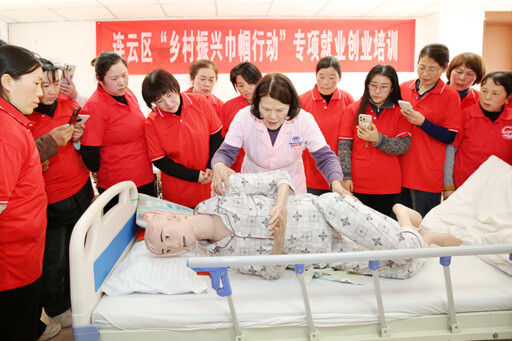
An instructor demonstrates elderly care skills at a domestic services training institution in Lianyun District, Lianyungang, Jiangsu Province, March 9. The session is part of a “Rural Revitalization: Women in Action” program organized by the Women’s Federation of Lianyun District. Photo: IC PHOTO
On March 13, the Outline of the 15th Five Year Plan for National Economic and Social Development was officially released. This comprehensive document, comprising 18 parts and 62 chapters, sets out a systematic blueprint for China’s economic and social development over the next five years, providing clear direction for consolidating foundations and making comprehensive efforts toward the basic realization of socialist modernization. Following its release, China’s philosophy and social sciences community quickly engaged in in-depth discussions. Scholars interviewed agreed that the outline, grounded in the new stage of Chinese modernization, introduces a series of forward-looking and strategic measures, creating unprecedented opportunities and ample academic space for accelerating the construction of an independent knowledge system for Chinese philosophy and social sciences.
Explicit development orientation
Scholars noted that the outline, building on the remarkable achievements of the 14th FYP period (FYP, 2021–25), delivers a series of key breakthroughs in advancing the modernization of China’s governance system and capacity, as well as in optimizing top-level design. This reflects a new level in the CPC’s understanding and application of the laws governing development.
Zhang Yi, a Member of the Chinese Academy of Social Sciences (CASS), paid particular attention to the provisions on improving people’s well-being. In the case of rural residents’ pensions, the increases indicated in the plan signal a more secure and fulfilling future for hundreds of millions of farmers. Zhang argued that income growth—reflected in rising per capita disposable income—is a prerequisite for stimulating domestic demand and promoting economic circulation. He added that growth in per capita disposable income must keep pace with, or even outstrip, overall economic growth, supported by high-quality and full employment. Furthermore, in response to changes in the employment structure driven by artificial intelligence (AI), proactively adjusting the education system will be essential for achieving high-quality population development and supporting Chinese modernization.
Based on the development mission of philosophy and social sciences in the new era, the outline calls for accelerating the construction of an independent knowledge system in these fields. Yin Jun, a research fellow from the Institute of Xi Jinping Thought on Socialism with Chinese Characteristics for a New Era at Peking University, explained that advancing systematic and theoretically grounded research and interpretation of the Party’s innovative theories is both a foundational project for building China’s independent knowledge system and a necessary step toward strengthening the basis for cultural prosperity.
Guan Xinping, director of the Institute of Social Construction and Management at Nankai University, urged social scientists to establish more effective linkages between economic and social development practices and the Party’s innovative theories, taking the new objectives outlined in the plan as guidance. He added that such efforts should provide robust academic support for the continued improvement of policies related to people’s livelihoods.
Clear innovation pathways
Centered on the various tasks for economic and social development during the 15th FYP period (2026–30), the outline presents a series of development visions characterized by explicit indicators, clear layouts, and concrete pathways.
As the overarching objective guiding all tasks, high-quality development has drawn particular attention. Wu Fenggang, vice president of the Jiangxi Institute of Socialism, observed that the ongoing technological revolution, led by AI, not only significantly enhances material productive capacity but also reshapes human cognitive processes and modes of thinking. This, he explained, is driving a fundamental shift in the paradigm of scientific and technological innovation—from a traditionally human-led model to one characterized by human–machine collaboration.
This emerging innovation paradigm, Wu noted, also calls for forward-looking and in-depth research into its long-term impact on research organization and the restructuring of industrial ecosystems, thereby providing solid academic support for the healthy development of new quality productive forces.
Balancing development and security is a key principle clearly articulated in the outline. He Zhipeng, dean of the Law School at Jilin University, stressed that political security is the most central, fundamental, and guiding component of national security. Guiding the public to develop a deep understanding of and identification with the country’s political philosophy, institutional framework, and development trajectory is therefore a crucial focus for social sciences scholars. In light of the increasingly complex interplay between traditional and non-traditional security challenges, he added, the outline sets out specific arrangements for safeguarding security in key areas such as the economy, cyberspace, food, and energy.
The ultimate purpose of both development and security lies in serving the fundamental interests of the people. For the first time, the outline includes a dedicated section on improving the population development strategy to promote high-quality population development, coordinating it with initiatives such as advancing urbanization with county towns as the main carrier and promoting coordinated regional development. Yang Hongtao, a professor from the School of Business Administration at Huaqiao University, noted that this reflects a shift in the treatment of population issues—from a relatively narrow focus on quantitative regulation to a foundational and strategic concern for the overall trajectory of Chinese modernization. By integrating population strategy, spatial planning, industrial development, and public services within a unified framework, it clearly signals a transformation in development philosophy—from reliance on “demographic dividends” to the cultivation of “talent dividends.”
The 15th FYP period marks a critical phase in China’s population development transition, characterized by the overlapping challenges of low birth rates, aging, and regional population disparities. At the same time, efforts to grant urban residency to the agricultural migrant population are entering a new stage marked by qualitative improvement. Cheng Guoqiang, director of the National School of Food Security Strategy at Renmin University of China, called for a deeper understanding of the long-term trends and phased characteristics of this transition, as well as systematic research to address institutional bottlenecks in the process of granting urban residency to rural migrants.
Enhanced cultural confidence
From the global popularity of the game “Black Myth: Wukong,” to the rise of Guochao (China Chic) brands and “new Chinese-style” lifestyles shaping new consumer trends, and grassroots sports events such as Cun BA (Village Basketball Association) and Cun Chao (Village Super League) generating significant social and economic value, China’s cultural landscape in recent years has shown notable vibrancy. Against this backdrop, the outline introduces a range of new measures to promote the development of socialist culture.
“The outline represents a strategic, systematic, and institutional upgrade in cultural development, spanning philosophies and pathways,” remarked Huang Juan, director of the Institute of Cultural Economics at Renmin University of China. This upgrade is reflected in three major shifts: The protection and transmission of traditional culture is moving from static preservation to dynamic development, creative transformation, and innovative development; the integration of culture and tourism is evolving from superficial combination to deeper symbiosis across the entire industrial chain; and the international communication of Chinese civilization is progressing from simple exchange and display to the construction of discourse systems, the export of cultural products, and the pursuit of global value recognition.
Lin Zhen, director of the Ecological Civilization Think Tank Center and the Ecological Civilization Research Institute at Beijing Forestry University, pointed out that the progression in wording—from “promoting” green development in the 14th FYP to explicitly “accelerating” the comprehensive green transformation of economic and social development in the 15th FYP—reflects both the urgency of achieving carbon peak and carbon neutrality goals and the deepening demands for the scope and intensity of green development. During the 15th FYP period, he emphasized, it is essential to uphold Xi Jinping Thought on Ecological Civilization as the guiding principle and to fully commit to accelerating high-quality development in the disciplinary, academic, and discourse systems related to ecological civilization.
Fulfilling mission of social sciences
The 15th FYP lays out a clear economic roadmap for the next five years, not only setting scientifically grounded development goals for 2030 but also mapping out concrete pathways for achieving them. This demonstrates the organic integration of policy continuity with the evolving priorities of the new development stage.
Liu Xianzhong, a research fellow from the Institute of Russian, Eastern European and Central Asian Studies at CASS, advised that social sciences scholars should align their efforts with the major practical issues emphasized in the plan—such as high-quality development and innovation-driven growth, the role of technology in leading economic and social progress, the steady expansion of high-standard opening up, and the deepening of high-quality Belt and Road cooperation. He called for more in-depth, forward-looking, targeted, and preparatory policy research to provide more solid and substantial academic support for the effective implementation of the plan’s blueprint. At the same time, scholars should consciously assume the role of cultural ambassadors, actively engaging in multi-level and wide-ranging international academic exchanges and dialogue to help the global community develop a more objective, comprehensive, and nuanced understanding of China and its development trajectory.
The successful implementation of the plan depends not only on strong academic support but also on broad public recognition and a solid social foundation. Song Jianxiao, deputy director and secretary general of the Fujian Provincial Research Center for Xi Jinping Thought on Socialism with Chinese Characteristics for a New Era and secretary of the Party members’ group of the Fujian Academy of Social Sciences, highlighted the importance of building a matrix-based system for theory communication. Leveraging key research bases, Marxist theory dissemination bases, and higher education institutions across regions, a series of themed outreach activities should be organized to ensure that the guiding principles of the 15th FYP are communicated accurately and efficiently across sectors and at the primary level.
Song further suggested that the decision-making and advisory functions of think tanks should be fully activated and utilized, with experts and scholars organized to conduct in-depth field research in grassroots settings such as farmlands, factory floors, and urban communities so that new developments and emerging issues in the implementation process can be identified in a timely and precise manner. On this basis, high-quality and impactful advisory reports can be produced, integrating rigorous theoretical analysis with innovative practical exploration.
Ideas emerge from their historical moment, and theory must be grounded in practice. Scholars in philosophy and the social sciences are encouraged to focus on the new developments emerging in the course of advancing Chinese modernization, engage closely with realities at the primary level, and truly ground their research in practice—so that their work speaks to the country’s lived conditions and contributes to the broader process of national rejuvenation.
Editor:Yu Hui
Copyright©2023 CSSN All Rights Reserved