


Chinese philosophy, social sciences make strides 10 years on
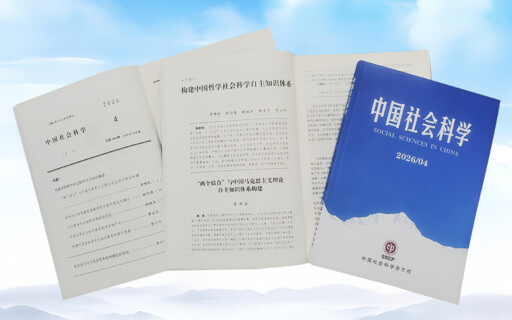
On the occasion of the 10th anniversary of General Secretary Xi Jinping’s “May 17” speech, Social Sciences in China (Issue 4, 2026) features a special section titled “Building an Independent Knowledge System of Chinese Philosophy and Social Sciences.” The feature brings together five scholars to examine this major issue from multidisciplinary perspectives, including Marxist theory, philosophy, economics, law, and history. Photo: Wang Youran/CSST
On May 17, 2016, General Secretary of the CPC Central Committee Xi Jinping gave a landmark speech at the Seminar on Philosophy and Social Sciences, in which he provided fundamental guidance and charted the course for the advancement of philosophy and social sciences in the new era. Over the past decade, from the top-level design of the “Three Systems” for fields of study, academia, and discourse, to the strategic goal of constructing an independent knowledge system, and from the achievement of notable breakthroughs to the development of new approaches for addressing the questions posed by China, the world, the people, and the times, Chinese philosophy and social sciences have made remarkable strides.
New achievements
Ten years ago, Liu Shouying, a professor from the School of Economics at Renmin University of China, made a professional shift, moving from serving as a national policy advisor to a position in mainstream academia focused on theoretical research. Having been deeply involved in policy formulation and advisory work related to China’s economic development and reform, he quickly noticed that mainstream economics often attributed China’s developmental success to marketization and property rights reforms aligned with Western models, largely overlooking the distinctive features and complexities of Chinese practice.
In Liu’s view, the miracle of China’s economic growth over the past four decades owes much to its distinctive development model. “Substantial efforts were required to distill the typical characteristics of Chinese practices, develop distinctive concepts based on these traits, and then articulate these concepts using scientific methods,” he explained. A decade later, he finds encouragement in the growing number of scholars dedicating themselves to this endeavor.
Kang Zhen, vice president of Beijing Normal University (BNU) and a professor from the School of Chinese Language and Literature at BNU, witnessed the evolution of Chinese literature studies over the past decade. He told CSST that scholars are no longer satisfied with interpreting Chinese literary phenomena solely through Western theoretical lenses; instead, they are increasingly developing theories grounded in China’s literary practices. The concept of “cultural poetics,” for instance, seeks to bridge literature and cultural studies, while discussions on “new popular literature and art” address the new forms of cultural production emerging in the digital era. Topics like “inter-civilizational mutual learning” and “rewriting the history of civilization” aim to challenge Western-centric narratives, trace the diverse origins of world literature, and construct a new global perspective on literature. Kang describes this approach as “China in theory,” presenting to the world an academic image of China built upon an independent knowledge system.
In law, the past decade has also seen transformative change. Lei Lei, dean of the Law School at China University of Political Science and Law, describes Chinese legal scholarship’s international influence as experiencing a “leapfrog improvement.” Chinese scholars have led multiple international academic dialogues on original topics such as a community with a shared future for humanity, foreign-related rule of law, and digital governance. Cases in investment dispute resolution, cross-border data flows, and climate legislation have become key references in comparative law studies. “The proportion of these achievements published in international journals and by leading publishers has significantly increased,” Lei noted.
Zhang Yi, a Member of the Chinese Academy of Social Sciences, recalled that 10 years ago, Chinese philosophers and social scientists were largely “translators, learners, and listeners” on the international stage. Today, he observes, “we are active participants in international academic dialogues.”
Chen Jinlong, director of the institute of Party history and building at South China Normal University, and his team have devoted themselves to building an independent knowledge system for studying the CPC’s history and Party-building efforts. They pioneered research areas such as the history of commemorative activities and the affective history of the CPC, fields that were previously underexplored yet critical for understanding the Party’s operational logic. “We have established a research paradigm for the history of the CPC’s commemorative activities,” Chen said, noting that a paradigm signifies methodological maturity and replicability.
Wang Weiguo, executive dean of the School of Marxism at the University of Chinese Academy of Social Sciences, emphasized that the “great practices of Chinese modernization provide the source and driving force for building an independent knowledge system for philosophy and social sciences.” Practices such as developing new quality productive forces, poverty alleviation, managing megacities, and pursuing common prosperity “provide the most fertile soil for academic research and the most solid testing ground for verifying research outcomes.”
Guidance of ‘Two Integrations’
Helping the world better understand China requires a nuanced apprehension of Chinese civilization. It also entails explaining, from the combined perspectives of history and reality, theory and practice, how to better uphold the Chinese path, promote the Chinese spirit, and rally strength across the nation. Wang argues that integrating the basic tenets of Marxism into China’s specific realities and fine traditional culture, or the “Two Integrations,” particularly the “second integration,” accentuates the spiritual essence and cultural foundations that should guide the creation of an independent knowledge system for Chinese philosophy and social sciences.
Xie Naihe, a professor from the School of History and Culture at Northeast Normal University, observed that, in the past, China’s historical research showed a “path dependence” on Western scholarship. “Concepts such as ‘empire,’ ‘Inner Asia,’ and ‘nation-state’ are closely tied to Western historical experiences. Directly applying them to Chinese history often forces a square peg into a round hole,” he explained.
Over the past decade, scholars have systematically explored original and distinctive concepts that highlight the prominent features of Chinese civilization, including tianxia (all under Heaven), minben (people-centered governance), datong (great harmony), xiaokang (moderate prosperity), and da yitong (great unity). These concepts are underpinned by comprehensive methodological awareness, and academia has proposed a “Chinese approach” to the origins and formation of civilization, alongside a series of locally developed, explanatory theories—what Xie calls an assertion of “subjectivity.”
Kang added that constructing an independent Chinese knowledge system requires deep theoretical research on the “Two Integrations” and the dissemination of cultural philosophies and research findings in compelling, persuasive forms.
Despite progress, multiple scholars acknowledged ongoing challenges to constructing an independent knowledge system for Chinese philosophy and social sciences. Chen stressed the need to elevate practical experience to the theoretical level, based on in-depth study of China’s practices, and to further clarify methods for integrating China’s fine traditional culture into the independent knowledge system, making it a vehicle for preserving and promoting Chinese cultural heritage.
Zhang emphasized the importance of continuously conducting practical investigations, carefully summarizing experiences, and deepening original theoretical research grounded in the practice of Chinese modernization, while Lei advocated for systematically documenting China’s governance experience over the past decade in emerging areas such as national security law, data security law, and anti-foreign sanctions law, alongside deep interdisciplinary research. These efforts aim to build an independent Chinese legal knowledge system rooted in domestic practice while addressing questions posed by China itself.
New trends
Looking at the field through the lens of Chinese modernization, Wang identified three emerging trends in philosophy and social sciences research. First, research topics increasingly focus on major Party and national strategies, forming a multi-dimensional synergy encompassing theoretical research, policy advisory services, and communication dialogue. Second, collaborative innovation mechanisms across disciplines, departments, and regions are rapidly taking shape, with research organization shifting from isolated efforts to organized, collective endeavors. Third, there is a dual emphasis on academic rigor and practical relevance, ensuring research outcomes are increasingly geared toward solving real-world problems, addressing public concerns, serving frontline governance, and supporting policy implementation.
In economics, Liu highlighted the pivotal role of digital technology. “We must excel at summarizing China’s rich digital economy practices, extract typical facts, propose original and distinctive concepts, and develop innovative, universally applicable theories to guide China’s digital economy,” he stated, emphasizing that this is critical for China to establish discourse power in the digital economy era. Outdated industrial-era frameworks are insufficient for analyzing these profound transformations.
Lei outlined a two-pronged approach for enhancing the international influence of Chinese legal scholarship: deeply engage with domestic rule-of-law practices, such as the legal safeguards in poverty alleviation and regulatory innovations in the digital governance of megacities, to distill concepts with universal explanatory power, and proactively set global agendas, articulating the underlying logic of the Chinese approach in internationally accepted academic language, particularly in emerging fields such as AI ethics and transnational crime governance. He particularly highlighted the importance of a shift in the mode of academic dialogue: “Through joint research, translation projects, and participation in international academic organizations, Chinese legal scholarship should transform from an ‘object of observation’ into a ‘reference paradigm.’”
Regarding historical research, Xie offered a philosophical perspective, asserting that building a system of Chinese history, along with the broader system of philosophy and social sciences with Chinese characteristics, represents both a contemporary cultural mission and a “cultural re-rooting” of the “meta-spirit” and theoretical-conceptual system of historical China since Chinese scholarship’s modernization. In Xie’s opinion, the study of Chinese classics provide the origin for the indigenous theoretical and conceptual systems, which is essential for building an independent knowledge system for Chinese philosophy and social sciences.
Scholars noted that over the past decade, Chinese philosophy and social sciences have strengthened the foundation for constructing an independent knowledge system through deepening institutional reforms and innovating talent cultivation. They observed that new organized scientific research models are being implemented, research platforms are being constructed to remove obstacles to productivity, and integrated talent training systems are being established. The effects of these efforts are becoming increasingly visible. While progress over the past decade has been considerable, the journey ahead remains long. It requires both the practical consciousness of being rooted in the Chinese context and an open-mindedness toward the world; it also necessitates the methodological guidance of the “Two Integrations,” as well as continuous breakthroughs in theoretical innovation.
Editor:Yu Hui
Copyright©2023 CSSN All Rights Reserved