


Xi Jinping Thought on Culture guides cultural inheritance, development in new era
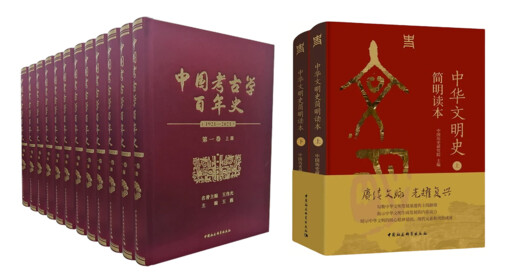
FILE PHOTO: One Hundred Years’ History of Chinese Archaeology (1921-2021) (left) and A Concise History of Chinese Civilization, both among the 30 representative major achievements in the philosophy and social sciences unveiled by CASS in May 2026
On June 2, 2023, at the Meeting on Cultural Inheritance and Development, General Secretary of the CPC Central Committee Xi Jinping, speaking from the strategic height that “culture is fundamental to a nation’s foundation and future,” clearly articulated the prominent features of Chinese civilization, elaborated on the great significance of the “Two Integrations”—integrating the basic tenets of Marxism with China’s specific realities and with its fine traditional culture—and issued a clarion call for undertaking the new cultural mission of the new era. Scholars interviewed by CSST agreed that over the past three years, under the scientific guidance of Xi Jinping Thought on Culture, particularly the important exposition on the “Two Integrations,” China’s philosophy and social sciences community has vigorously advanced the inheritance and development of fine traditional Chinese culture with a conscious sense of mission, profound academic foundations, and vibrant spirit of innovation, providing theoretical support and contributing scholarly strength to consolidating cultural identity, building a strong socialist culture, and creating a new form of human progress.
Fulfilling mission of new era
Xi Jinping Thought on Culture systematically addresses the fundamental questions of what banner to uphold, what path to follow, what principles to adhere to, and what goals to achieve in cultural development for the new era. As an enrichment and development of Marxist cultural theory, it serves as the fundamental guide for preserving and developing Chinese culture. Interviewed scholars noted that in recent years, academia has conducted in-depth studies of Xi Jinping Thought on Culture from a wide range of perspectives and at multiple levels. In terms of theorization, a defining feature of Xi Jinping Thought on Culture lies in its view—drawn from the developmental history of Marxism—that Chinese Marxists must not remain confined to the intellectual sources from which Marxism first emerged, but should integrate the basic tenets of Marxism with China’s fine traditional culture.
Under the guidance of Xi Jinping Thought on Culture, a series of academic achievements grounded in the Chinese nation’s great historical and contemporary practice, supported by solid theoretical foundations, and marked by distinct Chinese characteristics have been released. In May 2026, the Chinese Academy of Social Sciences (CASS) unveiled 30 representative major achievements in the philosophy and social sciences: One Hundred Years’ History of Chinese Archaeology (1921-2021) offers a systematic review of a hundred years of Chinese archaeological endeavor, providing solid empirical evidence for tracing the origins of civilization; A Concise History of Chinese Civilization, based on the latest advances in historiography and archaeology in the new era, highlights the new horizons and fresh dynamism attained by Chinese civilization in the new era; and the “Series of Findings on Rare and Endangered Disciplines”—covering Tangut studies, oracle bone studies, bamboo-and-silk manuscript studies, and ethnic epics—has helped restore these fields to prominence, helping safeguard the pluralistic genes and roots of Chinese civilization.
Li Guoqiang, a CASS Member and vice president of the Chinese Academy of History at CASS, noted that historians have firmly grasped the contemporary value of historical materialism, upheld the subjectivity of Chinese historiography, and continuously deepened their research and interpretation of the uniqueness of Chinese civilization, the inevitability of China’s historical developmental path, and the endogenous nature of the evolution of Chinese systems. Their work has yielded new concepts, theories, and methodologies with Chinese characteristics, enriching the discipline of history.
In May 2024, the Research Center for Xi Jinping Thought on Culture was officially inaugurated in Beijing, marking a new stage in systematic and organized research. The center has established the first batch of seven collaborative research bases—including at CASS and the Party School of the CPC Central Committee (National Academy of Governance)—and continues to deepen research and interpretation of Xi Jinping Thought on Culture through theoretical symposia, major projects, and the compilation of selected case studies on cultural development in the new era.
Zang Fengyu, dean of the School of Philosophy at Renmin University of China, observed that academia is intensifying research and building theoretical strongholds in order to gain a deep understanding of the core tenets of Xi Jinping Thought on Culture, promptly transforming scholarly output into teaching resources, nurturing a new generation with global vision who carry forward fine traditional Chinese culture, and developing a socialist culture with Chinese characteristics for the new era—a culture endowed with strong intellectual guidance, spiritual cohesion, value appeal, and international influence.
Cementing foundations of cultural confidence
Over the past three years, alongside the increasing systematization of research, a host of signature concepts and theoretical achievements—marked by distinct Chinese characteristics and contemporary relevance—have emerged in rapid succession. These include “cultural confidence,” the “second integration” (integrating the basic tenets of Marxism with China’s fine traditional culture), “cultural identity,” “cultural entity,” “creative transformation and innovative development of traditional culture,” “exchanges and mutual learning among civilizations,” “the community for the Chinese nation,” and “a new form of human progress.” Together, they have injected a continuous stream of momentum and vitality into the building of an independent knowledge system in Chinese philosophy and social sciences.
Li Zhen, head of the Department for Xi Jinping Thought on Culture at CASS’s Institute of Philosophy, noted that in recent years his team has undertaken joint research projects with relevant central departments, mobilizing the resources of the entire institute to compile the Lectures on Xi Jinping Thought on Culture and producing a series of significant outcomes, including “Deeply Understand the Groundbreaking Significance of the ‘Second Combination’” and “The Dao of China: The Philosophical Interpretations of the Outstanding Characteristics of Chinese Civilization.” Drawing on multidisciplinary resources ranging from Marxist philosophy to Chinese philosophy, these efforts have worked in concert to deepen research and interpretation of Xi Jinping Thought on Culture.
Fan Yugang, a distinguished professor at Shandong University, stated that these signature concepts and landmark achievements have advanced the theoretical study of Xi Jinping Thought on Culture and offered profound intellectual value and inspiration for cultural development, propelling cultural progress and promoting the flourishing of literature and art in the new era.
Safeguarding, carrying forward, and developing the treasures of Chinese civilization—which have endured the vicissitudes of time—is a prerequisite for breaking new ground in cultural inheritance and development. Over the past three years, a series of major cultural heritage conservation achievements have borne witness to national prosperity and rejuvenation.
In 2025, the Xixia Imperial Tombs were officially inscribed on the UNESCO World Heritage List as China’s 60th World Heritage site, filling a gap in the representation of the historical and cultural heritage of Xixia (the Western Xia Dynasty in Chinese history spanning from 1038 to 1227) on the list. The “Wuxing Ling” (“Order of the Five Elements”) and “Gongshou Zhan” (“Offense and Defense Divination”)—fragments of the Zidanku Silk Manuscript dating to the fourth and third centuries BCE that had been lost overseas for decades—finally returned home after traversing vast distances, silently testifying to the continuity of China’s cultural lineage and the flourishing of the nation. The Palace Museum celebrated its centennial, with its staff upholding the spirit of “sincere stewardship and craftsmanship inheritance,” allowing the ancient palatial complex to shine with contemporary brilliance through preservation and adaptive reuse.
Duan Jifang, dean of the School of Chinese Language and Literature at South China Normal University, emphasized that under the guidance of Xi Jinping Thought on Culture, China’s philosophy and social sciences circles—with their strong sense of history and responsibility—have continuously promoted the scholarly interpretation and original theoretical distillation of fine traditional Chinese culture, driving cultural creation while preserving cultural continuity, and protecting the enduring roots of the Chinese nation’s spirit.
The “second integration” represents not only profound theoretical innovation but also an increasingly shared set of values that informs people’s daily lives, even if often unconsciously. Mo Lifeng, a senior professor of humanities and social sciences at Nanjing University, and his colleagues have strived to bring scholarship beyond the ivory tower and sow the seeds of fine traditional culture among the public. In this spirit, they have compiled and published popular series such as Classics of China (Youth Edition), presenting canonical works in accessible forms to engage younger audiences.
Mo’s team also took the lead in establishing a “digital-intelligent mapping and scenario application laboratory for urban literature,” where they were able to build precise linkages between textual knowledge, urban positioning, and cultural landmarks. Building on academic outcomes such as the “Nanjing Trilogy,” Three Hundred Poems of Nanjing, and Nanjing Literary Map, and leveraging modern technologies such as artificial intelligence, their work has enabled residents to feel the pulse of this “city of literature” in their everyday movements.
“Cultural inheritance requires both rigorous academic research and broad public outreach,” Mo remarked. “While engaged in teaching and research, we are more than willing to contribute our part to the popularization of fine traditional Chinese culture.”
Co-creating new culture for the times
China’s long and continuous historical lineage has endowed Chinese modernization with remarkable profundity, characterized by innovation through inheritance and development through innovation, creating a new culture for the times.
“Applying scholarship to practical governance” is the most time-honored and deeply rooted tradition of Chinese historiography. According to Li Zhen, the historical community is actively integrating itself into the great practice of Chinese modernization. Focusing on major contemporary issues—such as tracing the origins of Chinese civilization, forging a strong sense of community for the Chinese nation, Belt and Road cooperation, and building a community with a shared future for humanity—historians are delving into the historical roots, internal laws, and practical pathways of current challenges from a deep historical perspective. Through these efforts, numerous outstanding scholarly achievements have emerged, providing invaluable historical wisdom and decision-making references for governance.
Looking ahead, Duan proposed continuing to refine the theoretical framework of Xi Jinping Thought on Culture in terms of systematization, theorization, and innovativeness, underscoring its theoretical character and demonstrating its intellectual value. At the same time, Duan argued, it is essential to uphold historical materialism, constantly expand the depth and breadth of research, and strengthen practice-oriented inquiries—particularly regarding the guiding principles for the development of contemporary Chinese culture. Fan, meanwhile, stressed that academic research should consciously provide theoretical support for consolidating cultural identity, helping translate guiding principles into vibrant cultural practices.
Zang noted that with the deepening integration of disciplines, emerging fields such as humanistic economics, the philosophy of artificial intelligence, and digital humanities are continuously expanding academic boundaries, offering new technological means and theoretical perspectives for cultural inheritance and development. Meanwhile, the growing momentum in cultural studies—such as new Sinology, global China studies, civilizational studies, and classical studies—has not only advanced the understanding of Chinese civilization but also illuminated the world-historical significance of creating a new form of human progress.
Going forward, Li Zhen suggested deepening interpretive work to theoretically clarify why and how Marxism and fine traditional Chinese culture are compatible, why they achieve mutual enhancement, and how they give rise to a new, organically unified cultural entity. He also highlighted the importance of intensifying constructive work—daring to dig deep inside fine traditional Chinese culture to distill more original and explanatory signature concepts—and integrating these with Marxism, so as to foster original theories with Chinese characteristics, Chinese style, and Chinese ethos through enhanced exchanges and mutual learning among civilizations.
Editor:Yu Hui
Copyright©2023 CSSN All Rights Reserved