


Exhibition in Athens showcases profound heritage of TCM culture
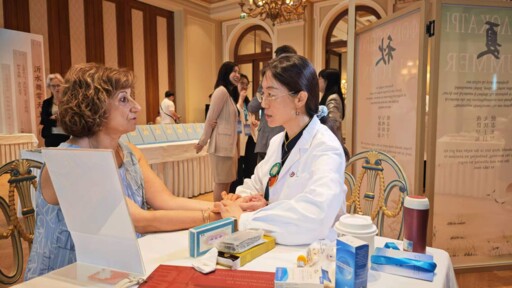
A conference participant tries TCM pulse diagnosis at the exhibition Photo: Zhu Gaolei/CSST
On June 9–10, an exhibition titled “Bringing Classical Civilization into the Modern Age: Achievements of World Classical Civilizations” was held in Athens, Greece, as a sub-event of the Second World Conference of Classics. Co-hosted by the Chinese Academy of Social Sciences (CASS), the National Administration of Traditional Chinese Medicine, and the Academy of Athens, the exhibition offered a systematic presentation of traditional Chinese medicine (TCM), including its rich cultural connotations, historical development, contemporary innovations, and international exchanges. Featuring ancient texts, TCM cultural displays, exhibits from archaeological science, and interactive AI experience zones, it offered participants an immersive cultural experience.
Formed and refined over centuries of lived practice, TCM embodies profound philosophical wisdom and stands as a quintessential expression of Chinese classical civilization. The TCM cultural section of the exhibition was divided between a main venue and sub-venues. The main venue focused on canonical medical texts and traditional medical instruments, displaying such seminal works as Huangdi Neijing (Yellow Emperor’s Inner Canon), Bencao Gangmu (Compendium of Materia Medica), Shanghan Zabing Lun (Treatise on Febrile), Wenyi Lun (Treatise on Pestilence), and Shennong Bencao Jing (Shennong’s Classic of Materia Medica), alongside traditional implements including jiuzhen (the Nine Needles), pulse-taking pillows, herbal mortars and pestles, and bronze acupuncture figurines. The sub-venues displayed more than 100 TCM-related volumes and featured hands-on activities such as pulse diagnosis, mugwort sachet-making for the Duanwu Festival, constitution assessments, and demonstrations of traditional Chinese health-preserving exercises, drawing large numbers of interested visitors.
Dr. Tan Tianyang and Chief Physician Zi Mingjie, both from Xiyuan Hospital of the China Academy of Chinese Medical Sciences, demonstrated Baduanjin, a TCM-based exercise routine, and Taiji Quan (Tai Chi) respectively. During the coffee break, many international scholars spontaneously joined in, immersing themselves in the slow, measured movements.
Theodoros Papangelis, a member of the Section of Letters and Fine Arts at the Academy of Athens, told CSST that after once suffering a fall caused by loss of balance, he found the “physical balance” and “inner peace” cultivated by Tai Chi to be precisely what many modern people urgently need. In his view, traditional Chinese practices such as Tai Chi and Baduanjin offer a much-needed way to “slow down” amid the pace of urban life.
The exhibition also showcased the unique wisdom of TCM through the lens of daily life. A series of infographics themed “Nourishing Life through the Four Seasons” illustrated the ancient Chinese philosophy of aligning life rhythms with the seasons and solar terms. In the “TCM in the Kitchen” section, common ingredients such as hawthorn, lily bulb, lotus seed, cinnamon, and chrysanthemum caught the eye of many visitors. Emphasizing holism and equilibrium, TCM regulates the body according to the thermal properties—warm or cool—and flavor profiles of foods. When Zi explained how red dates, lotus seeds, and lily bulbs can be used to regulate bodily functions, numerous international scholars took photos and notes. Scholars commented that while traditional Chinese and Greek medical systems share notable conceptual parallels, they were especially struck by TCM’s philosophy of integrating health preservation naturally into everyday life.
As a vital link in Chinese-foreign cultural exchange, TCM has long enjoyed a presence on the global stage, spreading to nearly 200 countries and regions and playing an active role in global health governance. Acupuncture and moxibustion, two hallmark practices of TCM, along with Tibetan medicinal bathing, and Tai Chi have been inscribed on the Representative List of the UNESCO Intangible Cultural Heritage of Humanity. Seminal texts such as Huangdi Neijing, Bencao Gangmu, and Sibu Yidian (Four Treatises) have also been included in the Memory of the World Register. As an outstanding representative of Chinese civilization, TCM has not only contributed to the flourishing of the Chinese nation but has also gained increasing recognition and resonance around the world.
Under the initiative “Shennong Tasting Herbs in the New Era,” exchanges between China and other countries in traditional medicine have continued to deepen. Zi noted that the Athens exhibition marked the first time CASS had included TCM in a supporting exhibition of the World Conference of Classics. Reflecting on the significance of the Athens visit for TCM practitioners, she expressed hope for sustained future cooperation, envisioning a process in which TCM culture and the classical wisdom of other civilizations illuminate one another and contribute to a shared future.
Editor:Yu Hui
Copyright©2023 CSSN All Rights Reserved