


Infrastructure revolution invigorates handcrafted economy
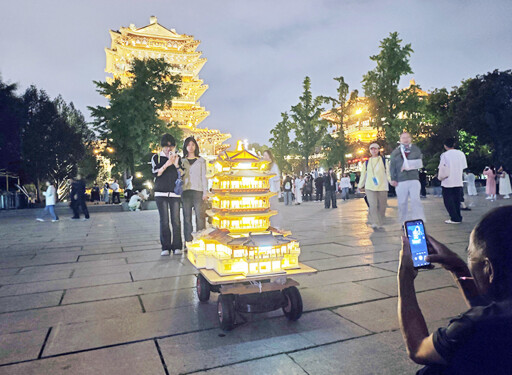
Tourists take photos with a miniature replica of Chaoran Tower, 3D-printed from recycled plastic waste at a 1:80 scale, in front of the authentic tower by Daming Lake in Jinan, Shandong Province. Photo: IC PHOTO
Across China’s entrepreneurial and consumer markets, the “shoucuo,” literally “hand-rubbed” or “handcrafted,” economy is gaining momentum in a variety of forms. What defines this emerging trend, and where is it likely to go next? CSST recently spoke with scholars in related fields to examine these questions.
The shoucuo economy refers to a new phenomenon in which individuals or small teams, without relying on traditional assembly lines or large organizational structures, rapidly convert creative ideas into products and capture market returns. Why has this model surged at this particular moment? Li Xianjun, an associate professor from the Institute of Industrial Economics of the Chinese Academy of Social Sciences (CASS), points to a fundamental transformation in underlying infrastructure.
“In the past, starting a business required heavy asset investment; the barriers to entry for manufacturing, technology application, and sales were formidable,” Li noted. Today, artificial intelligence (AI) has sharply reduced the costs of design, development, and content creation. At the same time, 3D printing has made small-batch, non-standardized physical production almost as straightforward as printing a document. E-commerce platforms and social media now offer individuals direct access to consumers through traffic gateways and transaction channels, while mature mobile payment and logistics systems provide essential support. As a result, individuals and small teams can bypass capital-intensive production chains and connect directly with markets. The efficiency of turning ideas into products has increased exponentially.
At first glance, the shoucuo economy may resemble traditional DIY practices or handicrafts, but its underlying logic has changed fundamentally. Quan Shiwen, head of the Department of Food Economics at the Rural Development Institute at CASS, explained that traditional handicrafts are built on artisans’ long-cultivated, proprietary skills that are difficult to replicate, with production centered on manual execution. By contrast, the shoucuo economy leverages generative AI, open-source hardware, and digital toolkits to transform specialized skills into widely accessible public resources. Moreover, while traditional handicrafts are typically confined to geographically bounded local markets, limiting their ability to aggregate dispersed demand, the shoucuo economy operates through digital platforms that act as intermediaries, using algorithmic recommendation systems to break down spatial constraints.
To experience the low threshold of entry firsthand, a CSST reporter installed an AI development tool from a popular platform and prompted it to “build an app that tracks my daily mood and generates a weekly report.” Within about three minutes, a functional prototype appeared, complete with a calendar check-in system, mood-selection charts, and text-generation capabilities. As of April this year, the development platform had already hosted more than 30 million such original applications. This illustrates the core logic of shoucuo digital products: extremely low trial-and-error costs and zero marginal distribution costs, making the digital domain the first area in which this economy has taken off at scale.
In the physical realm, lightweight smart hardware—supported by desktop 3D printers and highly integrated modular components—has enabled “studio-scale” small-batch customization. Zhou Mingxuan, a well-known mechanical hobbyist with more than a decade of shoucuo experience, told CSST that virtually any component he needs can now be readily sourced online—from specialty screws to custom circuit boards.
“China’s robust supply chain is the bedrock upon which creators like me survive,” Zhou said. “A single market in the Huaqiangbei electronics hub in Shenzhen, Guangdong Province can supply every part needed for a robot, and factories in the Yangtze River Delta are willing to accept orders as small as a few dozen units.”
Wang Chao, an associate professor from the School of Labor Economics at the Capital University of Economics and Business, argued that shoucuo products are able to capture consumers and build trust because of three distinct features. First, they precisely target hyper-specific niche demands, focusing on vertical scenarios and addressing narrowly defined pain points with single-purpose functionality. Second, they carry the creator’s personal imprint—ingenuity and craftsmanship that break away from the homogeneity of industrial production and add emotional value. Third, their production process is often made visible on social media platforms, where many creators livestream or post videos documenting each stage of development. By leveraging open-source ecosystems and interest-based communities, they narrow the distance between producer and user. This sense of “authenticity” reduces trust costs and turns consumption into an expression of identification with the creator.
Despite the romanicism of creation, however, most shoucuo projects remain commercially underdeveloped—only a small fraction of creators manage to achieve stable income or formal compliance. “The root cause lies in a structural mismatch between individual creative logic and industrial commercial logic,” Wang said. Creators who excel in R&D often struggle with supply chain management, compliance certification, cost control, marketing, and after-sales service, making it difficult to convert an impressive prototype into a deliverable product.
Wang added that the core appeal and premium pricing of shoucuo products stem from their personalized, non-standardized nature. Yet scaling up revenue and influence requires standardization and process optimization. Once creators embark on that track, their products risk losing their unique charm or costs may spiral if supply chains cannot be effectively managed. In addition, creators face the dual challenges of uncertain market positioning and intellectual property protection.
Wang advised addressing these constraints by building complementary teams that pair creative talent with experienced business operators, allowing for step-by-step validation of viable business models and flexible integration into existing industrial collaboration networks. On the regulatory side, Quan advocated a differentiated, tiered, and platform-based supervision system tailored to the structural characteristics of the shoucuo economy.
Editor:Yu Hui
Copyright©2023 CSSN All Rights Reserved