


Middle-range theorizing with explanatory power, imagination
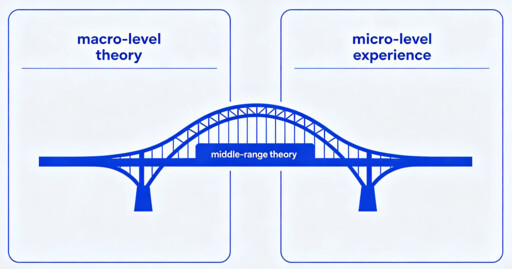
Middle-range theory was born to better bridge macro-level theory with micro-level experience. Image generated by AI
In the field of supply chain management, researchers often use cross-sectional survey data from supply chain managers to test broad organizational theories, reducing theoretical constructs to perception-based survey items. The statistical relationships that emerge may appear theoretically coherent, but they offer limited insight into how actual supply chain structures, planning systems, or operational processes shape performance in practice.
This kind of research—and the wider body of work it represents—has fallen into a curious predicament: methodologically impeccable and logically consistent, yet seemingly separated by an invisible wall from a reality that is complex, interactive, and constantly changing. Many social scientists have begun to sense that the bridge linking macro-level theory with micro-level experience—middle-range theory (MRT)—is becoming increasingly precarious.
Why MRT matters?
The concept of MRT was first advanced by American sociologist Robert K. Merton as a critique of the polarized state of social science research in the mid-20th century. Confronted with the widening gulf between the grand theoretical system advocated by leading American sociologist Talcott Parsons and the piecemeal character of empiricist inquiry, Merton proposed a third way in his seminal 1949 work Social Theory and Social Structure.
By constructing testable propositions through the analysis of delimited social phenomena, Merton sought to avoid both the abstraction of grand theory and the fragmentation of narrowly focused empirical studies. This approach quickly became a driving force in the professionalization of the social sciences, giving rise to a series of influential theories—from resource dependence theory to the “spiral of silence”—that have left a lasting mark on sociology, management studies, and communication research.
“Grand theories—such as resource dependence theory, transaction cost economics, or information processing theory—offer broad directional guidance about how organizations behave. They are useful at a high level, but they are typically too abstract to explain the complex interactions that occur within specific operational contexts,” Theodore P. Stank, a professor from the Haslam College of Business at the University of Tennessee, Knoxville, told CSST.
“Understanding those interactions requires studying phenomena within concrete settings,” Stank noted. “Supply chains operate within very particular environments: industry structure, product characteristics, demand variability, technology constraints, and institutional relationships all shape outcomes. MRT is precisely the level where those contextual mechanisms can be explored and understood.”
James Chu, an associate professor from the Department of Sociology at Columbia University in the United States, emphasized mechanism specification and empirical validation as defining features of MRT. “I imagine MRT as the production of a series of precise, logically linked propositions (e.g. A implies B, which generates C, etc.), along with clear scope conditions, which yield testable empirical claims,” Chu said.
Is there an explanatory crisis?
For all its significance, MRT faces a number of contemporary challenges.
Liu Hailong, a professor and dean of the Department of Communication at the School of Journalism and Communication at Renmin University of China, told CSST that MRT has long been an integral part of communication studies. Classic frameworks such as agenda-setting and the spiral of silence once captured with precision the particular social psychology and information mechanisms of the mass media era. Yet as the underlying logic of communication shifts from mass communication to algorithmic curation and digital connectivity, yesterday’s maps can no longer guide travelers to new shores.
“The original contexts underpinning established MRTs are being marginalized, and their explanatory power is waning,” Liu admitted. “Technological change is now too rapid to allow for proper theoretical abstraction. New phenomena emerge incessantly, only to become obsolete just as quickly. Consequently, much of today’s MRT remains stuck at the stage of describing phenomena, without maturing into explanatory macro-theory. Even when theories do crystallize, they tend to offer isolated descriptions of narrow phenomena, failing to connect them to broader social structures.”
Compounding this dilemma, grand narratives concerning the “social impact of media technology”—often imported from fields such as the philosophy of technology—can prove excessively abstract and detached from specific contexts, making them “difficult to falsify.” Caught between rapidly shifting empirical realities and highly abstract philosophical speculation, MRT now finds itself fractured, Liu said.
“The difficulty is not conducting this kind of work; the difficulty is publishing it,” Stank affirmed. “Many journals and review processes treat single-context studies, field studies, or inductive investigations as lacking generalizability. As a result, scholars are often pushed toward testing grand theories in settings where those theories were never intended to operate with precision.”
Not all scholars, however, accept the claim that MRT is in crisis. As Peter Hedstrom, a fellow of the Royal Swedish Academy of Sciences and professor of analytical sociology at Linkoping University in Sweden, put it: “The problem with MRT is rather the lack of systematization.”
Stank made a similar point, noting that fields such as sociology, political science, and certain subfields of economics routinely publish shorter empirical studies that examine specific mechanisms within particular contexts. “Over time, these cumulative findings build a broader theoretical understanding.”
Multiple reasons for challenges in MRT
Scholars interviewed by CSST identified multiple pressures that have made it harder to construct robust MRTs. In management studies, Stank argued, the root cause lies in the discipline’s excessive pursuit of “scientific legitimacy.” As a relatively young academic field, management studies has historically sought legitimacy by closely imitating the methodological standards of more established sciences—particularly logical positivism and hypothesis testing. This has fostered a kind of methodological fetishism, in which the value of research is increasingly tied to statistical sophistication and model rigor rather than to the depth of insight it offers into real-world problems.
“MRT, which frequently emerges through contextual investigation and inductive reasoning, fits less comfortably within that paradigm,” Stank observed. This preference has been further entrenched by academic publishing norms. Lengthy articles, complex modeling, and grand theorizing have become the de facto standard format, inadvertently stifling context-specific, small-scale exploratory research that prioritizes depth over scale.
Liu situated these challenges within broader social and historical currents. In his view, rapid technological development has accelerated social change to the point that it now outpaces the conventional rhythm of theory-building, creating a sense of latency akin to the Chinese parable of marking the boat to find a sword that has fallen into the river—a paradigmatic case of misplaced constancy. Compounding this issue, uneven development across societies and the proliferation of cultural diversity have made it increasingly untenable to explain reality through any single, universal theory.
In Hedstrom’s view, many studies “focus on statistical associations and causal effects without specifying the mechanisms and processes through which the association between X and Y is produced.”
“This sort of research can be highly useful in revealing patterns of interest, but it is not MRT in my and Merton’s sense of the term,” Hedstrom remarked, calling for a more structured theoretical toolkit for MRTs and explanatory mechanisms. By classifying and abstracting social mechanisms more systematically, scholars could identify general mechanisms—such as the Matthew effect—that operate across multiple domains, thereby reducing theoretical fragmentation and bringing the broader explanatory reach of sociological theory into sharper focus.
MRT with empirical depth, theoretical imagination
What, then, is needed to reconstruct robust, grounded MRTs? Should the priority be given to invent new concepts, adopt new methodologies, or reform academic institutions themselves?
“The most important change is cultural rather than methodological: a shift in how the field defines and evaluates ‘good research,’” Stank noted. “A more productive approach would encourage smaller, carefully designed empirical studies. These studies could accumulate across contexts and gradually build robust middle-range explanations, building theory from the ground up rather than continually forcing grand theoretical frameworks onto problems they were never designed to explain.”
Liu proposed a critical re-examination of the historical premises underpinning MRT itself as the first step. The key to reconstruction, he argued, lies in reclaiming MRT’s original strength: striking a balance between empirical reality and theoretical abstraction. Yet “both sides of this equation currently remain weak.”
On the empirical front, Liu said, scholarly descriptions often lack depth, historical perspective, and cross-cultural comparison, resulting in what he terms “empirical poverty.” This is particularly true of younger scholars who have come of age in digital and virtual environments. With relatively homogeneous life experiences and gaps in their historical education, some researchers move strictly “from textbook to textbook,” disconnected from the textures of lived social reality and lacking genuine social concern.
On the theoretical front, Liu pointed to a marked deficit in training for “theoretical imagination.” Squeezed between fragmented reading habits and a hyper-competitive, utilitarian academic evaluation system, scholars increasingly neglect deep engagement with canonical texts. As a result, when confronted with the complexities of contemporary phenomena, researchers often lack the intellectual scaffolding needed for effective abstraction and synthesis. The outcome, Liu added, is often a sense of analytical impotence and “discursive aphasia,” in which scholars find themselves unable to articulate the deeper structures at play.
Editor:Yu Hui
Copyright©2023 CSSN All Rights Reserved