


China’s academic publishing charts its own course to go global
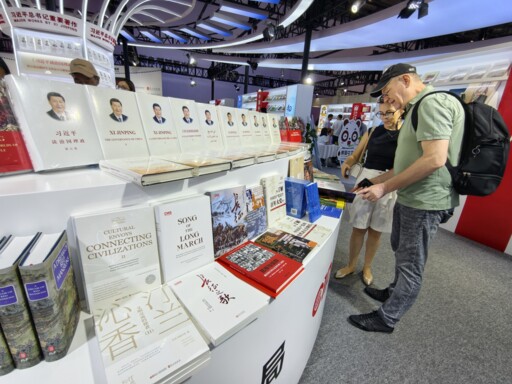
At the 32nd Beijing International Book Fair, foreign readers browse through foreign-language editions of books on Xi Jinping Thought on Socialism with Chinese Characteristics for a New Era. Photo: Duan Danjie/CSST
The 32nd Beijing International Book Fair (BIBF), held at the China National Convention Center from June 17 to 21, drew publishers, scholars, and copyright managers from countries and regions around the world. Behind the packed schedule of book launches, strategic agreements, and academic dialogues, a broader transition has taken shape: After long relying on “sailing abroad on borrowed vessels,” Chinese academic publishing is entering a new stage of “building its own vessels to sail overseas.”
Disseminating China’s independent knowledge system
Ma Rujun, Party Secretary and president of Foreign Languages Press, noted that in recent years, a growing body of multilingual thematic publications has created a strong platform for communicating China’s core intellectual narratives overseas. These titles include the Series on Studying Xi Jinping Thought on Socialism with Chinese Characteristics for a New Era, the Research Series on the Chinese Dream and China’s Development Path, the Understanding China series, Revitalization Library, and Stories of Xi Jinping and Poverty Alleviation in China. Together, they have sustained considerable interest among international readers.
Beyond thematic publishing, Chinese scholarship in philosophy and the social sciences is also making collective headway in going global. The 2026 Research Report on the Influence of Chinese Books in Overseas Library Holdings, released on the opening day of the BIBF, showed that overseas libraries permanently added nearly 1,000 more Chinese-language titles in 2025 than in 2024. The 30 publishing houses responsible for roughly 90% of that increase were concentrated mainly in the humanities and social sciences—long the most internationally competitive segment of Chinese publishing.
Through interviews conducted at the fair, CSST found that, as China advances its independent knowledge system in philosophy and the social sciences, research is expanding from broad studies of Chinese history into specialized histories, regional and country studies, and histories of cultural exchange. Accessible humanities works with genuine scholarly depth are also emerging as a new growth area for Chinese academic publishing overseas.
Gu Qing, Party Secretary and executive director of The Commercial Press, stressed that during the 15th Five-Year Plan period (2026–30), taking Chinese academic works overseas should not be treated merely as a technical exercise in “going global.” The deeper objective, he said, is to build China’s independent knowledge system so that Chinese culture and ideas can exert substantive influence across the international community.
“Academic publishing embodies the highest intellectual and cultural attainment of a country,” Yin Tao, editor-in-chief of Zhonghua Book Company, told CSST. High-standard translation and scholarly introduction, he added, can help Chinese academia reach the wider world and present an authentic, multidimensional, and intellectually profound picture of Chinese scholarship.
New models for international cooperation
The launch event for translated works under the China’s Independent Knowledge System program, hosted by China Social Sciences Press (CSSP) during the BIBF, attracted considerable attention from both academic and publishing circles. Myriam Poort, vice president of Humanities Books Publishing at Springer Nature Group, said the publisher would draw on its global distribution network to bring outstanding Chinese research in archaeology, history, and other fields to a wider international scholarly audience—making it more likely to be read, discussed, and cited, while promoting mutual understanding among civilizations through the exchange of knowledge.
Agnes Belotel-Grenié, editor-in-chief of French-language books at Canada’s Royal Collins Publishing Group, described the painstaking work behind the translation process. Chinese and French experts repeatedly deliberated over how best to convey culturally specific concepts such as lizhi (ritual systems) and tianxia (all under Heaven), sometimes spending hours debating the rendering of just one or two terms.
Their experience reflects a broader upgrade in the international cooperation model adopted by China’s academic publishing industry. Ji Weimin, Party Secretary and president of CSSP, summarized the approach as “content plus channels.” Chinese publishers provide high-quality scholarly content that has undergone rigorous peer review, while their foreign partners contribute professional marketing expertise and established international distribution networks.
“This cooperation model has proven an effective pathway for Chinese culture to go global,” Li Yanling, director of the International Publishing Branch at the Social Sciences Academic Press (SSAP), told CSST. To date, SSAP has established stable, long-term strategic partnerships with more than 100 leading overseas publishers and academic research platforms. This extensive network reaches mainstream scholarly communities in Europe and North America while also extending across Asia, Africa, and Latin America.
Gu added that The Commercial Press has formed strategic partnerships with major academic publishers including Oxford University Press, Cambridge University Press, and Taylor & Francis, helping to introduce outstanding Chinese scholarly works to readers worldwide.
From ‘going global’ to ‘integrating into global discourse’
In the digital era, digital publishing has become an indispensable part of bringing Chinese scholarship to international audiences. Digital databases such as the Chinese Social Science Library developed by China Social Sciences Press and the Zhonghua Book Company’s Database for Chinese Classic Ancient Books are evolving into digital humanities brands with Chinese characteristics, an international outlook, and growing academic influence. Once overseas university libraries subscribe, faculty and students can immediately search and cite both collated ancient Chinese texts and cutting-edge academic monographs from China.
Ji emphasized that China’s publishing sector must establish a data-driven model of targeted international communication while proactively participating in—and ultimately helping shape—international standards. Only then, he argued, can the industry move beyond merely “going global” toward “penetrating overseas markets” and “integrating into global discourse,” thereby elevating the worldwide influence of Chinese culture and scholarship.
Yin proposed that academic works be released simultaneously in Chinese and English, and that joint Chinese–foreign publishing arrangements and dual editor-in-chief systems should be established. More fundamentally, he argued, publishers must move beyond a print-centered mindset and embrace knowledge-graph-based dissemination, using data-driven knowledge systems to amplify the global impact of Chinese theories and culture.
Gu called on Chinese scholars and publishers to participate more actively in international public academic discussions, draw on mature overseas publishing systems to support localized operations and effective communication, and improve both the scholarly quality of original works and the quality of foreign-language translation. These efforts, he said, would help break down the cultural barriers that continue to limit the international circulation of Chinese scholarship.
Editor:Yu Hui
Copyright©2023 CSSN All Rights Reserved