


CASS releases provisional guideline on AI-assisted research
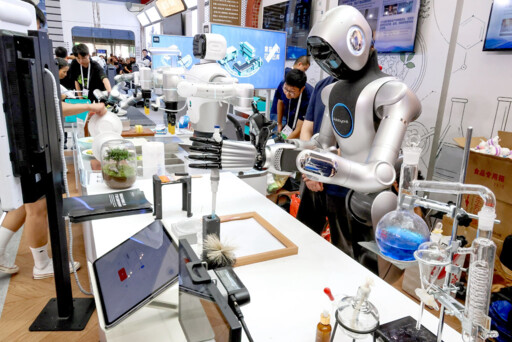
A robotic lab technician co-developed by Robbyant (an embodied AI company based in Shanghai) and Zhongshan Hospital (affiliated with Fudan University), on display at the 2026 World Artificial Intelligence Conference in Shanghai, China, July 19 Photo: IC PHOTO
Artificial intelligence (AI) is becoming embedded throughout the research process in philosophy and the social sciences, opening new possibilities for improving both quality and efficiency while also presenting a range of practical and ethical challenges. To address both sides of this transformation, the Chinese Academy of Social Sciences (CASS) recently issued the Basic Norms for AI-Assisted Scientific Research (Trial). Comprising 37 provisions across six chapters—General Provisions, Scope of Application, Prohibited Practices, Oversight and Management, Support Services, and Supplementary Provisions—the document delineates clear boundaries for AI use, establishes standards for responsible practice, and builds a system of safeguards. In doing so, it lays out an actionable and scalable institutional pathway for human–machine collaborative research.
Aligning scholarship with the times
In recent years, China has introduced a series of national policies to promote the use of AI in philosophy and social sciences research. Notably, the Opinions of the State Council on Deepening the Implementation of the “AI Plus” Initiative, issued in 2025, called for philosophy and social sciences research to transition toward human–AI collaborative models. In 2026, five government ministries, including the Ministry of Education, jointly released the Action Plan for “AI Plus Education,” encouraging the development of domain-specific AI agents and intelligent tools tailored to diverse research scenarios across the humanities, sciences, and engineering.
Tang Xiaofeng, chair of the Bureau of Scientific Research Management at CASS, told CSST that AI has already permeated virtually every stage of the research process. Researchers in philosophy and the social sciences, he argued, should respond to this broader shift by actively exploring new paradigms of AI-assisted research. CASS, as the premier institution guiding innovation in philosophy and the social sciences nationwide, has a corresponding responsibility to translate macro-level national policies into practical, ground-level protocols for researchers and to address the bottlenecks and difficulties arising from human–AI integration.
The formulation of the Norms, Tang emphasized, exemplified rigorous scientific and democratic decision-making. From inception to release, the process involved comprehensive field surveys, interdisciplinary drafting and deliberation, multiple rounds of opinion solicitation and textual revision, and a pilot implementation phase to ensure transparency and broad participation. The issuance of the guideline marks both a concrete response to national strategic directives and a pragmatic step by CASS to address emerging challenges in the evolving research landscape in line with its institutional mandate.
Upholding ‘people-centered’ foundation
The Norms explicitly define four cardinal principles that AI-assisted research should follow. First and foremost is human leadership with intelligent assistance—that is, “human direction, intelligent support.” Researchers remain the primary agents of academic reflection, research practice, and theoretical innovation, while AI serves as an important auxiliary tool. Any AI-generated content must be reviewed and approved by the user, who bears ultimate responsibility for it. At the same time, the Norms support and encourage active exploration and practical innovation in AI-assisted research, recognize the positive role AI can play in supporting scholarship, and promote a new research paradigm characterized by human leadership, intelligent assistance, and human–AI integration.
The second principle is quality enhancement and efficiency improvement. With the goal of improving research quality and productivity, researchers are encouraged to make active use of AI in routine and auxiliary tasks, thereby unlocking academic potential and promoting innovation in key fields.
The third is faithful disclosure. Whenever AI-generated content is used in research and contributes to outcomes, researchers must fully and truthfully disclose the name and version of the tool, the stages at which it was used, and the content it generated. They must also retain prompts, original inputs and outputs, and other process records to ensure that the use of AI remains traceable and verifiable.
The fourth is security and compliance. AI-assisted research must strictly comply with national regulations concerning cyber security, data security, confidentiality, intellectual property, research integrity, and science and technology ethics. Researchers must also take rigorous precautions against data leaks, technological loss of control, and ethical misconduct.
Tang noted that “human leadership with intelligent assistance” forms the core and logical starting point of the Norms as a whole. He added that the document is not intended to restrict the use of technology. Rather, by clarifying boundaries and addressing researchers’ concerns, it aims to encourage them to make effective use of AI and thereby release greater research productivity.
AI has a wide and expanding range of legitimate applications within scientific research. The Norms identify 11 categories of AI-assisted research scenarios: topic selection and assessment, research design, knowledge synthesis, investigative research, experimental research, archaeological excavation and cultural heritage conservation, refinement of research outputs, review and evaluation, interdisciplinary integration, academic communication, and international scholarly exchange.
These categories grew out of real research cases gathered in earlier institution-wide surveys and were deliberately designed with two practical considerations in mind. First, they cover the entire research process, clearly defining the boundaries of appropriate AI use and providing researchers with a practical framework for reference. Second, they offer concrete operational guidance tailored to the differing research modes of the humanities, social sciences, and interdisciplinary fields, reducing the ambiguity and implementation difficulties that might arise from overly general provisions.
Tang then highlighted four especially common applications, beginning with topic selection and assessment at the initial stage of research. AI can assist with retrieving cutting-edge literature, mapping research directions, and identifying emerging issues and frontier trends, thereby supporting the preliminary evaluation of a research topic. Decisions about the value of the topic, the formulation of the research question, and the explanation of its significance, however, must be made independently by the researcher.
The second common application is knowledge synthesis. AI can help aggregate large bodies of literature, extract summaries, trace intellectual developments, and generate knowledge graphs. However, the deeper interpretation of a text’s ideas and the logical synthesis of its arguments, he explained, must nevertheless remain the responsibility of the researcher.
For interdisciplinary research, Tang stressed that major real-world issues increasingly require collaboration across multiple disciplines. In this domain, AI can assist in tracking developments in different fields, integrating relevant resources, and addressing complex problems that cannot be adequately resolved within the confines of a single discipline.
In academic communication and international exchange, Tang added that AI can adapt content to different audiences and communication settings, helping to render scholarly theories more accessible, produce visual materials, and support multilingual translation. Researchers must still verify specialized terminology, ensure the accuracy of theoretical formulations, and review the substantive positions presented to international audiences.
Given the rapid iteration of AI technologies and the continuous emergence of new tools and scenarios, no fixed set of provisions can cover every form of research practice. In addition to the 11 explicitly enumerated scenarios, the Norms therefore include open-ended clauses, encouraging researchers to keep pace with AI development, judiciously employ frontier technologies to explore applications suited to their fields, and continually enrich the practical forms of AI-enabled research.
Unconstrained use of technology, however, can give rise to academic misconduct and create serious security risks. The Norms therefore set out 10 prohibited practices, organized around four dimensions. The first dimension involves prohibitions aimed at ensuring political direction and ideological standards are upheld. The second is concerned with safeguarding data security and confidentiality. The third involves the domain to which the Norms devote the greatest attention and the strongest warnings—preventing academic misconduct and protecting the fundamental standards of research integrity. Surveys indicate that academic misconduct arising from the misuse of AI is becoming increasingly common, posing a grave threat to scholarly integrity. Research integrity is the foundation of academic inquiry. Once that foundation is breached, research outputs lose their scholarly value and the wider academic environment is seriously damaged. The fourth dimension is to prevent the waste of research resources and curb formalistic practices in academic work.
Balancing constraint with empowerment
The overall institutional design of the Norms adheres to the principle of balancing constraint with empowerment and unifying regulation with development. The document not only establishes systems and rules, but also builds platforms, optimizes services, and promotes further development.
On one hand, it creates a tiered oversight and management mechanism, explicitly assigning responsibilities at four levels to balance collective governance, team-based control, and individual self-discipline. At the first level, research management units bear primary institutional responsibility. At the second, project leaders and organizers of academic activities are responsible for oversight. At the third, academic advisors perform a supervisory role, while at the fourth, individual users bear lifelong primary responsibility for their own use of AI—the most central and direct level of accountability.
On the other hand, issuing restrictive provisions without adequate supporting measures could easily leave researchers with the impression that the Norms impose limitations without providing assistance. This could foster reluctance and ultimately hinder the adoption of human–AI collaborative research models. The Norms therefore devote an entire chapter to support services, addressing six areas intended to help researchers use AI confidently, competently, and effectively.
First, the Norms support the development of infrastructure for AI-assisted research, including an integrated innovation platform combining computing power, algorithms, data, models, and security. Second, they support innovation in research evaluation mechanisms centered on research teams, encouraging the use of AI to produce high-quality interdisciplinary outputs. Third, they promote the integrated development of “AI plus disciplines,” strengthen emerging interdisciplinary fields such as digital humanities and computational social science, while advancing the digital and intelligent transformation of traditional disciplines. Fourth, they support the development of high-quality databases and case repositories for philosophy and the social sciences, encouraging open sharing within secure and controllable parameters. Fifth, they support collaborative AI-assisted research projects across institutions, disciplines, and fields, including the development of specialized models for particular academic domains. Sixth, they support the establishment of curricula and instructional materials for AI-assisted research in philosophy and the social sciences, with the aim of cultivating composite talent equipped with both humanistic literacy and AI expertise.
Exploring new paradigm for AI-assisted research
Tang emphasized that AI technology is developing rapidly, while regulatory and auditing mechanisms for AI-assisted research remain at an exploratory stage both in China and abroad. It would therefore be unrealistic to attempt to establish a rigid and permanent set of rules at this point. The present Norms represent only the beginning of CASS’s exploration of AI-assisted research. Their long-term goal, he said, is to unleash vitality, establish clear rules, and put new research paradigms into practice.
Looking ahead, Tang said that CASS will revise the Norms in close alignment with national legislation and evolving policies on AI governance, dynamically monitor their implementation, and continue refining their content. He added that CASS will also engage actively with the broader national philosophy and social sciences community to solicit feedback, working toward the gradual establishment of unified standards for AI-assisted research across Chinese academia.
CASS’s goal extends beyond simply regulating the use of AI tools. With the Norms as an institutional foundation, it will continue exploring new forms of academic research suited to the intelligent era, Tang added.
Editor:Yu Hui
Copyright©2023 CSSN All Rights Reserved