


Global journey of Chinese academic publications
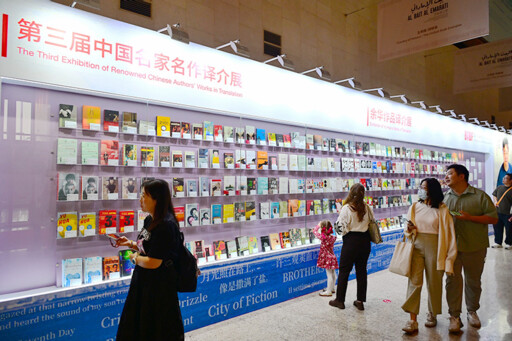
Visitors from China and abroad visit the Exhibition of Yu Hua’s Works in Translation at the Third Exhibition of Renowned Chinese Authors’ Works in Translation during the 32nd Beijing International Book Fair in Beijing, June 19, 2026. Photo: IC PHOTO
In August 2025, the English edition of A New History of World War II, compiled by the Institute of World History at the Chinese Academy of Social Sciences, was launched in Athens, Greece. Over the past year, this landmark academic volume centering on the Eastern theatre and breaking the Western-centric narrative has garnered wide recognition among Western scholars, with translations into Russian, Spanish, German, French, Arabic, and other languages underway.
The book’s international success is far from an isolated case. It vividly reflects the broader transformation in the global outreach of Chinese academic publications in recent years—from sporadic releases by individual authors and publishers to a coordinated, system-wide strategy on a much larger scale. With support from national cultural communication programs such as the National Social Science Fund’s Chinese Academic Translation Project, the Classic China International Publishing Project, and the Silk Road Book Publishing Project, Chinese universities and research institutes are accelerating the international dissemination of original academic research.
From scale expansion to quality upgrade
Xu Baofeng, dean of the College of Sinology and Chinese Studies at Beijing Language and Culture University and head of the secretariat for the Special Program Office of the Central Publicity Department’s Asia Classic Works Translation Initiative, said the systematic development of multiple national translation and publishing programs has comprehensively upgraded the global outreach of Chinese academic works. The focus has shifted from popularizing Chinese culture to pursuing substantive academic exchange, while topic selection has become increasingly systematic and research findings are reaching publication more quickly.
By the end of 2024, the Chinese Academic Translation Project had provided translation and publication grants for nearly 2,000 academic monographs, spanning fields such as traditional classics, theoretical works, contemporary governance, regional development, mutual learning among civilizations, and others. The Classic China International Publishing Project and the Silk Road Book Publishing Project have also helped more than 1,000 China-themed books enter mainstream overseas distribution channels. Publishing in series, by theme, and according to systematic plans have become prevailing models, enabling large numbers of original Chinese monographs to undergo standardized translation into foreign languages. This has begun to reverse the long-standing imbalance of “abundant research output yet limited global circulation, with scarce high-quality translated works.”
In international publishing cooperation, Chinese academic publishers have developed a mature, proven model of partnering with established international platforms to reach global markets. Li Yanling, director of the International Publishing Division at the Social Sciences Academic Press, told CSST that the press has established long-term, stable strategic partnerships with more than 100 prominent overseas publishing institutions and academic research platforms. These partnerships form a multidimensional network encompassing mainstream academic circles in Europe and North America while extending across Asia, Africa, Latin America, and other regions. Wang Yan, director of the Overseas Cooperation Department at Peking University Press, added that in-depth cooperation with internationally renowned institutions such as Cambridge University Press and Brill has brought a series of landmark academic works to readers worldwide.
Digital transformation has opened new avenues for academic communication. Li Tang, head of the Chinese collection at the University of Southern California Libraries, explained that overseas libraries have moved decisively toward digital acquisitions, with e-books generally taking precedence over print copies whenever both are available. Databases such as the Chinese Social Science Library, developed by China Social Sciences Press (CSSP), and Zhonghua Book Company’s Database for Chinese Classic Ancient Books are helping to build distinctive academic resources in the humanities with Chinese characteristics, a global outlook, and strong scholarly influence.
From interpreting China to China providing interpretive frameworks
A growing number of Chinese academics have come to recognize that earning genuine respect within global academia requires moving beyond established Western research frameworks and grounding their scholarship in local historical materials and original Chinese theories.
He Mingxing, a professor from the School of International Journalism and Communication at Beijing Foreign Studies University, said Western academics have long relied on secondary literature when studying many China-related topics, often reaching conclusions that diverge from the historical record. The core comparative advantage of Chinese scholars, he argued, lies in their deep knowledge of original Chinese archives and firsthand local sources.
Li Tang agreed, noting that international scholars place a high value on rare primary archives and raw empirical data. Research based on such materials and approached through innovative analytical lenses is therefore especially likely to attract attention and citations from mainstream international academia.
Chinese academics and publishers are also taking greater initiative in setting research agendas, making academic exchanges more effective. “Seminars between Chinese and foreign scholars centered on relevant themes simultaneously promote Chinese academic outputs and facilitate in-depth exchanges of scholarly viewpoints and profound inter-civilizational dialogue,” said Ji Weimin, Party secretary and president of CSSP.
Another avenue through which Chinese scholarship is gaining international traction is the use of rigorous academic analysis to address shared global concerns and contemporary challenges. A team led by Zhou Guanghui, a professor from the School of Public Administration at Jilin University, authored Paired Assistance: China’s Governance Experience for Large Countries, which examines the worldwide challenge of governing a country on an exceptionally large scale. The book was selected for both the Classic China International Publishing Project, which is supporting its English edition, and the Silk Road Book Publishing Project, which is supporting its Kazakh edition. Zhou emphasized that academic research must identify issues of common concern to Chinese and international scholars, ground its analysis in China’s practical experience and millennia-old civilization, and draw on independent Chinese academic discourse to tell the shared story of humanity’s journey toward modernization.
From ‘going global’ to ‘taking root overseas’
Despite these notable achievements, Chinese academic publications still face several systemic obstacles as they seek to progress from merely “going global” to truly “taking root overseas.” Xu identified four structural shortcomings that constrain high-quality international dissemination: an imbalanced pool of translation professionals, insufficient ability to adapt discourse to foreign cultural contexts, fragmented communication value chains, and disjointed mechanisms for collaboration between Chinese and foreign academic communities.
To address these challenges, scholars have identified targeted, region-specific forms of expression as essential to improving communication effectiveness. Wu Bo, a professor from the English Department at China Foreign Affairs University, noted sharp regional differences in the reception of Chinese academic works. In Europe and North America, sinologists form the core audience and are particularly interested in Chinese classics, history, and philosophy. Officials, academics, and international students in Africa, Southeast Asia, Latin America, and other parts of the Global South, by contrast, show considerably greater interest in China’s development experience and governance models, as well as a stronger desire to study and draw lessons from them. Communication strategies must therefore be differentiated and adapted to the needs of audiences in each region.
He Mingxing argued that building systematic cross-border communication networks and institutional mechanisms is indispensable to high-quality global outreach. Global distribution and sales systems must be improved so that they can serve overseas readers more precisely. Publishing houses should therefore recruit specialists familiar with the cultures and market regulations of different regions, commission manuscripts and develop publication plans tailored to Global South countries, and expand cooperation on overseas copyright licensing. Together, these measures would substantially enhance publishers’ capacity for localized operations.
Today, Chinese scholarship is helping reshape global knowledge production on an unprecedented scale and with unprecedented depth. At the forefront of this transformation is a growing cohort of Chinese scholars equipped with firsthand archival materials, original theoretical frameworks, and a strong sense of cultural confidence.
Editor:Yu Hui
Copyright©2023 CSSN All Rights Reserved