


Beautiful China initiative makes considerable headway
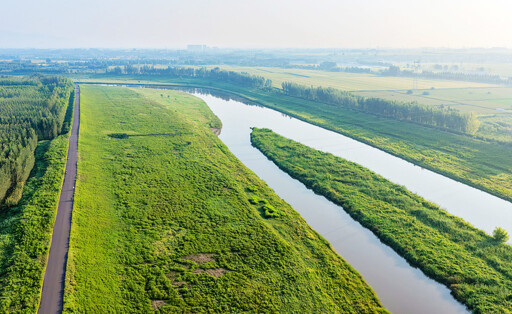
Wetland scenery along the northern section of the Fenhe River in Xiangfen County, Linfen City, Shanxi Province, Aug. 16, 2026 Photo: CFP
Since the 18th CPC National Congress, under the strategic guidance of Xi Jinping Thought on Ecological Civilization, notable strides have been made in building a Beautiful China, marking a historic leap from “overall planning and layout” to “fundamental improvement.” Statistics provide compelling evidence of this miraculous green transformation.
In 2026, the average concentration of PM2.5 in Chinese cities at the prefecture level and above fell by more than 50% from 2013 levels. More than 90% of monitored surface-water sections had good-quality water, while China’s installed renewable-energy capacity remained the world’s largest. Zhang Yongsheng, director general of the Research Institute for Eco-civilization at the Chinese Academy of Social Sciences (CASS), said China’s own experience has demonstrated that harmony between humanity and nature can be achieved through green and low-carbon development.
The Three-North Shelterbelt Forest Program forms a “green Great Wall” protecting China’s vast territory from wind and sand. Minqin in northwest China’s Gansu Province shines like a radiant pearl in this green barrier. Today, the “Come Plant a Tree in Minqin” campaign has grown into a nationally prominent ecological brand, drawing tens of thousands of volunteers from across the country. The “Internet-based nationwide voluntary tree planting” model has substantially mobilized social resources and grassroots ingenuity.
Since the 18th Party Congress, Xi Jinping, general secretary of the CPC Central Committee, has made four inspection trips to Shanxi Province in north China, issuing a series of important instructions, including calls to make the Fenhe River “plentiful in water, good in water quality, and beautiful in scenery.” Zhang Yunfei, a research fellow from the National Academy of Development and Strategy at Renmin University of China, described the governance of the Fenhe River as a landmark project for improving people’s well-being—from ecological water replenishment to maintain the river’s base flow, to improving water quality and safeguarding drinking water, and creating ecological spaces for public recreation.
Southeast China’s Fujian Province has maintained the country’s highest forest-coverage rate for 47 consecutive years, while 100% of its major river basins meet good-quality water standards. Luo Xianyu, deputy dean of the College of Marxism at Fujian Agriculture and Forestry University, said that for more than two decades, Fujian has aligned its thinking and actions with the CPC Central Committee’s decisions and arrangements for ecological civilization development. The province’s experience vividly demonstrates the theoretical and practical power of Xi Jinping Thought on Ecological Civilization.
In Beijing, residents increasingly find that air-quality apps on their phones issue far fewer alerts, while “sharing photos of blue skies” has become commonplace on social-media feeds. In Yucun Village, Anji, Zhejiang Province in east China, former limestone quarries that once reverberated with machinery have been transformed into lush ecological resorts, where more than 8,000 cups of coffee are sold on peak days. Huang Chengliang, secretary general of the Research Center for Xi Jinping Thought on Ecological Civilization at CASS, said China’s ecological governance has undergone a profound shift from “passive defence” to “active reconstruction.” The “Two Mountains” theory, which holds that “lucid water and lush mountains are invaluable assets,” has recast ecological protection from a developmental “cost item” into a “capital item.” Through institutional and technological innovation, this approach has created incentives that reward ecological protection while requiring those who damage the environment to bear the costs.
Achievements in Minqin, along the Fenhe River, across Fujian, and elsewhere have powerfully challenged the view that “environmental protection and economic development are mutually exclusive.” Luo said that, guided by Xi Jinping Thought on Ecological Civilization, ecological advantages in many parts of China are gradually being transformed into economic advantages, creating a green, circular path toward Chinese modernization.
The steady progress of ecological civilization development in the new era owes much to an increasingly stringent institutional framework. From forceful central inspections of ecological and environmental protection and binding evaluation and accountability mechanisms, to the full implementation of river-lake chief and forest-chief systems that assign custodians to every river and forest, and the enactment of the Ecological Environment Code, which brings ecological civilization development more fully under the rule of law, a mature institutional system has taken shape—one characterized by strict prevention at the source, rigorous oversight throughout the process, and severe penalties for violations.
Guided by the principle that mountains, rivers, forests, farmlands, lakes, grasslands, and deserts form a community of life, China has coordinated a series of major ecological protection and restoration projects. Ecological protection red lines have been demarcated and strictly enforced, while a system of protected areas centered on national parks is taking shape at an accelerated pace. Campaigns to protect blue skies, clear water, and clean soil have yielded remarkable results. China’s national forest coverage rate has risen to 25.09%. The main streams of the Yangtze and Yellow rivers have consistently maintained Grade-II water quality. Wild populations of rare species have continued to recover, and ecological protection and restoration work has been completed across more than 120 million mu (roughly 80,000 square kilometers) of land.
Xi Jinping Thought on Ecological Civilization has not only profoundly transformed China but also injected strong momentum into global ecological governance. China actively advocates for building a shared future for all life on Earth. It took the lead in releasing its National Plan on the Implementation of the 2030 Agenda for Sustainable Development, promotes the full and effective implementation of the United Nations Framework Convention on Climate Change and the Paris Agreement, and continues to contribute Chinese approaches to biodiversity conservation and climate change response. Successful practices drawn from “China’s governance experience,” such as “ecological protection red lines” and the “life community,” have been incorporated into international consensus within the global sustainable development agenda, marking a theoretical leap from “China’s governance practice” to “global wisdom.”
Editor:Yu Hui
Copyright©2023 CSSN All Rights Reserved