


How AI facilitates high-quality academic development
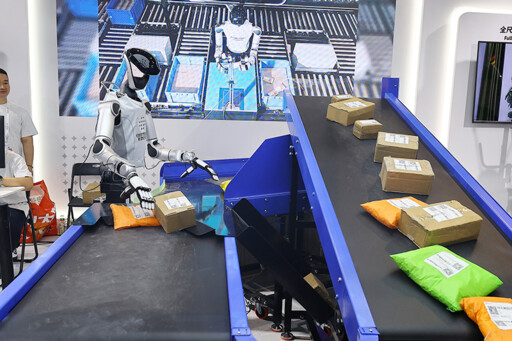
A parcel-sorting robot developed by Chinese embodied intelligence company ROBOTERA, on display at the Embodied Intelligence Hall of the 2026 World Artificial Intelligence Conference in Shanghai, July 19, 2026 Photo: CFP
Since the convening of the 2026 World Artificial Intelligence Conference and the High-Level Meeting on Global AI Governance, discussions surrounding advances in artificial intelligence (AI), global governance, and human subjectivity have continued to intensify. With these questions drawing increasing attention, CSST spoke with several scholars about how AI can contribute to knowledge discovery, how its outputs can withstand academic scrutiny, and how it can support the development of China’s independent knowledge system in philosophy and the social sciences.
Machines move to front end of knowledge production
In July, Fudan University, the Shanghai Academy of AI for Science, and Nature Research Intelligence, an AI-led service helping research decision-makers under Springer Nature, jointly released the report “AI for Science 2026.” The report shows that AI is already widely used in research for gathering materials and presenting findings and is increasingly extending into analysis and judgment.
Shen Si, a professor from the School of Economics and Management at Nanjing University of Science and Technology, noted that the key development is not simply that models “can perform more tasks,” but that machines are moving beyond back-end work such as retrieval, classification, and statistics into problem decomposition, material organization, and preliminary interpretation.
Within philosophy and the social sciences, AI has moved beyond data entry and literature retrieval into organizing historical materials, establishing knowledge connections, identifying research questions, and cross-verifying evidence. Wang Dongbo, a professor from the College of Information Management at Nanjing Agricultural University, described the change as a reorganization of research materials: Ancient texts, archives, and academic papers are no longer solely for human reading but are also becoming computable, linkable, and traceable resources. Wang cited a large language model (LLM) specialized in ancient texts relating to renowned Confucian philosopher Xunzi as an example, noting that it can perform intelligent indexing, information extraction, automatic punctuation, classical Chinese translation, and reading comprehension.
At the Institute of Ethnology and Anthropology at the Chinese Academy of Social Sciences (CASS), the “Longshui Character Recognition System” now covers over 10 writing systems, including Tangut, Uyghur, Manchu, Tibetan, and Yi scripts, and its associated platform has recorded over 100,000 cumulative uses. The Qinghai–Xizang Plateau Cultural Knowledge Base compiles and correlates more than 800,000 records. Scattered and difficult-to-decipher materials are thus gradually being transformed into searchable, comparable, and verifiable research resources. Long Congjun, a research fellow at the institute, noted that machines do not draw conclusions for scholars; rather, their value lies in dismantling barriers between source materials and making connections among language, culture, mentality, and behavior accessible to research and cross-validation.
AI-generated outputs face academic scrutiny
As machines move further upstream in the knowledge production process, how should their outputs acquire epistemological validity? Yin Jie, Party secretary of Shanxi Normal University, argued that content generated by LLMs is better regarded at present as “data in a preliminary form of knowledge” and should not be granted the status of established knowledge without scrutiny. Yin described the transformation in knowledge production as a shift from “production and validation” to “generation and recognition”: AI generates texts, datasets, and candidate hypotheses, while the academic community is responsible for examining, questioning, and verifying them. For a hypothesis to attain scientific standing, it must demonstrate both factual validity and explanatory power while also showing what new knowledge it contributes.
Yan Hongxiu, a professor from the School of Marxism and the School of History and Culture of Science at Shanghai Jiao Tong University, argued that AI-assisted research must pass four key tests: Source materials must have reliable provenance and proper authorization, methods must preserve records of model versions and human intervention, results must be cross-validated against independent data and real-world investigations, and responsibility must be assigned to the specific actors involved in selecting research questions, adopting conclusions, and publishing findings.
Gao Qiqi, a professor from the School of International Relations and Public Affairs at Fudan University, observed that as the capabilities of LLMs rapidly improve, academic evaluation should place greater emphasis on whether research questions are original, source materials are solid, methods are transparent, and conclusions can explain real-world phenomena.
Research methodology shifts toward human–machine collaboration
Turing Award laureate and American computer scientist Jim Gray categorized scientific discovery into four paradigms: the empirical paradigm, which identifies patterns through observation and experimentation; the theoretical paradigm, which explains the world through laws; the computational paradigm, which relies on computer simulation; and the data-intensive paradigm, which searches for patterns in massive datasets.
Zhou Aoying, founding dean of the School of Data Science and Engineering at East China Normal University, held that the data-intensive paradigm expands the boundaries of conventional reductionist research and increasingly blurs the boundaries between the natural and social sciences.
Liu Tieyan, president of Zhongguancun Academy and chairman of the Zhongguancun Institute of Artificial Intelligence, described AI for Science as the “fifth paradigm” of scientific discovery. Under this paradigm, AI progresses beyond data processing and pattern recognition to pose research questions, formulate candidate hypotheses, compare research pathways, and design verification protocols.
Changes in methodology also demand changes in research organization. Liu Wei, director of the Information Research Institute at the Shanghai Academy of Social Sciences, suggested that future research teams will increasingly be organized around major research questions, bringing disciplinary scholars, data engineers, model developers, and ethics and legal experts into the same research process.
According to Xiao Lisheng, a research fellow from the Institute of World Economics and Politics at CASS, seven modules operate simultaneously within the institute’s Laboratory for Global Macroeconomic Forecasting and Policy Simulation. The “Ecopolis 2.0” knowledge repository has collected and parsed more than 1.2 million articles, reports, and policy documents from over 1,200 sources and tracks more than 300 think tanks worldwide each day.
Yu Jianxing, director of the Academy of Social Governance at Zhejiang University, characterized the bidirectional interplay between AI and philosophy and social science research as a relationship of “mutually defining frontiers”: Engineering delineates what is technically possible, while philosophy and the social sciences address what is normatively acceptable.
Zhao Puguang, a professor from the College of Liberal Arts at Jinan University in Guangdong Province, warned that when documents are converted into data streams, some of the historical context, atmosphere, emotion, and situational information embedded in their original form may be diminished. “Distant reading” can enable macro-scale mapping, he noted, but it must remain grounded in “close reading” and immersive scholarly reflection.
Guo Taihui, a professor from the School of Ethnology and Sociology at Yunnan University, emphasized that for Chinese knowledge to explain reality and participate in global dialogue, genuine research questions must emerge from Chinese practice, reliable materials must provide the basis for evidence, and experience must be elevated into theory through indigenous concepts and rigorous argumentation.
Zha Jianguo, Zhu Gaolei, Chen Lian, Wang Guanglu, Li Yongjie, Chen Yajing, and Zhang Sai contributed to this story.
Editor:Yu Hui
Copyright©2023 CSSN All Rights Reserved