


A clear-eyed look at development of BCI economy
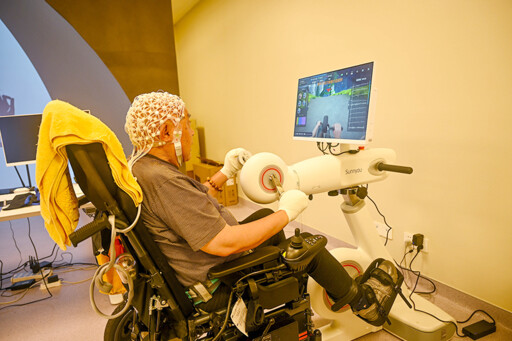
A patient receives brain-computer interface rehabilitation training at Beijing Jishuitan Hospital (Guizhou Hospital) in Guiyang, Guizhou Province, on Aug. 26, 2026. Photo: CFP
In 2026, brain–computer interfaces (BCIs) were included for the first time in China’s government work report, alongside future energy, quantum technology, embodied intelligence, and 6G as future industries to be cultivated. The National Healthcare Security Administration has established dedicated projects for BCI technology, while seven ministries, including the Ministry of Industry and Information Technology, have issued implementation guidelines for industrial innovation and development. China’s first industry standard for BCI medical devices has also officially taken effect.
Capital and markets have responded swiftly. Data from the China Center for Information Industry Development shows that China’s BCI market reached 3.2 billion yuan (approximately $0.48 billion) in 2024, up 18.8% year-on-year, and is projected to reach 5.58 billion yuan by 2027. Major cities including Shanghai, Beijing, Hangzhou, and Shenzhen are leveraging local strengths in scientific research, clinical practice, engineering, and industrial chains as they compete for a foothold in this emerging industry ecosystem.
As this interdisciplinary field accelerates toward industrialization, how much commercial potential does the emerging “BCI economy” really hold? And where should the line be drawn between technological breakthroughs, ethical governance, and the fervent expectations of capital? To explore these questions, CSST spoke with a number of experts and scholars.
From lab breakthroughs to national strategy
BCI development in China is no longer characterized by isolated breakthroughs, but by progress across the entire chain—from chips and algorithms to systems, standards, and clinical and engineering applications. The “Shengong” series, for example, developed by the team led by Ming Dong, vice president of Tianjin University and head of the university’s Haihe Laboratory of Brain–Computer Interaction and Human–Machine Integration, has produced demonstrable results in clinical BCI-assisted rehabilitation, brain-function assessment and modulation, and even brain–computer interaction in space.
Ma Yide, dean of the School of Intellectual Property at the University of Chinese Academy of Sciences, stated that restorative BCIs hold the greatest short-term potential for commercialization in medical rehabilitation, assistance for people with disabilities, and the treatment of neurological disorders. Over the medium to long term, BCIs may converge with embodied intelligence, intelligent robotics, and digital healthcare, becoming an important force shaping the global economic landscape.
Two major technical approaches define BCIs today: invasive and non-invasive. Ming argued that China should build on its own strengths and application needs while advancing both approaches in parallel. “Invasive BCIs,” he explained, “deliver unique value for targeted disease treatment and high-precision research, while non-invasive solutions offer safety, convenience, and reusability, promising more inclusive, broader-scale adoption and greater industrial potential.”
Li Zhen, deputy dean of the School of Marxism at Sun Yat-sen University, observed that although invasive technologies offer transformative breakthrough potential, social acceptance remains extremely low because they require craniotomy, pushing the industry toward non-invasive alternatives. The latter, however, face inherent limitations in signal precision and information throughput. Public understanding of BCI fundamentals, data rights, and usage boundaries also remains limited, giving rise to either irrational fears or inflated expectations.
Strengthening ethical norms, technical standards, legal frameworks
In February 2024, the AI Ethics Sub-Committee of the National Science and Technology Ethics Committee formulated the Ethical Guidelines for Brain–Computer Interface Research, setting out six core principles, including safeguarding health and advancing human well-being, to guide BCI research in compliance with ethical standards. Since early this year, the State Administration for Market Regulation has issued a number of recommended national standards for BCIs. In April, the China National Center for Biotechnology Development released two filing guidelines governing clinical research on invasive and non-invasive BCIs.
Yang Dong, dean of the Law School at Renmin University of China, pointed out that BCIs differ fundamentally from technologies associated with the digital and AI economies because the rights involved possess both personality-related and data-related attributes. He proposed piloting regulatory sandboxes to create controlled testing environments and build practical experience for future legislation. At the same time, dedicated legislation should establish rules for protecting neural data privacy, defining data property rights, and allocating related interests.
Li Lun, head of the Centre for Artificial Intelligence Ethics at Hunan Normal University, emphasized that invasive BCI technologies remain at the clinical trial stage and must be supported by sufficient evidence from animal experiments.
Industry data shows that more than 80% of Chinese BCI enterprises use non-invasive technologies. Consumer-grade non-invasive BCI products have already entered the education, entertainment, and health-monitoring markets, but limitations in signal fidelity remain, requiring continued advances in areas such as novel dry-electrode materials and flexible electrodes. By contrast, invasive BCIs for medical restoration remain largely confined to clinical trials; commercialization is only just beginning, and the overall market remains small.
Governance consensus has coalesced around a regulatory framework centered on risk classification. In June, the National Medical Products Administration issued the Guiding Principles for Product Classification and Definition of Brain–Computer Interface Medical Devices and the Guiding Principles for General-Name Naming of Brain–Computer Interface Medical Devices, giving institutional form to this risk-based approach. Invasive and implantable BCI medical devices are subject to the strictest Class III regulation. Non-invasive BCI medical devices intended for disease treatment, functional compensation, or rehabilitation training are also, in principle, classified as Class III. By contrast, products intended for non-medical uses—including functional enhancement, entertainment and interaction, and assistance in daily life—are not regulated as medical devices.
Editor:Yu Hui
Copyright©2023 CSSN All Rights Reserved