


Chinamaxxing: Everyday appeal of Chinese life
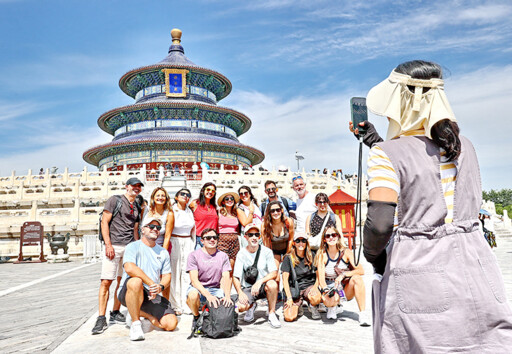
Overseas visitors posing for a group photo while visiting the Temple of Heaven in Beijing, Sept. 4 Photo: CFP
Recently, Chinese lifestyles and everyday habits rooted in traditional wellness practices have gone viral on social media overseas. Overseas netizens are trading cold drinks for hot water, soaking their feet, practicing Baduanjin (a traditional Chinese mind-body exercise consisting of eight gentle movements coordinated with breath and awareness), and tuning in to Chinese TV dramas. Under hashtags such as “Becoming Chinese” and “Chinamaxxing,” young people around the world are joining in the trend, creating content that portrays Chinese-style living through their own eyes.
Sherry Zhu, a Chinese–American content creator, regularly shares glimpses of everyday Chinese life on TikTok: wearing slippers at home, steeping goji berries in a thermos, avoiding cold salads in chilly weather, and more. Her down-to-earth clips frequently draw millions of views. For Generation Z viewers abroad, habits that seem perfectly ordinary to Chinese audiences can feel like novel discoveries, prompting comments such as, “I’ve just unlocked my Chinese identity and want to learn more life rules.” Some users even take on the role of class note-takers, summarizing key points and pairing them with playful memes as they follow along. Others simply ask where they can buy Chinese house slippers. Several overseas celebrities have also shared Chinese-style routines such as tea-making and morning exercise on Rednote and other social media platforms.
As enthusiasm for Chinese-style living grows online, the number of international visitors traveling to China is also rising. With visa-free entry expanded to more countries, online “Chinamaxxing” is increasingly spilling over into a real-world “China Travel” boom. Data from China’s National Immigration Administration shows that 22.914 million foreign nationals entered China in the first half of 2026, up more than 20% year on year; 17.815 million entered visa-free, a year-on-year increase of 30.6%. Scottish vlogger Hugh Abroad began traveling through China in late 2025, visiting Shanghai, Chengdu, Chongqing, and other cities. His first-person videos document experiences ranging from street food to ear cleaning and cupping, offering viewers a vivid sense of the cultural texture of Chinese urban life. One commenter wrote, “These authentic long-form videos are wonderful. I cannot wait to visit China.”
Katherine, an American creator who has lived in China for seven years, traveled with her parents through rural areas of southwest China’s Xizang Autonomous Region this June. Her lens captured alpine meadows and cascading waterfalls, authentic yak-meat pies, solemn ancient monasteries, retired women running restaurants for the pleasure of it, oral folk tales being shared, and the intricate details of homestay architecture. Through her immersive documentation, these modest fragments of everyday life become vivid, field-based “China stories.” In this way, the warmth of Chinese culture is being seen, felt, and experienced more directly by audiences around the world.
Zhang Zhi’an, a professor from the School of Journalism at Fudan University, observed that large numbers of non-Chinese users overseas have shifted from observers of another culture to active practitioners of Chinese lifestyles, helping create a vast ecosystem of user-generated content. Young foreign netizens share Baduanjin routines and wellness-tea recipes, associating Chinese-style living with emotional healing and relief from burnout. Their interest in traditional Chinese medicine, healthy living, and Chinese modernization is also turning online curiosity into in-person travel. These online trends are spilling over into the real world, echoing the surge in inbound tourism since 2025.
This viral online trend reflects growing appreciation among young people overseas for contemporary Chinese life and its underlying cultural logic. Chang Jiang, a professor from the School of Media and Communication at Shenzhen University, attributed the phenomenon to several factors. First, China’s growing international visibility is allowing a fuller, more authentic picture of the country to emerge through inbound travelers, ordinary overseas netizens, and short-video platforms. Second, overseas Generation Z are approaching cross-cultural understanding differently. Raised in internet culture, they are wary of didactic elite narratives, value diversity, and place greater trust in ordinary people’s footage, firsthand experiences, and tangible details of everyday life. Finally, social media has reshaped cultural flows, with cultural meaning increasingly emerging through online connections, sharing, and interaction among users rather than one-way media messaging.
Editor:Yu Hui
Copyright©2023 CSSN All Rights Reserved