


18th BRICS Summit draws keen academic attention
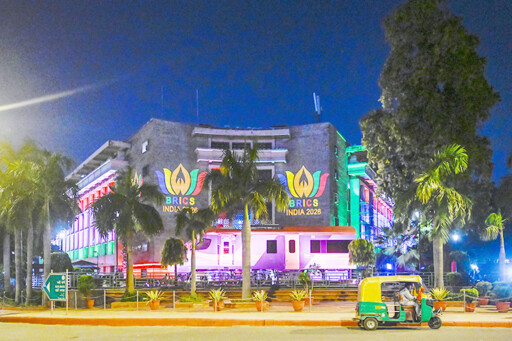
Rail Bhawan, headquarters of Indian Railways in New Delhi, is illuminated on Sept. 10, 2026, in preparation for the 18th BRICS Summit. Photo: VCG
On Sept. 12–13, Chinese President Xi Jinping attended the 18th BRICS Summit in New Delhi, India. This year marks the 20th anniversary of BRICS cooperation. Having grown from the original four countries into today’s “greater BRICS,” with 11 full members and 10 partner countries, the BRICS mechanism has become the world’s most influential platform for cooperation among emerging markets and developing countries. At this juncture between past achievements and future development, the 18th BRICS Summit has continued to draw keen attention from scholars abroad.
Representative force of the Global South
Binod Singh Ajatshatru, director of the BRICS Institute in New Delhi, said the summit’s successful convening signals the arrival of an era shaped by the Global South.
During the summit, the five initiatives China put forward for deepening BRICS cooperation—the open source and inclusive AI initiative, the trade and investment facilitation initiative, the digital industry cooperation initiative, the intelligent manufacturing cooperation initiative, and the science and technology talent development initiative—attracted widespread attention. Ajatshatru noted that BRICS countries believe that, to shape the future, they must take a candid view of the close ties among member states and fully recognize that their relationships are complementary rather than competitive.
Since the 2025 BRICS Summit in Rio de Janeiro, BRICS members have held multiple rounds of discussions and consultations. William Daldegan, a professor from the Institute of Philosophy, Sociology and Politics at the Federal University of Pelotas in Brazil, said that these exchanges helped pave the way for the adoption of the BRICS New Delhi Declaration at this year’s summit and for agreement on a series of important issues. Discussions also went deeper into trade, finance, and other areas, while artificial intelligence and digital industry cooperation emerged as key topics.
Reflecting on the past two decades, Daldegan said the BRICS mechanism has withstood severe tests such as the financial crisis and continually renewed its vitality in responding to challenges. Today, he added, BRICS displays strong political cohesion and appeal, particularly at a time when multilateralism faces setbacks and unilateralism, protectionism, and isolationism are on the rise.
Robert Walker, an emeritus professor from Green Templeton College at the University of Oxford, remarked that the BRICS mechanism has increasingly become a representative force of the Global South. By purchasing power parity, BRICS members account for roughly 40% of the global economy and contribute more than 50% of global economic growth.
For economies struggling to fully realize their potential and aspirations under the existing international system, the BRICS mechanism offers an effective alternative and greater room for growth, according to Yaroslav Lissovolik, a member of the Russian International Affairs Council and founder of the think tank BRICS+ Analytics.
Continued expansion, new stage of development
In recent years, the number of countries applying to join the BRICS mechanism has continued to rise, making expansion a defining feature of its development. For Daldegan, the growing interest among emerging markets and developing countries in joining BRICS is itself evidence of the mechanism’s continued growth.
In January 2024, Egypt, the United Arab Emirates, Iran, and Ethiopia formally became BRICS members. In October that year, during the 16th BRICS Summit in Kazan, Russia, BRICS introduced the “partner country” model, reflecting the mechanism’s broad recognition among developing countries. In 2025, Indonesia formally joined BRICS, while Malaysia, Thailand, Vietnam, Belarus, Bolivia, Cuba, Kazakhstan, Uzbekistan, Uganda, and Nigeria became BRICS partner countries.
Walker attributed BRICS expansion in part to the lack of effective channels through which developing countries can express their interests in the global governance system. He noted that even within the United Nations, where developing countries make up a relatively large share of the membership, decision-making power on some major issues still rests largely with developed countries.
According to Daldegan, expansion has increased the diversity within BRICS, but this diversity is not an obstacle to cooperation; rather, it can serve as a catalyst for advancing it. He noted that BRICS upholds multilateralism, acknowledges differences among countries, and seeks to turn those differences into momentum for mutually beneficial cooperation. By accommodating differences, maintaining institutional flexibility, and encouraging independent action, BRICS cooperation has continued to build internal momentum and foster consensus among member states. Daldegan added that this flexibility, pragmatism, and freedom from rigid institutional constraints have helped Global South countries gain a greater voice and broader participation in the global governance system.
In recent years, founding members, new members, and partner countries have taken steps to further strengthen the vitality of the BRICS mechanism while balancing the interests and concerns of different parties. Lissovolik described balance as an important principle guiding deeper BRICS cooperation. He said the “partner country” model was designed to accommodate the differing needs of established members, newer members, and prospective participants.
As the world enters a new period of turbulence and transformation, BRICS bears significant responsibility for promoting global economic recovery and safeguarding peace and stability. Lissovolik emphasized that the diversity of development paths and models within BRICS has enriched the global economic landscape. In his view, the more successful examples of such diverse development emerge, the more they can offer Global South countries seeking paths suited to their own national conditions.
Walker commended China’s efforts to promote the building of a community with a shared future for humanity, describing the BRICS mechanism as a concrete expression of that vision. Lissovolik, meanwhile, underscored China’s important role at key junctures and critical moments. He singled out the “BRICS Plus” cooperation concept, first proposed during the 2017 BRICS Summit in Xiamen, southeast China’s Fujian Province, as one of China’s most notable contributions. In his view, the concept is inclusive rather than exclusive, promotes shared benefits, and responds directly to the development needs of the Global South.
Ajatshatru emphasized, “The Global South already accounts for half the world, and BRICS countries are keenly aware of this.” He added that Global South countries will continue to uphold their own positions as they pursue development paths suited to their national conditions.
Editor:Yu Hui
Copyright©2023 CSSN All Rights Reserved