


Exploring new paths for academic publishing to go global
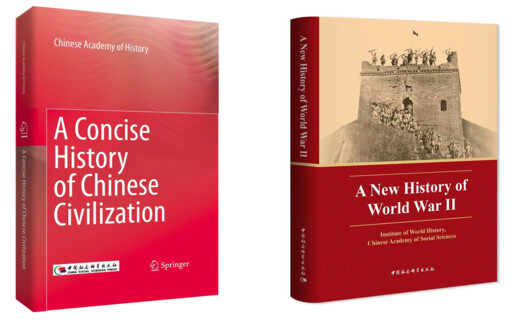
FILE PHOTO: A Concise History of Chinese Civilization and A New History of World War II
The English editions of A Concise History of Chinese Civilization and A New History of World War II, published by China Social Sciences Press (CSSP), have recently been selected as exemplary cases of the Seventh “Belt and Road” Publishing Cooperation Program. One explores civilization, the other war; together, they address a question facing Chinese scholarship today: How can it reach a global audience? The two books offer a vivid example of Chinese academic publishing’s active participation in global knowledge production.
Ji Weimin, Party secretary and president of CSSP, attributed the two books’ selection to their combination of a content-first approach and an international outlook. He explained that A Concise History of Chinese Civilization addresses international interest in mutual learning among civilizations through a narrative of Chinese civilization, while A New History of World War II uses its core concept of “the main Eastern battlefield” to challenge the long-standing Western-centric narrative. Both works combine substantial academic value with an ability to translate major questions in Chinese history into international scholarly topics of broader relevance.
“This capacity for transformation speaks directly to the international community’s concern for shared historical memory and mutual learning among civilizations—and that is precisely why they have been truly embraced by the international community,” Ji said.
Hao Zhensheng, president of the Chinese Society of Editors, has stressed at multiple international publishing forums that “going global” in publishing is no longer simply a matter of copyright licensing or book exports, but now encompasses the entire chain, from topic planning and content production to translation, adaptation, and brand communication.
Ji added that Chinese publishers should respond to international concerns with solid original scholarship while drawing on established overseas academic platforms to bring their work to international readers and integrate China’s historical narratives and scholarly perspectives into global academic discussion.
The move from mere copyright deals to content co-creation and “sailing abroad on borrowed boats” marks a notable shift in the international cooperation model of Chinese academic publishing in recent years. A Concise History of Chinese Civilization and A New History of World War II, for example, were published in cooperation with Springer Nature and Paths International Ltd. in the United Kingdom, respectively. According to Li Tianming, vice president of CSSP, the foreign partners were involved from the contracting stage onward, contributing to topic refinement, marketing strategy, and distribution planning. This deeper level of engagement helps Chinese academic books move beyond simply “speaking to themselves.”
A “multilingual matrix” helps channel Chinese scholarship directly into mainstream academic circles in different markets. Li said that the partners for A New History of World War II are all academic publishers with mature distribution channels in their regions. The greatest advantage of this model, he noted, is that it achieves a shift from “casting a wide net” to “precise penetration”: Chinese books can enter directly into the discovery, acquisition, and reading environments of overseas readers, greatly enhancing their reach and impact.
Academic publishing “going global” requires preserving its scholarly character while overcoming the dual barriers of language and culture, making the process in some respects considerably more difficult than taking popular works overseas. In response to the “three hurdles” facing Chinese academic publishing today—cognitive barriers, translation distortion, and inadequate channel adaptation—Ji proposed “three levers”: first, drawing on national translation projects such as the “Classics Chinese International Publishing Project” to promote systematic publication in coordinated series; second, embracing digital transformation in response to the growing use of digital acquisition by overseas libraries; and third, combining technological tools with human quality control, using cross-cultural communication and standardized translation to help break down long-standing imbalances in global discourse.
In Ji’s view, bringing Chinese scholarship into overseas knowledge production and academic exchange—and enabling Chinese scholars to help frame questions and participate in rule-setting on certain issues—is essential to moving Chinese scholarship from “going out” to truly “settling in.”
Editor:Yu Hui
Copyright©2023 CSSN All Rights Reserved