


Red star shines in the new era
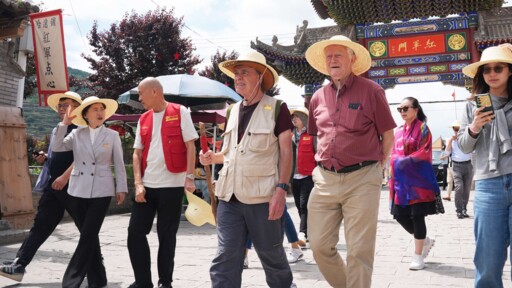
In the summer of 2026, the CICG launched the “Retracing the Long March Route” campaign. Participants from various countries retraced six main sections of the route, revisiting the history of the revolution along the way. Photo: Provided to CSST
2026 marks the 90th anniversary of the victory of the Chinese Workers’ and Peasants’ Red Army’s Long March (1934–36), as well as the 90th anniversary of renowned American journalist Edgar Snow’s visit to the Shaanxi-Gansu-Ningxia Soviet Area. The first Western journalist to report from the area, Snow offered an objective, vivid account of red China in his classic work of reportage, Red Star Over China. Its chapters on the Long March gave readers around the world a systematic account of the Red Army’s heroic 25,000-li (12,500-kilometer) journey.
Firm faith unites the people
Snow set off with some unanswered questions. During nearly four months in northern Shaanxi Province, he interviewed Red Army leaders, frontline soldiers, peasants, intellectuals, and Young Pioneers. He sat in on political lectures, observed cultural activities, visited cooperatives in the Soviet area, and reported from the front. For Sun Hua, a professor at Peking University and director of its China Center for Edgar Snow Studies, faith was central to the answers Snow found during his visit. Snow discovered that the Red Army was not a disorderly mob fighting blindly, but a force with ideals, discipline, and clear political aims, whose members understood what they were fighting for.
The hardships of the Long March emerge vividly from the figures Snow recorded. The Central Red Army crossed 18 mountain ranges, five of which were snow-capped year-round, forded 24 rivers, traversed 12 provinces, and captured 62 cities and towns of varying sizes. It also broke through encirclements by 10 local warlord armies and fought off or evaded Kuomintang troops pursuing it and blocking its path.
Li Ping, a professor from the College of Literature and Journalism and Communication at Yan’an University, noted that Snow brought a foreign journalist’s perspective to the Red Army’s journey of hardship and glory. Through accounts of the forced crossing of the Dadu River, the daring seizure of the Luding Bridge, the crossing of snow-capped mountains, and the march through grasslands, he brought that journey to life, conveying the hardships, sacrifices, and convictions that defined the Long March.
Xiang Fen, a research fellow from the Institute of Journalism and Communication at the Chinese Academy of Social Sciences, attributed the credibility and emotional force of Snow’s account to his faithful portrayal of the hardships, sacrifices, optimism, and faith of Red Army officers and soldiers.
A great journey that saw the awakening of the people
In Li’s view, the Long March was “a great journey that saw the awakening of the people” because the Party and the Red Army remained rooted among the people and relied on their support, drawing the strength to advance from these close ties.
The well-known story of “half a quilt” from the Long March endures to this day: Red Army soldiers with only a single quilt cut it in half to share with local people. This act captures the profound bond forged through shared hardship between Chinese Communists and the people, revealing the deepest source of strength behind the Long March’s success.
What made the Long March’s success possible? Zhang Xuesong, director of communications operations and head of the Department for Strategy Research at the Center for Asia and Pacific under China Foreign Languages Publishing Administration (CICG), identified two key reasons. The first was a commitment to independence and self-reliance—rejecting blind faith in imported experience and devising strategies grounded in actual conditions. The historic turning point of the Zunyi Conference and the military ingenuity displayed in the four crossings of the Chishui River illustrate this principle. The second was a commitment to putting the people first. The Red Army maintained strict discipline, abided by the rule of “not taking even a needle or a thread from the masses,” and earned popular support through its sincerity.
Great Long March spirit lives on
Ninety years ago, Snow documented the Red Army’s experiences, letting the world “see” the Long March. Ninety years on, growing numbers of “contemporary Edgar Snows” travel across the globe to build bridges between China and the world. Their efforts carry the Long March spirit into a new era through exchanges and mutual learning among civilizations.
In the summer of 2026, the CICG launched the “Retracing the Long March Route” campaign. Participants from various countries, including experts and scholars, retraced six main sections of the route through Jiangxi, Guangxi, Guizhou, Sichuan, Gansu, and Shaanxi provinces, revisiting the history of the revolution along the way.
Tomoyoshi Kimura, a veteran Japanese journalist and former Nippon Hōsō Kyōkai (NHK) anchor, took part in the Gansu leg of the campaign. Standing at these historic Long March sites, he said, he could almost picture Red Army officers and soldiers fighting fearlessly. He could sense their suffering in desperate circumstances, their joy at overcoming countless obstacles, and the warmth with which local people welcomed them.
Zhavier Harris, marketing and communications manager at the Springfield Urban League in the United States, also joined the initiative and walked sections of the Long March route. Ten years ago, he took part in a similar CICG event as a young man eager to explore Chinese history and document what he saw. Today, he understands the powerful sense of unity that sustained people through extreme hardship. For Harris, the Long March’s spiritual legacy extends beyond textbooks and printed pages. It lives on in the resilient character of the Chinese people, in the land they have built and transformed, and in the unwavering convictions that continue to inspire generation after generation.
Zhang emphasized that the smoke of war along the Long March route has long since cleared, but challenges remain on the road ahead. Retracing the route gives tangible meaning to faith, sacrifice, and perseverance, helping Chinese people today, especially the younger generation, stay true to their original aspirations and strengthen their resolve.
Editor:Yu Hui
Copyright©2026 CSSN All Rights Reserved