


CSCSA: Two years of building bridges through classical studies
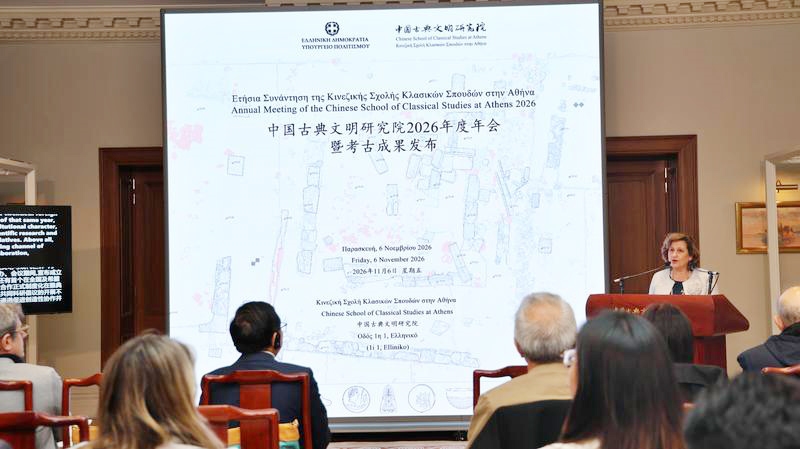
Olympia Vikatou delivers the opening remarks at the CSCSA 2026 annual meeting. Photo: Lian Zhixian/CSST
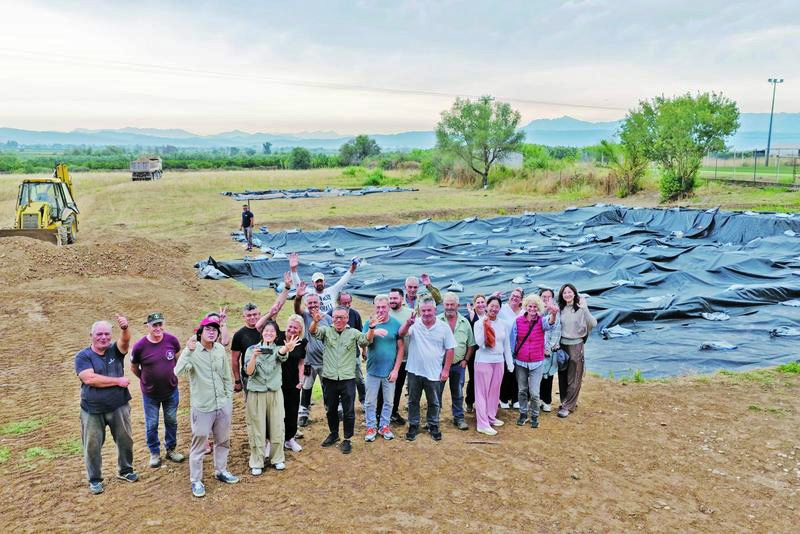
Chinese and Greek team members pose for a group photo at the end of the first excavation season of their joint archaeological project at Aggelokastro. Photo: PROVIDED TO CSST
On the evening of Nov. 6, the Chinese School of Classical Studies at Athens (CSCSA) under the Chinese Academy of Social Sciences (CASS) held its 2026 annual meeting in Athens, Greece, and presented its latest archaeological findings. Representatives from the Chinese Embassy in Greece, the Greek Ministry of Culture, and Athens-based classical schools and academic institutions from the United States, Britain, Germany, and other countries joined scholars and experts to review the CSCSA’s progress over its first two years in cultural exchange, field archaeology, academic research, and the training of young scholars. Participants also discussed the future of classical studies and cross-civilizational academic cooperation. During the event, the CSCSA and the Greek Ministry of Culture formally released the results of the first excavation season of their joint archaeological project at Aggelokastro.
Mutual learning among civilizations more relevant than ever
In a world marked by turbulence and upheaval, how can civilizations deepen mutual understanding and forge consensus? What intellectual resources can the study of classical civilizations offer to help address the challenges of our time? These questions were central to discussions as guests gathered to mark the CSCSA’s second anniversary.
In his address, Fang Qiu, Chinese ambassador to Greece, described human history as one of coexistence and mutual enrichment among civilizations. Civilizations have endured and flourished not by closing themselves off, he observed, but by continually renewing and enriching themselves through exchange that crosses time and space and transcends differences. He called for classical heritage to be understood from the perspective of humanity as a whole, rather than dividing civilizations along geographical lines.
Civilizations should treat one another as equals, Fang emphasized, recognizing the distinctive value of each culture. China and Greece have set a fine example of inter-civilizational exchange and mutual learning, he noted, expressing the hope that the CSCSA would further strengthen its role as a bridge for mutual understanding and cooperation among civilizations.
In her opening remarks, Olympia Vikatou, secretary general for culture at the Greek Ministry of Culture and the Greek head of the first Chinese-Greek archaeological project, noted that the establishment of the CSCSA in Athens has given cooperation between the two countries in archaeology and classical studies a more stable institutional footing. The CSCSA also provided a new platform, she added, for scholars on both sides to pursue creative collaboration and exchange professional knowledge and experience.
The CSCSA has not only advanced academic research but also deepened each nation’s understanding of the other’s civilization, Vikatou said. When scholars from different countries and cultural traditions carry out archaeological research together, she added, archaeology itself becomes a form of cross-cultural exchange.
Li Xinwei, director of the CSCSA, stressed the importance of strengthening research on classical civilizations around the world and pursuing cross-civilizational exchange at a time of profound global change unseen in a century. Such efforts, he explained, help Chinese scholars gain a deeper understanding of Western civilizations and recognize the distinctive characteristics of Chinese civilization through comparison with other civilizations. They also enable the CSCSA to serve as a platform for exchange and mutual learning, furthering understanding among the world’s civilizations.
Mei Zhongtang, Party secretary of the Institute of Archaeology at CASS, addressed the event by video. He noted that the Aggelokastro project is the first archaeological excavation China has undertaken in Greece. The Chinese and Greek teams have approached their work in a spirit of equal dialogue and mutual learning, he said, applying China’s well-established field methods and scientific techniques while drawing on Greece’s extensive experience in archaeology and classical studies. He expressed the hope that new archaeological material would provide a basis for the teams to work with international colleagues to broaden the scope of research on classical civilizations.
Expanding international classical studies network
Over the past two years, the CSCSA has become increasingly integrated into the international classical studies network, as its academic partnerships have developed beyond exchanges and visits to encompass joint research.
In November 2024, Natalia Vogeikoff-Brogan, director of archives at the American School of Classical Studies at Athens, attended the inaugural World Conference of Classics in Beijing, where the founding of the CSCSA was announced. Two years later, she joined the institution’s second-anniversary celebrations in Athens, where the results of its first archaeological project were presented. Reflecting on the CSCSA’s growth and progress, she noted how smoothly cooperation between China and Greece had developed and expressed the hope of seeing further results in the years ahead.
Through high-level academic events, scholarly publications, and visiting scholar programs, the CSCSA has fostered dialogue between Chinese and Western scholars at the frontiers of classical studies worldwide. Its English-language journal, Classics and Civilizations, is now in circulation, providing a new avenue for research informed by Chinese perspectives to reach the international academic community.
In June this year, the Second World Conference of Classics was held in Athens. Under the theme “Dialogue Between Ancient and Modern: Contemporary Inspirations from Classical Wisdom,” scholars and experts from different countries and academic traditions drew on history, archaeology, philosophy, literature, and other disciplines to explore the richness of classical civilizations and their lessons for contemporary society.
In December 2025, the CSCSA organized a 10-day exchange program in China for 27 Greek university students, who learned about Chinese history, culture, and contemporary development through lectures, cultural activities, and field visits. In July this year, 24 Chinese university students traveled to Greece for a summer program devoted to mutual learning among civilizations. Through firsthand encounters with ancient Greek civilization, they deepened their understanding of the historical experiences of different civilizations.
Building independent knowledge system
International academic exchange has created the conditions for dialogue among civilizations while opening up opportunities to broaden research horizons and pose new scholarly questions.
In August this year, the CSCSA hosted an academic symposium titled “Beyond the Silk Road: Archaeological Perspectives on East-West Connections.” Scholars from China, the United Kingdom, the United States, Kazakhstan, Lithuania, Hungary, and other countries discussed topics ranging from prehistoric exchange networks in Eurasia to interaction in material culture and the arts along the Silk Road.
In September this year, the CSCSA and the Institute of Ancient History at CASS jointly held the “Civilization Coexistence and Mutual Learning: International Symposium on Ancient Sino-Foreign Exchanges in Material Technologies and Culture.” Scholars from different countries and disciplines drew on historical evidence to explore the complex processes by which knowledge, technology, and culture circulated among civilizations.
Field archaeology has enabled the CSCSA to contribute to international research on classical civilizations through the study of firsthand material. This year, Chinese and Greek teams completed the first excavation season of the institution’s inaugural field archaeology project, working together on field surveys, excavations, and the study of archaeological remains. At the second-anniversary event, the two sides presented their research work and interim progress, showcasing results that combine archaeological survey, excavation, and architectural study.
From academic exchange to long-term partnership
As the CSCSA’s academic work develops, turning existing scholarly ties into long-term partnerships has become a priority for its next stage of development.
Constantina Benissi, head of the Department for the Supervision of Greek and Foreign Scientific Institutions and Coordination of International Cooperation and Organizations at the Greek Ministry of Culture, has followed the CSCSA’s development from its initial planning, through its move to new premises, to the launch of its first joint archaeological project. Reflecting on its remarkable progress over the past two years, she described how an ambitious idea was taking shape as a “vibrant and active academic institution.”
“Greece has traditionally been an international meeting point for archaeological research and classical studies,” Benissi said. The establishment of the CSCSA has added an important new dimension to the international academic landscape, she noted, while providing a platform for Chinese and Greek academic institutions to build closer and more systematic partnerships.
Progress on the Aggelokastro project illustrates how the two sides are moving from academic exchange to substantive research collaboration. The joint project offers a valuable opportunity to share scientific knowledge, research methods, and technical experience, Benissi explained. Working together in the field, she noted, is particularly valuable for building professional ties that can develop into lasting academic partnerships.
“The CSCSA is becoming a valuable partner within Greece’s international academic community and an important contributor to the development of closer scientific and cultural relations between our two countries,” Benissi said.
Looking ahead, Li outlined the CSCSA’s plans to strengthen multidisciplinary research in field archaeology and produce high-quality results as quickly as possible. In classical studies, it will place greater emphasis on comparing civilizations and explore more varied forms of international cooperation. Supporting and training young scholars will also be a priority, he added—scholars with both solid academic grounding and a concern for the wider world, alongside a commitment to building a community with a shared future for humanity.
China and Greece, Benissi observed, “possess exceptionally rich cultural heritages and long intellectual traditions. This provides a natural basis for dialogue, but it is through sustained research, education and the exchange of expertise that this relationship can acquire real depth and continuity.”
“I sincerely hope that its [the CSCSA’s] second anniversary marks not simply the celebration of what has already been achieved, but the beginning of an even more fruitful and ambitious period ahead,” Benissi said.
Editor:Yu Hui
Copyright©2026 CSSN All Rights Reserved