


Revisiting history of PRC’s early industrial development
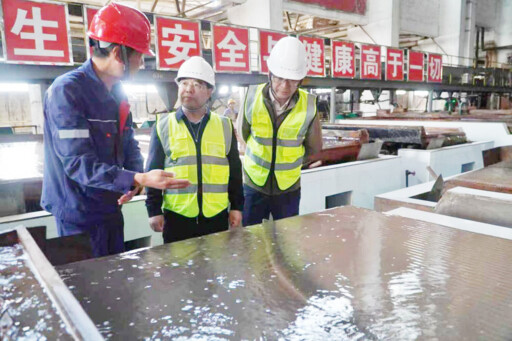
The research team conducting a site visit at the workshop of Yunnan Tin Group in Gejiu, Yunnan Province Photo: PROVIDED TO CSST
In the context of China’s rapidly evolving industrial landscape, the “156 Projects”—launched during the First Five-Year Plan period (1953–57) and widely regarded as the bedrock of the PRC’s early industrialization—have once again captured broad public and academic attention. Spanning steel, nonferrous metallurgy, coal, electric power, chemicals, and machinery manufacturing, these landmark undertakings laid the essential groundwork for building an independent and comprehensive industrial system.
The dedicated “156 Projects” investigation team from the Institute of Economics at the Chinese Academy of Social Sciences (CASS) spent several years conducting fieldwork across more than 10 provinces and cities. Through close examination of 30 representative enterprises and a multidisciplinary research framework, they reconstructed the formation logic of the “156 Projects” and illuminated their long-term significance for China’s industrial trajectory.
Traveling through a ‘tunnel of time’
Deep inside an underground mine operated by the Yunnan Tin Group in Gejiu, Yunnan Province, the team members—helmeted and wearing protective gear—carefully followed staff through a labyrinth of tunnels. Production vehicles rumbled past, and despite the depth, the entire space was brightly lit, lending the mine an almost cinematic atmosphere.
Returning to the surface, the researchers entered a modern dispatch center where large digital screens displayed real-time data from the mine below. Staff members monitored underground operations continuously, coordinating production with precision. Mine managers explained that recent years had seen notable gains in resource-use efficiency through technological upgrades and resource integration, alongside steadily improved safety and environmental protections.
Designated in 1953 as one of the 156 key construction projects under the First Five-Year Plan, Yunnan Tin received 144.54 million yuan in capital construction investment. Today, the company accounts for one-quarter of the global tin product market—a testament to the solid foundation built during that formative period.
The “156 Projects” were the first batch of major industrial undertakings in the early years of the PRC. They represented a clear commitment to gradually building independent capabilities in critical sectors and laid a durable foundation for China’s industrialization. Fully understanding their significance requires stepping inside the enterprises themselves. After extensive preparatory work, the research team selected 30 enterprises for field investigations. As investigation team head and CASS research fellow, Zhao Xuejun recalled, “This was by no means an easy task. Many of these enterprises are large in scale, high in administrative level, and maintain strong confidentiality. It took considerable effort to establish contact, and we succeeded only with support from various parties.”
Intergenerational dialogue uncovering secrets of development
To recover the lived history of the “156 Projects,” the team employed a “three-generation interview method,” speaking with senior, mid-career, and young technical staff and managers within each enterprise. This “intergenerational dialogue” approach helped them understand developmental trajectories—recovering historical facts—and identify internal factors shaping enterprise growth through cross-generational comparison. At North China Pharmaceutical Corporation (NCPC), for instance, they uncovered vivid recollections from senior expert Qi Moujia and his peers, who helped overcome bottlenecks in Soviet-era fermentation technology.
In the 1950s, while China’s penicillin output was still extremely low, penicillin production projects, along with starch projects for antibiotic production were introduced from the Soviet Union. Qi was subsequently sent to the Soviet Union to study antibiotic production and immersed himself in every stage of the process—from strain growth characteristics to fermentation parameters and processing techniques. Upon returning to China, he became a workshop director. After the withdrawal of Soviet experts, Tao Jingzhi led a team that successfully cultivated an improved strain, surpassing the Soviet original.
By the early 2000s, NCPC faced challenging business conditions. Yet in recent years, Genetech—a Tier-3 subsidiary of NCPC—has drawn on deep technological reserves to advance vaccine research and development and achieve a strong turnaround, now accounting for more than 60% of the group’s total profits. This dramatic contrast underscores the critical importance of “professional depth” for the long-term development of state-owned enterprises (SOEs).
When working with enterprises in highly confidential sectors such as defense and petrochemicals, the research team adopted more flexible strategies. At Lanzhou Petrochemical, the absence of historical records complicated the investigation. Faced with the dilemma of inaccessible archives, the team sought external substitute sources—locating Russian-language documents in Russia—and cross-referenced them with surviving internal minutes to obtain accurate historical information.
By comparing Russian archives and plant records with on-site interviews with long-serving employees, the researchers clarified the true balance between Soviet assistance and China’s own innovation, concluding that domestic innovation had in fact played a far larger role than commonly assumed. This finding highlights the early PRC’s remarkable capacity for independent research and technological creativity. By diving deeply into these historical details, the investigation also revealed overlooked turning points and innovation milestones that enrich the history of technology and offer valuable reference points for contemporary industrial planning.
Dual narratives of technological history and social responsibility
For the researchers, this was not only an academic project but also a profoundly moving “red journey.” The history of the “156 Projects” is tightly intertwined with the fate of the nation. These enterprises are more than economic entities—they are stewards of China’s red industrial heritage. Their struggles and spirit form a vital chapter in the story of China’s development.
The sacrifices involved were profound, and the closer the researchers looked, the more this reality came into focus. The team was especially struck by the patriotism and dedication of early industrial workers, whose daily labor unfolded under conditions that tested both physical endurance and emotional resolve. In its early years, the PRC was capable of producing cars and aircraft, yet poor oil quality posed a major barrier to developing weaponry and equipment. When Soviet experts withdrew their technical support, researchers at Lanzhou Petrochemical persevered through enormous difficulties to produce high-quality oil products essential for aircraft and vehicle performance. “Many of the workers on the front lines had joints so deformed they could not act normally, yet they remained at their posts and kept working,” said team member and CASS research fellow Yu Wenhao. Workers embodied a powerful sense of loyalty and responsibility, offering a vivid reminder of how personal sacrifice underpinned national progress. This history underscored that the “156 Projects” succeeded not only because of technological advances but also because of national spirit, unity, and collective commitment.
A visit to China First Heavy Industries (CFHI) in the Fulaerji district of Qiqihar, Heilongjiang Province—long known as “the first stronghold of China’s manufacturing industry”—left an equally deep impression. Behind CFHI’s achievements stand generations of tireless industrial workers with superb technical skills, a profound love for their country, and a deep sense of responsibility for the nation’s industrial development.
The research team found not only advanced production facilities and modern management systems, but also a shared spirit that animates the enterprise and shapes its internal culture—a discovery that left them deeply impressed after learning about CFHI’s long and storied history. This intangible strength is a priceless asset in China’s industrial history and encouraged the team to broaden their lens beyond GDP to consider SOEs’ contributions to technological autonomy, industrial-chain security, and social responsibility.
At Harbin Turbine Company, fully automated workshops filled with robots and only a few staff members showcased the rapid progress of intelligent transformation in China’s key industrial equipment sector. At Ansteel, heavy investment in environmental upgrades showed SOEs’ quiet dedication to ecological sustainability and public welfare, illustrating how responsibility and modernization increasingly go hand in hand. The training of industrial workers at SOEs likewise represents significant social value, ensuring that technical expertise continues to evolve across generations. These experiences reinforced Zhao’s conclusion that “efficiency is only one dimension of evaluating SOEs. Their roles in core technological autonomy, industrial chain security, and social stability are irreplaceable.”
To date, the team has completed preliminary manuscripts on several key themes: the construction and commissioning of the “156 Projects,” their impact on the economic development of Luoyang, their role in shaping the industrial growth of Anshan, their influence on the steel industry, and their contributions to advancing the petrochemical sector. Supported by extensive archival materials and reliable data, these studies shed new light on the achievements and legacy of the “156 Projects” across regions and sectors, and together offer valuable insights for China’s ongoing and future industrial development.
Editor:Yu Hui
Copyright©2023 CSSN All Rights Reserved