


Global South plays growing roles in global governance
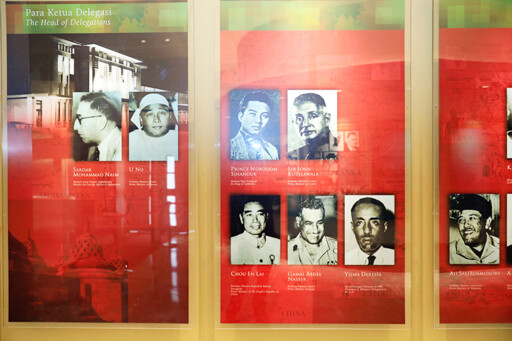
Photos of heads of states who attended the Asian-African Conference, also known as the Bandung Conference, on display at the Museum of the Asian-African Conference Photo: IC PHOTO
As old and new conflicts intersect and the governance deficit widens, the international community needs more than ever the wisdom and resolve to rise above zero-sum thinking. China’s Global Governance Initiative (GGI), grounded in the principles of extensive consultation, joint contribution, and shared benefit, offers guidance for addressing a fundamental question: How can the global governance system genuinely respond to humanity’s shared aspirations for peace and development?
Reshaping governance landscape
Amid this profound transformation, countries of the Global South have ceased to be mere observers of global governance and have become central drivers of change.
The current global governance system confronts three major challenges: unbalanced representation, outdated rules, and insufficient action. The most striking contradiction is that although Global South countries constitute more than 80% of the world’s population, they were long marginalized, holding less than 40% of voting power in international financial institutions. This structural imbalance has rendered the governance system’s capacity inadequate to address transnational challenges such as climate change and the digital divide.
Currently, the world is undergoing transformations unseen in a century, and global governance is experiencing profound shifts. The governance model dominated by developed countries has struggled to respond effectively to global challenges such as climate change, public health crises, and development gaps. Meanwhile, the Global South—an emerging force—is moving from the periphery to the center of the global governance architecture. Spanning Asia, Africa, and Latin America, the Global South represents more than 80% of the world’s population and contributes over 40% of global GDP. Its collective rise is not only reshaping the international balance of power but also steering global governance toward greater fairness and inclusivity. Against this backdrop, the GGI provides both guiding principles and an institutional framework to support the Global South’s participation in governance reform.
Proactively setting rules
Global South countries are also becoming active co-constructors of global rules. Their role in global governance has evolved—from being oppressed under colonial systems, to dependent actors during the Cold War, to active participants in the age of globalization, and now to proactive shapers of global governance rules. After WWII, the Bandung Conference’s “Ten Principles” marked the first collective effort by Global South countries to demand a stronger voice in world affairs. In the 1960s, the rise of the Non-Aligned Movement further advanced calls for a new international economic order. Entering the 21st century, as emerging economies rose collectively, Global South countries significantly strengthened their bargaining power in international trade, finance, and climate governance.
Today, the Global South is asserting a shared voice in rule-making on issues such as artificial intelligence ethics, deep-sea mining, and cross-border data flows, through platforms including BRICS and the Group of 77. Notably, the International Organization for Mediation, co-established by China and more than 30 other countries, has broken the West’s monopoly on dispute-resolution mechanisms. The African Union’s entry into the G20 also marks a historic restructuring of global decision-making bodies.
These developments affirm the GGI’s core proposition: International rules should not be dictated unilaterally by powerful states, but forged collectively within the UN framework through the participation of diverse civilizations. Only when Global South countries incorporate the survival needs of other developing nations, the security concerns of climate-vulnerable states, and the innovative experiences of emerging economies into new rules—thereby dismantling the old order in which rich countries set rules and poor countries abide by them—can global governance truly embody inclusivity.
Driving governance reform
Global South countries are also emerging as catalysts of governance transformation. In the face of countercurrents such as decoupling and supply-chain disruption promoted by certain countries, the Global South is defending multilateralism through concrete action. For example, Southeast Asian countries are advancing the implementation of the Regional Comprehensive Economic Partnership; Latin American nations have established peace dialogue mechanisms free from external interference; the African Continental Free Trade Area is unlocking a market of 1.3 billion people; and the Alliance of Small Island States has pushed developed countries to adopt the 1.5°C temperature-control target in climate negotiations. These efforts vividly reflect the GGI’s emphasis on seeking common ground while accommodating differences.
Fu Xiaoqiang is president of the China Institutes of Contemporary International Relations.
Editor:Yu Hui
Copyright©2023 CSSN All Rights Reserved