


Digital technology redefines historical research paradigm
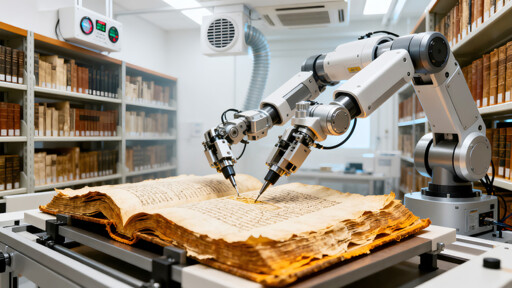
A hypothetical depiction of a robot restoring an ancient book Photo: TUCHONG
Amid the global wave of digital transformation, historical research is undergoing a profound shift. From AI-powered text mining of ancient documents to the integration and analysis of multimodal historical data, and from deciphering inscriptions and recovering lost texts to mapping ancient social networks and simulating historical processes, digital technologies are reshaping not only the methodologies historians rely upon but also how people understand the past. In this context, CSST recently spoke with scholars about the changing landscape of historical research in the age of AI.
‘Close reading’ as important as ‘distant reading’
“Close reading” has long been a central method in historical scholarship, requiring meticulous, systematic, and context-sensitive engagement with texts to discern subtle meanings. In contrast, as digital technologies advance, “distant reading” has become a signature approach in the digital humanities. It emphasizes breadth and regularity—treating large text collections or corpora as whole datasets and using computational tools for quantification, visualization, and pattern analysis—to achieve a more comprehensive understanding of history.
Ruth Mostern, a professor from the Department of History and the Institute for Spatial History Innovation at the University of Pittsburgh in the US, pointed out that large-scale data analysis can reveal temporal or spatial patterns that would otherwise be invisible. Some historians may wish to write about those patterns, while for others the potential significance of large-scale analysis lies in its ability to pinpoint events that can then be further examined through close reading.
“For instance, big data analysis could expose times or places in which some phenomenon changed or was most pronounced, or in which there was some interesting anomaly. At that point, the task of the historian would be to add narrative context and detail that explains the pattern in the data,” Mostern elaborated.
“History needs to become more global, more comparative, and more attuned to large-scale processes involving migration, trade, or climate,” stated Steven Mintz, a professor of history at the University of Texas at Austin in the US. “AI can accelerate this by making sources in multiple languages searchable and translatable, opening up archives that were once inaccessible. It can also reveal patterns—such as shifts in rhetoric, networks of correspondence, or changes in cultural sentiment—that would be invisible to traditional research.”
“That said, it doesn’t eliminate the need for close reading or interpretation. Instead, it reframes the balance: macro-analysis to spot the big shifts, micro-analysis to explain them,” Mintz articulated.
Mostern warned that historians must always integrate findings from big data with the granular texture of events and sources. She also noted many excellent use cases for large language models (LLMs) beyond data mining and distant reading. For instance, LLMs can assist with transforming unstructured text into structured data, transcribing hand-written text into machine-readable form, assembling bibliographies, and assisting with translation and copy-editing.
Mostern offered an analogy: Transportation has not been transformed by fully autonomous self-driving cars. However, the judgment of human drivers is now routinely supported by sensors, cameras, alerts, and other tools that have made driving safer and easier. “Something similar may happen when it comes to historical research,” she predicted.
Building more inclusive datasets
In Mostern’s view, since LLMs are simply complex statistics engines, they inevitably magnify the most common characteristics of the datasets on which they are trained. Less common information risks being obscured or lost entirely. “The well-known 2021 paper ‘On the Dangers of Stochastic Parrots: Can Language Models Be Too Big?’ by Emily Bender, Timnit Gebru, Angelina McMillan-Major, and Margaret Mitchell, makes precisely this point. Since LLMs mimic human language without offering genuine meaning and understanding, they simply ‘parrot back’ the biases and harmful ideologies in that data.”
“This is unavoidable, but there are several ways to mitigate the problem,” Mostern said. First, it is essential to ensure that those who use LLMs or other big-data techniques understand how these systems work. Second, researchers can query datasets to pinpoint biases—for example, by asking a model to list all the women in its dataset, identify the roles they played in the events in which they appear, and calculate what percentage of all named individuals they represent. Third, she argued that the future of historical research may lie not in creating ever-larger corpora but in building highly curated small and medium-sized datasets that focus on distinct topics, supported by excellent metadata and human tagging, and that can be mined, mapped, and structured under expert guidance.
Mintz suggested building more inclusive datasets—incorporating oral histories, community archives, and “small data” that reflect marginalized voices—to address biases in historical archives. Another strategy is to train models to flag silences and gaps rather than smoothing them over.
“In this sense, AI can actually help us see bias more clearly, provided we don’t mistake its outputs for neutral truth,” Mintz added.
When confronted with the surging tide of technologies such as AI, big data, and social network analysis, it is no longer sufficient for historical research to rely solely on scholars working independently with ancient texts if they hope to address broader and more complex questions. Interdisciplinary collaboration is essential—particularly in tackling shared global challenges such as climate change, pandemics, and migration.
Mintz affirmed that AI can’t be used effectively without partnerships with computer scientists, data analysts, and linguists. “But academic incentive structures don’t reward this kind of teamwork. That has to change if historical scholarship is to remain vital.”
Mostern echoed this, stressing that big-data projects in history are frequently team efforts. Alongside developing, training, and querying corpora for LLMs, such projects require raising funds to support a team, building trust among team members, managing the project, navigating diverse individual and institutional incentives, and learning the disciplinary expertise, terminology, and techniques of collaborators.
‘AI is a tool, not a replacement’
As emerging technologies, the application of AI and big data in historical research is still in an exploratory phase. Mostern explained that big data and AI remain novel approaches for many historians, who still prefer to conduct archival research or gather oral histories, value close reading, and craft engaging and learned narratives that highlight the agency of individuals and small groups involved in specific events.
Moreover, most archival sources used by historians to gain insights and craft arguments remain undigitized and AI and big-data approaches are still the purview of a small number of historians, Mostern continued. “This is true not only because the techniques are unfamiliar, but because they do not address the types of scholarly questions that most historians ask.”
In Mostern’s view, LLMs and data-analysis tools are extraordinary engines for identifying patterns in the large corpora of data on which they have been trained, but nothing more. They are neither “artificial” nor “intelligent.” They can identify correlations, anomalies, and patterns, and generate free text, structured data, images, and computer code to convey those findings with remarkable speed and efficiency—especially compared to humans. Yet only humans can offer insight, analysis, interpretation, context, and political, ethical, philosophical, or aesthetic judgment.
“AI has capacities no individual historian can match,” Mintz asserted. “It can sift through massive archives of digitized sources, detect patterns across millions of documents, visualize trends, and map connections that would take human researchers lifetimes to uncover. It can mine texts for linguistic shifts, track how concepts travel across languages, and even automate labor-intensive tasks like metadata tagging or literature reviews.”
Equally important, Mintz noted, AI can serve as a brainstorming partner: testing existing interpretations, suggesting alternative hypotheses, and broadening the range of questions historians might ask.
“Still, AI is a tool, not a replacement. The historian’s craft—posing questions, weighing evidence, contextualizing, detecting bias, and making interpretive judgments—remains indispensable. Used well, AI can extend those capacities, giving us new vantage points on the past without stripping away the human element,” Mintz said.
Looking forward, Mostern foresees the most promising development for big data and AI in historical research as their potential to enhance humanistic scholarship, foster ethical engagement, and deepen our understanding of complex meanings and significant social issues. “If big data and AI can enrich our insights, for instance, by discovering voices that have been hidden away in remote places in documents, that will be a great result. The new tools can allow historians to quickly test hypotheses, and they can serve as research assistants to clean and transform messy data and to translate and summarize documents.”
“However, it is important always to remember that LLMs and other large corpora are collated from and trained on human documents, they are queried by human beings, and they deliver responses based on predictive algorithms. They do not know about truth, they only know about statistics, and they are only as good as the documents that comprise them and the people who design them,” Mostern concluded.
Editor:Yu Hui
Copyright©2023 CSSN All Rights Reserved