


Scholars debate ‘quantum turn’ in IR research
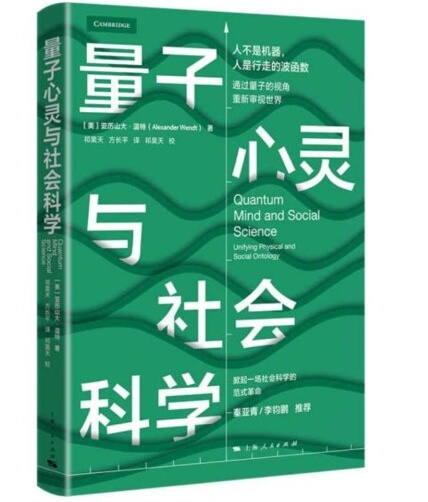
FILE PHOTO: Quantum Mind and Social Science, by American scholar Alexander Wendt, and translated by Qi Haotian and Fang Changping, advocated for the legitimacy of introducing quantum mechanics into social sciences research.
The world today is undergoing changes unseen in a century. International politics is in flux, global uncertainty is rising, the system of global governance is being profoundly restructured, and non-traditional security threats continue to proliferate. At this critical moment—when theory is expected to respond to pressing real-world challenges—a “quantum turn” emerging from frontier interdisciplinary inquiry is quietly entering the field of international relations (IR), seeking to offer a new set of cognitive tools and theoretical paradigms for understanding this uncertain world.
Practical dilemmas spawn theoretical buds
In recent years, the international order has come under severe strain. Traditional IR theories have increasingly struggled to explain complex global issues, making theoretical innovation an urgent necessity.
Against this backdrop, in 2015, American scholar Alexander Wendt argues in his book Quantum Mind and Social Science for the legitimacy of introducing quantum mechanics into social sciences research, and attempts to reconstruct social sciences research paradigms on this basis. This bold endeavor sparked wide debate in international academic circles, with some scholars observing that the book’s “profoundly disruptive ideas have undoubtedly opened up new horizons for knowledge production in the social sciences and for the theoretical development of IR.”
Qin Yaqing, a professor at Shandong University, noted in an article that a fundamental divide between the classical scientific worldview represented by Newtonian thought and the quantum scientific worldview, represented by quantum mechanics, lies in how they understand the basic nature of reality. Classical science treats certainty as the essential attribute of the world, whereas quantum science regards uncertainty as its fundamental condition. If uncertainty is indeed intrinsic to reality, then the foundational assumptions of the three major IR theories—and the scientific and cultural worldviews underpinning them—face fundamentally destabilizing challenges. Established core concepts in IR, such as the state, international society, and power, would require rethinking, and the construction of non-deterministic theories would become a new direction for knowledge production.
Explorations of “quantum theory” in IR research center on the introduction of quantum thinking. Fang Changping, a professor from the School of International Studies at Renmin University of China, explained that traditional theories assume the world is essentially determinate and that human rationality can progressively approximate and explain that determinacy. In contrast, the quantum worldview holds that uncertainty is foundational, and that the uncertainties inherent in international society—as the object of study—do not arise from the limits of human cognition, but constitute objective attributes of the social world itself. This, he emphasized, is not a refinement or extension of existing theories, but a fundamental challenge to the epistemological foundations and cognitive frameworks from which those theories emerge.
Li Junpeng, vice dean of the College of Sociology at Central China Normal University, further elaborated on the deeper implications of this notion of “uncertainty.” He stressed that this is not the “epistemic uncertainty” familiar from classical probability theory—such as not knowing whether a tossed coin will land heads or tails—but rather an “ontological uncertainty.” It resembles a coin in the midst of spinning, simultaneously existing in a superposition of “possibly heads up and possibly tails up.” Such a perspective undermines the deterministic foundations of traditional research and compels scholars to reconsider contingency in historical development as well as the intrinsic unpredictability of international interactions.
At present, the interdisciplinary application of quantum theory has extended well beyond physics, achieving progress in psychology and other social science fields and giving rise to the early contours of “quantum social science” as an interdisciplinary domain. However, Li Quanmin, a professor from the Department of Philosophy at East China Normal University, noted that current research follows two fundamentally different paths. Most scholars adopt a cautious approach, using the formal models and conceptual tools of quantum theory to describe or explain empirical phenomena while remaining neutral on whether human consciousness has quantum properties. A smaller, more radical group—represented by Wendt—advocates the construction of a unified ontology, even proposing that human beings are “walking wave functions” and that human consciousness is the product of primordial consciousness operating through quantum mechanisms.
In the field of IR, such conceptual transfer manifests primarily as a reflection on and reconstruction of methodology. Qi Haotian, an associate professor from the School of International Studies at Peking University, observed that what is currently labeled “quantum theory in IR” has not yet coalesced into a complete or rigorous system. Instead, it functions more as a “quantum analogy” or “quantum-inspired” research orientation. Its core ambition is to introduce the worldview revealed by quantum mechanics into the study of broad social phenomena, in hopes of addressing complex problems involving macro-micro linkages that traditional theories have difficulty explaining.
Facing both opportunities and challenges
Although the “quantum turn” has opened up new imaginative space for IR research, it remains relatively marginal within the broader academic landscape. Its innovative potential and scholarly influence have yet to seriously challenge the dominance of established paradigms.
A survey of existing studies suggests that quantum approaches in IR have taken shape along several distinct lines. One is the ontological reconstruction associated with Wendt, which seeks to rethink the cognitive foundations of social facts and actors by treating certain social phenomena as “macro-quantum phenomena.” A second involves formal transplantation, borrowing on mathematical tools from quantum cognition and decision theory to explain phenomena such as order effects in group decision-making or strategy superposition in negotiation behavior. A third adopts a critical-expansive approach, applying quantum concepts to reinterpret soft power and discursive power, and examining how narratives influence the operation and practice of power through “nonlinear superposition.”
At the empirical level, some exploratory research has already produced preliminary findings. For instance, quantum decision theory has used parameterized models to better account for certain behavioral paradoxes in risk selection. Even so, this emerging field continues to face significant constraints. Fang summarized these challenges as three major “conversion” problems. The first concerns the transition from micro to macro levels: Quantum mechanics primarily describes microscopic particles, and convincing evidence that its principles can be meaningfully transferred to macro-level social domains such as IR remains lacking. The second involves the shift from natural science to social science: The social world consists of “intentional and meaning-bearing humans,” and mechanically importing concepts such as quantum entanglement or the uncertainty principle risks neglecting the subjective and culturally specific construction of social phenomena. The third concerns knowledge dissemination and acceptance: Foundational works in this field address the social sciences broadly, with relatively limited and unsystematic engagement with IR, leaving many scholars unconvinced and skeptical.
Objectively speaking, within the social sciences as a whole, critics of the quantum worldview far outnumber its supporters. Li Junpeng noted that mainstream academic acceptance remains low, and that quantum-related articles are still rare in leading journals. While some younger scholars in sociology and political science—often frustrated with traditional paradigms—have begun exploring quantum approaches, substantial methodological difficulties remain in effectively “operationalizing” these ideas and applying them to concrete research.
A look back at the history of disciplinary development reveals that although the introduction of quantum theory and the behavioralist revolution in IR both represent interdisciplinary attempts, the nature of the challenges they face is fundamentally different. Qi explained that the behavioralist revolution was primarily a methodological innovation. It imported empirical research methods from the natural sciences into social inquiry, generally aligning with the cognitive habits of the classical scientific worldview. By contrast, the quantum turn resembles an ontological “adventure,” requiring scholars to abandon intuitive understandings rooted in everyday experience and to accept a more “philosophically and sensorially-challenging picture of reality.” This not only demands considerable theoretical courage, but also raises the urgent need to address potential crises of internal coherence, lest excessive disruption of established concepts lead to theoretical confusion.
Exploring new paths amid reflection and debate
As quantum theory gains greater visibility within IR research, critical reflection and skepticism have become increasingly prominent. Core debates revolve around two questions: Whether quantum concepts are being misused, and how fundamental ontological differences should be handled.
Some critics have argued forcefully that without careful delineation of applicable boundaries, the indiscriminate introduction of quantum physics concepts into social science risks careless borrowing, conceptual misuse, and even the slide into “pseudo-science.” Li Junpeng agreed that there is a real danger of “fashionizing” quantum theory, noting some studies remain at the level of superficial conceptual borrowing, failing to generate empirically testable hypotheses. If left unchecked, this could encourage intellectual superficiality and the spread of pseudo-scientific discourse.
Yet other scholars adopt a more open and constructive attitude. Li Quanmin suggested that “it is often difficult to prevent a concept from becoming popular through borrowing and generalization, but academic research should always interpret and apply it within a professional background of knowledge.”
Despite the formidable challenges ahead, most scholars agree that quantum theory has indeed injected “revolutionary thinking” into IR studies, and its potential value should not be overlooked. The crucial task, they emphasized, is to avoid treating quantum terminology as mere academic ornamentation or pursuing novelty for its own sake. Instead, scholars should ground their work in a careful engagement with the philosophical implications of quantum theory, seeking a workable balance between theoretical innovation and real-world relevance.
Looking ahead, many scholars regard micro-level decision-making issues as the most promising areas for progress. Some believe that topics such as the evolution of identity in IR, the maintenance and unraveling of strategic ambiguity, and gaming behaviors in crisis situations directly involve actors’ intentionality, the uncertainty of interactions, and complex coupling effects. These align closely with the core concerns of quantum theory and may allow scholars to draw on advances in quantum cognitive science to achieve limited but substantively meaningful breakthroughs.
Editor:Yu Hui
Copyright©2023 CSSN All Rights Reserved