


‘China’s transformation today is an extraordinary process’
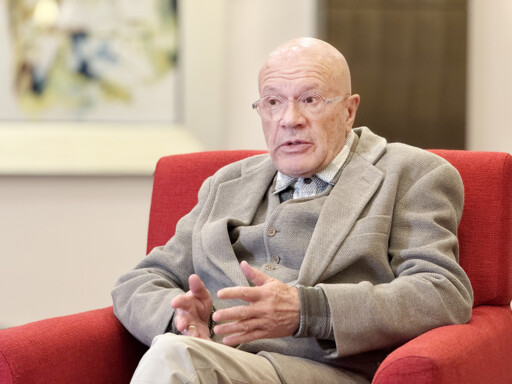
Martin Jacques Photo: Lu Zhiyu/CSST
Martin Jacques, a former senior fellow in the Department of Politics and International Studies at the University of Cambridge, has published widely on China’s rise and what he sees as the relative decline of the West. His book When China Rules the World: The End of the Western World and the Birth of a New Global Order was published in 2009 and soon became an international bestseller. The book offers global readers a way to understand an Eastern major country moving steadily toward the center of the world stage as its composite strength continues to grow.
Today, as China plays a larger role in the international system, it presents a stronger and more thriving posture. “Chinese modernization” has become a key term through which many countries study the country’s trajectory. One day ahead of the 2025 International Forum of the Overseas Studies on Xi Jinping Thought on Socialism with Chinese Characteristics for a New Era (2025), which was held in Beijing from Nov. 12–13, CSST conducted a one-hour interview with Jacques. Speaking about China’s future, Jacques expressed confidence, arguing that Western countries must recognize that China’s transformation today is “an extraordinary process.”
Prescriptive approach to governance
CSST: Over the past 10 years, China has taken on a new look as a major country. How would you assess China’s performance in the international system in recent years?
Jacques: The past 10 years have been, in different ways, obviously very successful, depending on what we’re looking at. If we take our minds back to 2012, China was still regarded essentially as an economic phenomenon around the world. It was not seen so much in broader terms with respect to its political, social, cultural identity, and so on. But during the previous 10 years, there’s been an extraordinary growth in China’s presence, statements, and interventions on a much wider basis. The Belt and Road Initiative is one of the typical things that President Xi Jinping announced. And that has become an extraordinarily important initiative for Global South countries. I would say it has had huge international repercussions because it’s been a major factor in organizing the Global South.
CSST: Compared with the West, what do you think are the biggest advantages of China’s system and model, particularly regarding leadership?
Jacques: I think that Chinese leadership, particularly political leadership, is very different from Western leadership. This is not just true of the recent period. It’s true historically over a much longer period. The core logic of governance in China is to develop very clear, long-term plans for national development, for social progress, and for international relations. In that sense, it is a very prescriptive approach—about what the targets are and what needs to be achieved.
That is very different from the Western approach. Basically, the Western approach is dominated by the electoral cycle: the need to get elected and then to get re-elected when you come to the end of your term. This inevitably accentuates the need for pretty short-term measures, seeking some popularity on this issue or that issue, and so on. It leads to a kind of politics being much more of a short-term game.
These two are really in striking contrast. In China, leaders regard their role as being responsible for the country’s successful development. Chinese leaders’ performance is measured by results. Whereas unfortunately, in Western countries, leadership is much more about rhetoric—about speeches, about short-term appeal.
CSST: The Fourth Plenary Session of the 20th CPC Central Committee has received wide attention from the international community. The session mapped out a new development blueprint and deployed new measures for the next five years. Some analysts observe that China is very clear about the future path it will embark on, but in Western countries governments are often dominated by the market and vague about long-term national planning. How do you view this contrast?
Jacques: There’s a very big difference between the Chinese approach and the Western approach. The West does not have long-term plans—basically, it does not have five-year plans or anything like them. There have been in the past some examples of a limited kind, but essentially they don’t believe in planning ahead.
This is partly because the state is much weaker in Western countries than it is in China. The five-year plans are very much state plans, formulated by the government on behalf of society. Whereas in the West, they don’t really have that because the private sector is seen as the dominant factor in economic development. They are not under the wing of the state; they are independent of the state.
China’s rise beyond narrow economic terms
CSST: China is undergoing the most profound social transformation in its history. Chinese modernization has offered developing countries an example of moving toward an independent path of modernization. China has completed this modernization process within several decades, but it took several centuries in the West. Can you comment on this?
Jacques: Certainly, the speed with which China has arrived at its present level of development has been extraordinary, and it has done it in a remarkably short period of time. If we think about China’s trajectory dating, let’s say, from 1978 and the reform and opening up period, then in a very short period of time China has gone from being a very backward economy to being one of the two most advanced economies in the world.
How has China managed to do this? I think this is a tribute to the Chinese system, and that China has shown itself to be able to achieve very rapid economic growth rates. So China has proved itself to be quite remarkable. If you look at the latest figures, the latest developments, the latest inventions and innovations, and so on, China is able to do this across a very broad range of things.
CSST: China’s poverty alleviation measures have won wide acclaim in the international community as a great achievement in human history. China has also taken many measures to narrow the gap between urban and rural areas. What are your views on this?
Jacques: This is perhaps China’s greatest achievement. It has taken around 800 million people out of poverty. China is a huge country, and reaching people in the countryside and in remote areas is very difficult. It gets more difficult the further you go, so you end up in the last part of the effort with extremely labor-intensive work.
It is difficult to think of another country in the world that has had anything like this—an organized, comprehensive anti-poverty strategy. It is not something that any Western country I know, in the recent past, has tried to do. The attitude in the West toward poverty is basically that it’s their fault, and therefore you have got to sort yourselves out. Whereas China’s attitude is that poverty is a result of circumstances—as a structural problem in the economy, and so on. People on their own can’t sort it out. We need the state to help those who are poor to improve their conditions. So that is a people-centered approach—policies are designed to help people.
CSST: In your book, you point out that the West no longer holds a dominant position in the 21st century. China’s rise not only transforms the global landscape, but will also shape people’s ways of thinking, lifestyles, and even mentalities. Can you elaborate on this?
Jacques: China’s rise is not seen in narrow terms. It is not just an economic phenomenon. Until about a decade or so ago, it was seen in the West in rather narrow terms. But subsequently China has spread its wings across different areas—economic development, social development, and international engagements.
It has become clear that China is much more than just an economic power. It is a political power, a diplomatic power, and a cultural power. This is now becoming part of the lived experience of people both in the United States and in Europe. In fact, Chinese electric vehicles in my own country have now become a big media topic. The media has been quite sympathetic and quite rational about the Chinese imports, saying that they are of great value for money, have good technology, and are well built.
CSST: You have mentioned that China has increasingly become a cultural power. You also suggested that in China, culture tends to carry greater weight than politics or military power, whereas in Western countries military and political strength are more often treated as the defining features of modern power. Do you think this difference is related to the West’s colonial mentality?
Jacques: It is certainly true that in the Western tradition, the use of force and military power has been much more conspicuous. In this context you’ve got to remember that Western countries colonized a large part of the world from the late 18th century all the way through to 1945, and it always involved, in varying degrees, the use of military power for European countries. It is the long colonial history, plus the WWI and WWII, that made it so.
China’s appeal is more fundamentally cultural than based on the use of physical force or military power. China has developed a very effective military, but only to protect its own state.
‘If China says something, it does it’
CSST: How do you view the global initiatives that China has proposed, including the Global Development Initiative (GDI), Global Security Initiative, Global Civilization Initiative (GCI), and Global Governance Initiative? What kind of inspiration do you think Chinese wisdom offers to the world?
Jacques: I think they’re very interesting, and they’ve had effects. Some are more directive—at least two of them. The GDI and GCI are more directed toward, and more relevant to, the developing world than the West.
One of the great contrasts, in my view, between Western policy and Chinese policy is that China, if it says something, it does it. It’s not about hot air; it’s about delivery.
As China has become more prosperous and is able to play a role in lots of different areas, it is more and more concerned about how to shape a better mentality in society. China is recognizing that because of its strength, it has the responsibilities of a global leader—to give leadership to the world on the key problems the world is facing. That’s a big change, because China was not able to do that 20 years ago, or 30 years ago, or even earlier. But now it is much more able to do this.
Editor:Yu Hui
Copyright©2023 CSSN All Rights Reserved