


A literary bridge connecting Nordic countries and China
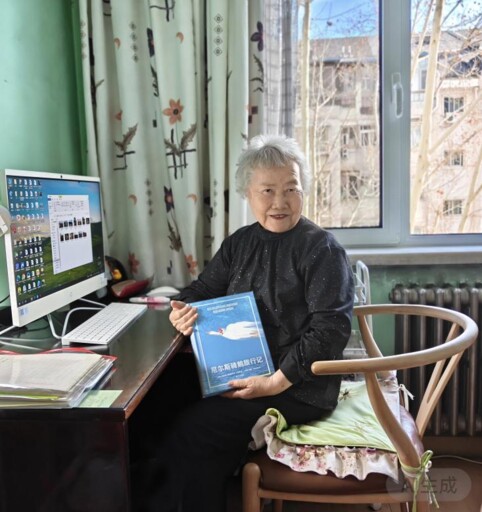
Shi Qin’e and her translated work The Wonderful Adventures of Nils Photo: Chen Yajing/CSST
When a translator is referred to as a “translation master,” the distinction lies less in the sheer volume of translated works than in the translator’s capacity to shape literary language and extend its expressive horizons. On Sept. 4, 2025, the 23rd World Congress of the International Federation of Translators (FIT) convened to present its translation prizes, including the Astrid Lindgren Memorial Award. The award was conferred on Shi Qin’e, a Nordic literature expert from the Institute of Foreign Literature at the Chinese Academy of Social Sciences (CASS), marking the first time the honor has been awarded to a translator from Asia. In its citation, the jury highlighted Shi’s sustained dedication to children’s literature and underscored the way her career has united meticulous translation practice with long-term educational commitment.
Recently, CSST paid a visit to Shi at her residence. Upon entering, one is immediately struck by her vibrant and spirited presence. Against the wall stands a small table neatly arranged with trophies and certificates: awards from the Swedish Authors’ Fund, the First Prize of the National Award for Outstanding Foreign Literature Publications (2000–01), the Hans Christian Andersen Award, and the “Lifetime Achievement Award in Translation” from the Translators Association of China, among others. Together, these honors testify to her remarkable achievements and enduring contributions to the world of translation.
Embarking on journey into Nordic literature
Shi’s association with Nordic literature took shape through a particular historical opportunity. After graduating in 1958, she joined the Ministry of Foreign Affairs and was sent to Sweden to study the Swedish language. Upon completing her studies in 1962, she returned to China to take up a position as a lecturer in Swedish at the Beijing Foreign Languages Institute (now Beijing Foreign Studies University). This cohort of students constituted China’s first group of university students formally trained in a Nordic language.
In 1980, Shi transferred to the CASS Institute of Foreign Literature, thus beginning a long and sustained engagement with the study and translation of Nordic literature. Recalling her early days at the institute, she noted: “At the time, there were many well-known scholars there. I was something of a latecomer—I had been engaged in teaching and had never worked in literary research before. Even so, I was not discouraged. Instead, I became more determined to work hard, aspiring to learn from them and accomplish something significant.”
Shi observed that although literary histories of French, German, and other national traditions were already available in China, there was no comprehensive history of Nordic literature. “At that time, there was not a single book on the history of Nordic literature. I hoped to fill this gap. I once mentioned this to writer and translator Feng Zhi, and he advised me not to rush, as compiling a literary history is a formidable task.” Acting on this advice, Shi turned first to translation, devoting herself to world literature more broadly and laying a solid foundation for the eventual writing of a history of Nordic literature.
In 1981, Shi was invited to attend the First International Strindberg Theatre Festival in Stockholm. At a symposium held during the festival, she delivered a report in Swedish entitled “Strindberg in China,” offering a detailed account of the translation, reception, and critical evaluation of Strindberg’s works in China from the early 20th century through the 1980s.
“During the early years of reform and opening up, I devoted myself to the introduction and translation of Nordic literature,” Shi recalled. After returning to China, she compiled her experiences from the conference, along with reflections on revisiting Sweden after two decades, into an article entitled “The Chinese People,” which was published in People’s Daily.
Shi’s accomplishments in translation and research alike are substantial. In her translation practice, she adheres to principles of fidelity to the original text, sensitivity to context, and the transmission of cultural spirit, focusing particularly on Nordic classics. Her Chinese translation of The Wonderful Adventures of Nils captures the humanistic depth and fantastical qualities of the original while remaining highly readable, and has become an influential Chinese edition. She has also translated the Nordic epics Edda and Saga, and served as chief editor of Icelandic Sagas: A Selection, thereby filling a major gap in the Chinese translation and introduction of ancient Nordic texts. In research, she has participated in national-level projects, co-authored History of European Literature, and edited Contemporary Nordic Short Stories, constructing a comprehensive framework for introducing Nordic literature from ancient mythology to modern and contemporary works. Through these efforts, she has made significant contributions to the development of foreign literature studies in China and given Chinese readers the resources for a panoramic understanding of Nordic literature.
Building cultural bridges through language
In 2005, Shi’s History of Northern European Literature was officially published. As the first work in China to systematically trace the literary development of the five Nordic countries, the book spans ancient mythology, modern literature, and contemporary writing, introducing major authors, representative works, and literary movements across different periods. It has since become a standard textbook for foreign literature majors at Chinese universities.
In 1992, Shi was seconded to the Chinese Embassy in Iceland, where she encountered Icelandic epics—Edda and Saga—for the first time. “Although I had long heard of Icelandic epics, I knew little about their specific content, and there were very limited resources available in China. Seeing ancient Saga manuscripts written on lambskin parchment for the first time was truly overwhelming,” she recalled. During the process of translating Edda and Saga, Shi came to recognize the extraordinary richness of Icelandic epic literature. “If these works could be translated into Chinese, they would greatly broaden the reading horizons of Chinese readers.”
In Shi’s view, translation is not merely a transfer between languages, but also a process of cultural exchange and dissemination. After successfully translating a number of Swedish literary works, she received invitations from publishers hoping she would introduce works from other Nordic countries as well. Shi explained that although the five Nordic countries are geographically close, they encompass six distinct languages. In Norway, alongside the official Norwegian language, New Norwegian—formed through the deep interweaving of local dialects and Danish—constitutes an indispensable linguistic tradition.
To work more effectively across Nordic literatures, Shi expanded her linguistic repertoire beyond English and Swedish. In 1991, she was invited to serve as a visiting professor in Denmark. During her three to four months there, she actively participated in literary events, engaged in discussions with writers, took part in the selection process for the Nordic Council Literature Prize, and enrolled in a Danish language program, through which she mastered the essentials of the language. Over the following decade, she devoted herself to refining a direct-from-Danish Chinese translation of The Complete Fairy Tales and Stories of Hans Christian Andersen. Characterized by precision and delicacy, this translation was selected as the official edition for the celebrations commemorating the 200th anniversary of Andersen’s birth.
To better understand Norwegian literary works, Shi later undertook the challenge of teaching herself Norwegian. She took advantage of diplomatic events at the Norwegian Embassy in China to consult the ambassador and embassy staff on translation-related questions. Over a period of seven to eight years, from the age of 63 to 70, she gradually acquired proficiency in Norwegian through this distinctive and self-directed approach.
Nurturing new generation of scholars
“One is never too old to learn. There are still so many things I need to study,” Shi remarked. “I constantly feel that there is never enough time. In the blink of an eye, I am already 89, yet there are still many things left unfinished. In translation, we often encounter a practical difficulty: Languages such as English and German have dictionaries, but many minor languages do not, which makes translation extremely challenging.”
In 2024, China’s first truly Swedish dictionary, A Concise Swedish-Chinese Dictionary, was published, filling a long-standing gap in reference tools for lesser-taught languages. Reflecting on the motivation behind compiling the dictionary, Shi explained: “Although Nordic literature has long been translated and introduced into China, Chinese readers’ understanding of it remains limited. Beginners in Swedish often have to consult a Swedish-English dictionary first, and then an English-Chinese dictionary. This process is not only cumbersome but also prone to inaccuracies.”
In her later years, Shi has become increasingly attentive to the role of reading in children’s growth. The Nordic tradition of children’s literature is rich and well established: Andersen’s works are renowned worldwide, Sweden’s Pippi Longstocking enjoys international acclaim, and Norway likewise boasts outstanding children’s literature. Shi firmly believes that these works, both entertaining and instructive, help children better understand the world and cultivate virtues such as kindness, integrity, and courage.
Shi has long placed great emphasis on academic continuity and mentorship. Even after retirement, she has continued to support the growth of younger scholars and translators, sharing her experience and research methods without reservation. She encourages the younger generation to solidify their linguistic foundations while developing a deep awareness of cultural differences, and to approach every translation with scholarly rigor. At present, she remains engaged in compiling the Nordic Literature Translation Series, carefully planning its contents while actively incorporating young scholars into the editorial process to aid their development.
“Literature is the finest medium for dialogue among civilizations, and translation means building cultural bridges across national borders.” Through more than six decades of unwavering dedication, Shi has embodied this belief. From language teaching to academic research, from diplomatic service to international exchange, and from the translation of classics to the foundational building of a discipline, each step of her journey has been closely intertwined with cultural exchange between China and Northern Europe. Her translations and scholarship have not only enriched the corpus of China’s foreign literature studies, but have also promoted dialogue and mutual understanding between civilizations, contributing scholarly strength to the building of a community with a shared future for humanity.
Editor:Yu Hui
Copyright©2023 CSSN All Rights Reserved