


Physical bookstores await spring
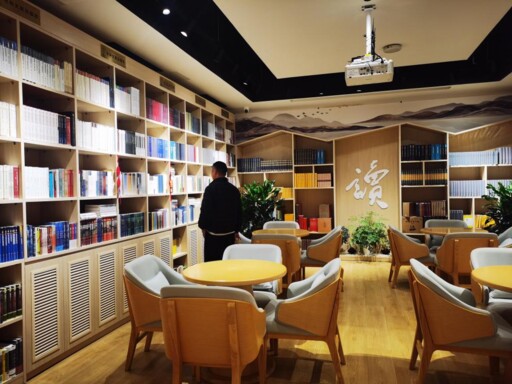
Dushuren Bookstore Photo: Duan Danjie/CSST
Recently, the Beijing Municipal Bureau of Press and Publication released a public notice proposing to grant support and incentives to 437 physical bookstores and 2,153 reading and cultural activities across the city. After public review, bookstores that meet the eligibility criteria will receive financial support, with a maximum of three million yuan (approximately $428,161) for large bookstores and up to one million yuan (approximately $142,720) for small and medium-sized ones. For physical bookstores struggling through a harsh winter, this support is undoubtedly a timely lifeline.
Stepping into Dushuren Bookstore, located within the Chinese Academy of Social Sciences (CASS), visitors are greeted by warm yellow lighting. Several readers stand quietly before the shelves, absorbed in weighty academic volumes. Zhang Huabing, the bookstore’s general manager, looks on with a sense of comfort tinged with concern. “What we are safeguarding is an academic oasis,” he said. “But beyond this oasis, the survival environment for physical bookstores is undergoing an unprecedented cold spell.”
Zhang’s sentiment is widely shared. In recent years, the difficulties facing physical bookstores have been the subject of constant discussion. On one hand, news of trendy “internet-famous” bookstores opening or specialty bookstores expanding frequently makes headlines; on the other hand, soaring costs, diverted customer traffic, and uncertainty over how to reposition and transform their business models have left many bookstores struggling to stay afloat. What challenges are physical bookstores truly facing, and where are they headed? To explore these questions, CSST spoke with several scholars and industry professionals.
Systemic difficulties amid changing times
Set against these mounting pressures, the “winter” confronting physical bookstores has been harsher than expected. “Either readers don’t come, or they come only to browse offline and place orders online,” said Hao Dachao, general manager of Sanlian Taofen Bookstore, articulating a dilemma shared across the industry. This so-called “fitting-room effect” has become a serious blow to the survival of brick-and-mortar bookstores.
The data is even more sobering. Surveys show that in 2024, physical bookstores accounted for just 14% of total book retail sales revenue, while platform-based e-commerce represented 40.9% and content-based e-commerce 30.4%. This structural imbalance has left physical bookstores increasingly disadvantaged in market competition. “Physical bookstores face not only the common pressures of rising rents and customer diversion typical of brick-and-mortar commerce, but also structural challenges unique to the book industry,” explained Ren Jiangzhe, chairman of the China Xinhua Bookstore Association, as well as Party secretary and executive director of Xinhua Bookstore Head Office. Overall demand for print reading is declining, and relying solely on book sales is no longer sufficient to sustain operations.
Bookstores that once filled airports and railway stations have nearly disappeared, and even some high-profile internet-famous bookstores have closed in large numbers. Zhang Zhiqiang, executive deputy director of the Publishing Research Institute at Nanjing University, distilled the challenges facing physical bookstores into four unavoidable factors: economic pressure, fierce competition from online bookstores, shifts in social reading habits, and the instability of government support policies.
The difficulties faced by physical bookstores are not an isolated industry issue, but a microcosm of the profound transformations of the digital age. “The real competitors of physical bookstores are no longer just e-commerce platforms, but short-video and social media apps that occupy people’s fragmented time,” observed Cao Hongyu, assistant to the president of Minzu University of China Press.
Changes in the reading ecosystem support this observation. In 2024, Chinese adults spent an average of 108.76 minutes per day on mobile phones, compared with only 24.41 minutes reading printed books. Sheng Hu, a professor from the School of Humanities at Central South University, noted that the development of the internet has shifted cultural consumption from deep reading driven by a demand for knowledge to fragmented and shallow reading driven by a demand for information. “The book-selling function of physical bookstores has been severely weakened by ‘high-efficiency, low-price online channels,’ yet bookstores have not fully transformed into ‘high-cost, experience-oriented cultural spaces,’” Hao explained. This state of “transition limbo” is perhaps the most accurate portrayal of the industry today.
Price disparities further exacerbate the problem. Online platforms often sell books at 50-70% of list price, with promotional prices sometimes dropping to 30-40%. Physical bookstores—burdened by fixed costs such as rent and labor—are usually forced to maintain list prices. A book priced at nearly 100 yuan can be purchased online for just 30 or 40 yuan after discounts. With such a large price gap, consumers naturally gravitate toward online purchases. Wang Bin, director of the Marketing Center at China Social Sciences Press, noted that physical bookstores, positioned in the middle of the book distribution chain, are under enormous operational pressure.
The changing purchasing habits of Ding Fan, a senior professor of the humanities and social sciences at Nanjing University, are emblematic of this broader trend. A scholar and passionate bookstore browser since the 1970s, he has largely stopped visiting physical stores since the early 2000s, turning instead to searching online for good books. This shift, in miniature, captures how broader technological and cultural changes have reshaped everyday reading habits.
Seeking new paths through persistence and innovation
Despite formidable challenges, industry practitioners have not resigned themselves to decline. Instead, they are actively exploring new pathways, seeking opportunity amid crisis. “The future of physical bookstores lies in redefining their core value—from book retailers to operators of reading-based cultural lifestyles,” Hao argued. Successful bookstores, in his view, should become urban cultural living rooms, community social hubs, and third spaces that inspire creativity and reflection.
Professionalization and differentiation have become common strategies. Zhang explained that Dushuren Bookstore has cultivated a niche focus on the social sciences, establishing a selection committee to provide precise services to scholars and build a stable readership. “We have also launched an online platform to synchronize online and offline sales, creating a virtuous cycle,” he added.
2025 saw a number of new-style bookstores exploring survival paths through extreme specialization. Rather than trying to serve all readers, they focus on specific fields, replacing “big and comprehensive” with “small and specialized.” Qianmo Bookstore, located in Ji’nan, Shandong Province, has chosen a different route: deep engagement with local culture. The store features a distinctive mini post office displaying over a hundred postcards printed with scenes of the city’s springs, alongside dozens of carefully designed stamps incorporating Ji’nan’s cultural elements. This deep integration of regional culture with bookstore operations has gained scholarly recognition. Wang Guanyi, vice dean of the South China Business College at Guangdong University of Foreign Studies, noted that excavating, revitalizing, and utilizing local cultural resources is an effective way for physical bookstores to differentiate themselves, thereby building competitive advantages and helping them escape homogenization.
CITIC Bookstore’s efforts in creating cultural spaces are also representative. Liu Mengran, responsible for activity planning, explained that the bookstore organizes a wide range of cultural events each week. “The purpose is not simply to turn bookstores into sales venues, but to build vibrant public cultural spaces for knowledge production, exchange, and dissemination,” she said.
Some bookstores have also enhanced customer experience through scenographic spatial upgrades. Qingdao Book City, for example, has created themed IP spaces such as anime zones, Ultraman areas, and Pokémon displays to attract consumers. Similarly, the Nangang Xinhua Bookstore in Harbin, Heilongjiang Province, has constructed immersive thematic displays within the store, enhancing the sense of engagement.
Policy empowerment and digital opportunities
Sustained policy support and guidance in China have provided crucial backing for the healthy development of physical bookstores, most notably through the 2016 issuance of the Guiding Opinions on Supporting the Development of Physical Bookstores by 11 government departments. The nationwide reading initiative has been written into the Government Work Report for 12 consecutive years, and a National Reading Activity Week has recently been formally established. Taken together, these measures have helped create a favorable policy environment for physical bookstores.
In an era of irreversible digitalization, physical bookstores are undergoing profound transformation. “We must recognize that screens are no longer just tools; they have become part of our living environment,” Liu observed. In the digital age, offline cultural activities allow physical bookstores to highlight their unique locality, embodied social interaction, and authentic emotional connections. Wang noted that many bookstores are actively exploring hybrid models such as “bookstore plus cultural creativity” and “bookstore plus exhibitions,” and experimenting with VR and AR technologies to create immersive reading spaces, striving for deep online–offline integration and mutual empowerment.
“Bookstores such as All Sages Bookstore, SDX Joint Publishing Company, and Beijing Books Building are far more than places to buy books—they carry the reading memories and cultural emotions of countless people,” said Wu Chao, a research fellow from the Institute of Contemporary China Studies at CASS. The scent of books, the tactile sensation of turning pages, and the serendipity of encountering a good book combine to create a rich cultural experience that online platforms cannot replicate.
Between the shelves, a young reader crouches in a corner, fully immersed in a book, while the city’s noise contrasts sharply with the quiet inside. In an age of unstoppable digitalization, such scenes are becoming increasingly precious. Though winter has set in, the promise of spring is already palpable. With policy support, industry self-help efforts, and growing social recognition, physical bookstores continue to keep watch amid the cold, nurturing new life through perseverance.
Duan Danjie, Wang Guanglu, Zhang Yixin, and Chen Yajing contributed to this story.
Editor:Yu Hui
Copyright©2023 CSSN All Rights Reserved