


American scholar reveals unique value of archaeology
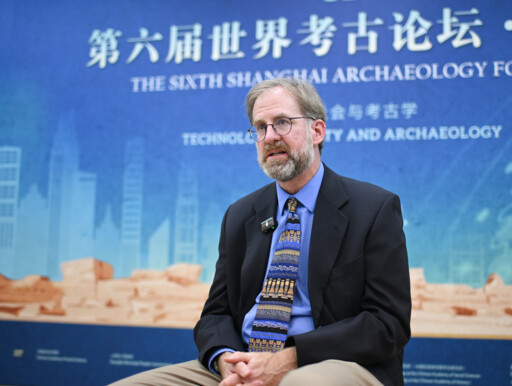
Scott Ortman, director of the Center for Collaborative Synthesis in Archaeology at the University of Colorado Boulder in the United States Photo: Wang Zhou/CSST
On Dec. 16, 2025, the Sixth Shanghai Archaeology Forum was held in Shanghai under the theme of “Technology, Society and Archaeology,” gathering over 300 experts and scholars from more than 40 countries and regions. During the forum, CSST interviewed Scott Ortman, director of the Center for Collaborative Synthesis in Archaeology at the University of Colorado Boulder in the United States. Combining his passion for exploring the commonalities of human civilizations with his practical experience in interdisciplinary collaboration, Ortman shared forward-thinking insights into archaeology. From the interactive evolution of technology and society to archaeological insights across different cultural contexts, and from the challenges facing the field to the responsibility of passing knowledge on to younger generations, he grounded his views in solid research and a broad international outlook, highlighting archaeology’s distinctive role in linking the past with the present and informing humanity’s future development.
Commonalities in civilizational development
CSST: Archaeological records serve as a vital bridge connecting history and reality. In your view, what unique insights does archaeology offer into the development of humanity?
Ortman: Well, one thing I would say is that documentary evidence regarding civilizations always reflects the views of the people who were writing things down. Because archaeological evidence is a record that exists today and continues to exist, we can go back to it and ask new questions of it from different points of view. As time goes on, the record is also decomposing. I wouldn’t say it’s a race, but we can’t do nothing—we have to keep working. If we’re going to integrate the cumulative experience of humanity to chart a better future, archaeological evidence is the best evidence and most inclusive evidence we have.
Something that continues to be amazing to me is how similar the story of human development is in different parts of the world. And I don’t think it’s just because people are finding what they want to find, or already have a belief about it and are just imagining it. It’s really there, in archaeological records.
There’s much more variety in the art styles, languages, social structures, family structures, and kinship systems of cultures around the world. They are very much more and broader patterns of human development, of learning how to produce food, store surplus, and build public goods, and of ritual integration, etc. There are certain paths that societies all over the world and throughout history have followed in seeking prosperity and sustainability. What understanding actually lies behind the common patterns is much more difficult than just identifying their existence.
To make progress, what you have to figure out is the right altitude from which to observe human development. If you look too close to the ground, all you see is local detail and nothing has ever happened twice in detail; if you go too far up, you know, into outer space, we are all human beings living on the earth in the end. There’s gravity and 24 hours in a day. It’s all the same, so there’s some level in between those two. That is where the key things that are driving these common patterns of human development are hidden.
Crucial role of technology
CSST: “Technology” and “society” were among the key themes of the Sixth Shanghai Archaeology Forum. How do you interpret the role of technology in social evolution and the interactive relationship between the two from an archaeological perspective?
Ortman: It’s very clear that advances in technology and history have expanded the possibility space for human cultures, and for development and coordination. This can be traced back all the way back to agriculture, which made it feasible for people to permanently settle in one place. Humans benefit from working together, from being close, and from being able to coordinate their activities. Agriculture made that feasible, and other technological advances have just made it even more so. It’s clear that technology is an important driver.
One reason technology is very important is that you could think of technology as emanating from human knowledge. It’s knowledge of materials, of processes, of phenomena, and of what people learn—how to control fire, how to turn clay into pottery, and how to turn stone into metal, all those sorts of things.
What I think AI will help us the most with is abstracting from details. You can process more details more rapidly, but what are the summary abstractions that come out of it? And with AI, I think, the most helpful progress in science has always involved useful abstractions. Without abstraction, there’s just reality. You can’t predict anything with reality. But what are the useful concepts that we will develop by abstracting from all that information? That’s going to continue to take place in smart people, thinking about them and thinking about the data. I don’t think the computer by itself can do that.
Archaeological records show us how human societies work. The history of development is the same, but the patterns and sequences of development that occur in societies around are not. Technology has played a role in that process. It is an expression of knowledge, and it is knowledge that everyone benefits from. Economists say that technology is non-rival and non-excludable, and what that means is that the knowledge exhibited by technology is knowledge that all people benefit from, not just the people that know how to make an iPhone.
Opportunities for change
CSST: What positive developments are taking place in the field of archaeology? And what is the mission of young scholars in preserving and advancing this discipline?
Ortman: The most positive change is just how much easier it is now to integrate, process, and analyze information, due to the combination of computing technology, the internet, and now remote sensing, geophysics, and all that. Our ability to collect information systematically from the archaeological reference has expanded exponentially in my lifetime. And there are huge benefits: not only in collecting information, but also in processing, analyzing, organizing, and examining it.
I’d like to think that archaeology is rapidly becoming something like a “census bureau of the past,” for long stretches of time in a radically inclusive way. Not all aspects of human behavior leave systematic traces in the archaeological market; many things that people did are lost. But there are some things that have been systematically preserved. The ways in which people utilized ceramic vessels have been preserved systematically everywhere in the world where people have done it. There are very few places around the world where ceramic vessels are not preserved in archaeological remains. You have the opportunity to measure that aspect of human behavior systematically everywhere, for all people who have ever lived. What more could you ask for?
Core challenges
CSST: What are the core challenges currently facing global archaeology?
Ortman: I would say the challenge for today is balancing the ideals of open science with the concerns about heritage and belonging. In my country, one of the challenges that we face is that much of the archaeological records of the United States—that is, the history of native American communities and those communities that have been there—is often excluded from the benefits of American civilization.
Leaders of many of those communities are frustrated by that and are concerned about the aspects of traditional archaeology that have been, in their view, extractive. People from other communities are coming and moving things from their ancestral places and taking them away for their own benefit—not the benefit of the future.
In many parts of the world, archaeological practice has evolved in ways that benefit local, indigenous, and traditional communities, while also feeding our broad understanding of the community, human development, and creating a better future for all of us. We need to integrate the wisdom of indigenous peoples all over the world—as well as ancient civilizations—in charting a better future, making sure that we can do that in ways that indigenous people find positive as well. I do think that’s a challenge.
Archaeological records are radically inclusive, but archaeological practice has not been, so we need to make the practice of archaeology more consistent with the material heritage we study. We have to work together to overcome that legacy for archaeology to reach its potential. It’s appropriate for people to send community members to care about what happens to their ancestral things, and to insist that archaeology is done in ways that provide benefits to them as well. It’s the right thing to do, so archaeology needs to adapt if it’s going to take advantage.
Diverse wisdom
CSST: How do you understand the diverse wisdom reflected in archaeological work—from research topic selection to heritage preservation—across different cultural contexts?
Ortman: Every archaeologist chooses what to investigate, and they make those decisions based on their conversations, other aspects of their life, and the social context in which they live. It’s wonderful to be exposed to that diversity of perspectives, because it helps all of us to have a broader conception of what’s important to people.
There’s an interestingly infinite number of questions we could potentially ask of archaeological records. So which ones do we ask? Which ones do we focus on? It is all subject to the points of view of the archeologists.
An example is the unearthing of a sluice gate when building a new apartment building in Shanghai. The excavating team found, while building the foundation of the building, traces of a medieval or 14th-century public works project. The city government, or the local government of Shanghai, thought that the finding was significant enough to preserve, and changed how that land was going to be used—turning it into a museum. This sends a message about the important values of the people of Shanghai today.
Doing archaeology always involves making choices: What do we focus on, what do we preserve, and what do we pay attention to? It’s great that people in different parts of the world have different answers to those questions—it helps all of us to think more broadly about what we do.
Editor:Yu Hui
Copyright©2023 CSSN All Rights Reserved