


Chinese classical gardens contain rich ecological wisdom
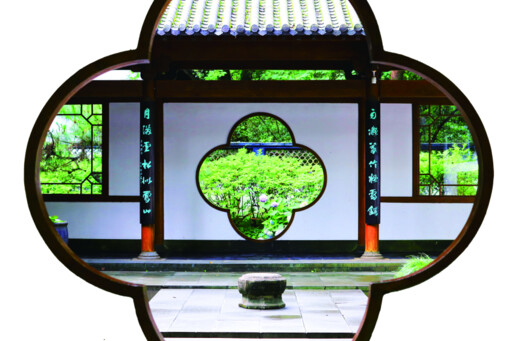
The plum blossom gate of the Jiangnan-style garden at Yunsong Bookstore in Hangzhou, Zhejiang Province Photo: TUCHONG
Chinese classical gardens have a long history and are treasured gems of Chinese civilization. For centuries, they have been regarded both as places of residence and as landscapes to be appreciated. Gardens such as the Humble Administrator’s Garden (Zhuozheng Yuan) and the Lion Grove Garden in Suzhou, Jiangsu Province; the Mountain Resort in Chengde, Hebei Province; the Geyuan Garden in Yangzhou, Jiangsu Province; and the Jichang Garden in Wuxi, also Jiangsu, are representative exemplars that integrate the vitality of natural landscapes with the ingenuity of human craftsmanship.
With the rise of Western ecocriticism, however, questions about Chinese classical gardens have begun to surface: Are Chinese gardens ecological or anti-ecological? Are they paradigms of the unity of humanity and nature, or expressions of anthropocentrism? For readers new to ecocriticism, such questions can be genuinely perplexing, since a core tenet of ecocritical thought is the critique of anthropocentrism, and this framework is often used to evaluate human engagements with nature.
Confusion of anthropocentrism
Anthropocentrism, in simple terms, is the view that human beings occupy the center of the universe, and that everything in nature exists for human purposes. Nature is thus viewed merely as a means or tool for realizing human ends.
Under the influence of this outlook, value judgments are made primarily from the standpoint of human interests: What benefits humans is considered good and worth pursuing, while what does not is deemed undesirable or unnecessary. In the eyes of environmental humanists and ecocritics, anthropocentrism lies at the root of today’s ecological degradation, because in the pursuit of maximizing human benefit, the rights and lives of non-human beings are neglected or violated, ultimately destabilizing the Earth’s life-support systems.
Critiquing anthropocentrism is both reasonable and necessary. Yet in some overly simplified or extreme discussions, concern for human interests is equated wholesale with anthropocentrism, giving rise to a reflexive aversion to any emphasis on “the human.”
Under this logic, literary works that draw on elements of nature to express human emotion or values are easily labeled anthropocentric. By this standard, many of the most celebrated works in Chinese literary history would fall under suspicion, since techniques such as expressing emotion through scenery or articulating ideals through objects have long been integral to the literary tradition.
This raises a familiar question: Does projecting human emotions onto natural scenery amount to manipulating or exploiting nature? Are lines such as Tang (618–907) poet Li Bai’s “I raise my cup to invite the moon who blends. / Her light with my shadow and we’re three friends” (trans. Xu Yuanchong) or Tang poet Du Fu’s “Grieved over the years, flowers make us shed tears; / Hating to part, hearing birds breaks our heart.” (trans. Xu Yuanchong) expressions of anthropocentrism?
These verses appear to anthropomorphize natural entities rather than acknowledge their subjectivity. Extending this reasoning to Chinese classical gardens, their artificial mountains, managed waters, constructed terraces, and borrowed scenery are all the results of human intervention in nature, and their construction is oriented toward human needs. Does this make them anti-natural expressions of anthropocentrism?
The answer is no. The confusion stems from the application of an inappropriate evaluative framework. While Western ecocritical theory is well intentioned, it often perpetuates a dualistic mode of thinking characteristic of Western culture. Applying such a framework to cultural phenomena rooted in the Chinese ideal of the unity of humanity and nature risks serious distortion.
For over five millennia, Chinese civilization has flourished on this land, developing in close entanglement with its natural environment, sharing weal and woe in a relationship of mutual embeddedness—“you within me, and I within you.” This is fundamentally different from the Western conception of a rigid either–or dualism that separates subject and object, humanity and nature.
In Chinese cultural thought, nature is a humanized and poeticized nature, one in which subjects and objects form an organic whole. Without reverence for and affection toward nature, ancient literati could not have produced the vast corpus of enduring natural poetry that defines the tradition.
To grasp the ecological implications of Chinese classical gardens, we must therefore resist mechanically importing Western ecological frameworks that presuppose a sharp human–nature divide. What is required instead is an appreciation of the sense of a shared community of life embodied in these gardens, and of the wisdom they offer for the sustainable coexistence of humanity and nature.
Ecological attributes
Chinese classical gardens integrate architecture, painting, calligraphy, literature, sculpture, and the beauty of nature into an organic whole. Possessing both cultural and natural qualities, they stand as paradigms of harmonious coexistence between humanity and nature, embodying rich and multifaceted ecological wisdom. Generally, Chinese classical gardens exhibit a strong sense of livability, naturalness, and a striking ecological character.
Livability: From a human perspective, these gardens provide not only comfortable physical environments but also spaces for self-cultivation and spiritual nourishment. From the perspective of nature, they function as self-contained microhabitats, forming distinctive ecosystems capable of sustaining biodiversity. In terms of architectural design, Chinese classical gardens follow natural conditions, emphasizing energy conservation, low-carbon principles, and environmental friendliness. Aesthetically, they offer multisensory engagement—visual, auditory, tactile, olfactory, and kinesthetic—rich in interest and resonance, creating quintessential aesthetic environments in which body, mind, and surroundings are fully integrated.
Livability is a defining feature of Chinese classical gardens. Gardens are built to serve human needs, and functionality therefore plays an important role. Unlike Western gardens, Chinese classical gardens do not solely emphasize visual appreciation. If Western gardens are characterized by a mode of “viewing the picture from outside,” Chinese gardens emphasize “dwelling and roaming within the picture,” highlighting harmonious interaction and mutual integration between humans and nature.
This livability is reflected not only in physical comfort but also in their capacity to fulfill spiritual and psychological needs. The arrangement of mountains, waters, and plants creates visual pleasure and a sense of tranquility amid urban bustle, while plant choices—such as plum, orchid, bamboo, chrysanthemum, and lotus—carry symbolic meanings tied to the spiritual pursuits of the ancient literati.
The Confucian dictum that “wisdom delights in water; love delights in hills” underscores the formative influence of landscapes on moral cultivation. Within the constructed mountains and managed waters of classical gardens, personal character and moral cultivation are nurtured. In this sense, Chinese classical gardens offer literati not merely spaces for leisure or health preservation, but environments that fuse “home” and “garden,” satisfying both bodily and spiritual needs and exemplifying genuinely ecological livability.
Naturalness: The highest ideal of Chinese classical gardens is encapsulated in the phrase “though made by human hands, they appear as if born of nature.” Although artificially constructed, such gardens convey a sense of natural spontaneity.
Naturalness is another defining feature of Chinese classical gardens and one that encapsulates much of their ecological wisdom. One dimension of this naturalness lies in preserving the original forms of natural elements during construction and avoiding excessive carvings or artificial embellishments. As a result, Chinese gardens differ markedly from many European gardens characterized by geometric patterns and strict symmetry. Instead, they “bend according to form and curve in response to terrain,” striving to retain the original states of plants, rocks, and water features. This explains why some European missionaries during the Ming (1368–1644) and Qing (1644–1911) dynasties were struck by their apparent “wildness,” “disorder,” or “irregularity” in their first encounter with Chinese gardens.
In fact, this apparent wildness and irregularity stem from adherence to the principle of the unity of humanity and nature, modeling design on nature itself and achieving harmonious rhythm through forms that are “unconfined by rigid rules.” Such an approach reduces construction costs and avoids damaging natural landforms, embodying an environmentally responsible architectural philosophy.
Another dimension of naturalness is spontaneity, or natural unfolding. The natural state cultivated in Chinese classical gardens allows those who dwell within them to experience a sense of returning to nature, achieving relaxation of body and mind and the cultivation of emotions and temperament. This, too, reflects an ideal of unity between humanity and nature, fulfilling the garden designer’s aspiration to “enlighten heart from ambience and shape landscape by ambience.” In this sense, Chinese gardens embody both the humanization of nature and the naturalization of humanity.
Ecological character: Chinese classical gardens contain astonishing ecological wisdom, and even when evaluated through the lens of modern ecology, their ecological sophistication remains impressive. From site selection and spatial layout to the management of terrain and water systems, from flora and fauna choices to architectural design and microclimate regulation, these gardens reflect an integrated ecological worldview held by ancient Chinese thinkers.
In Yuan Ye (The Craft of Gardens), written by Ji Cheng during the Ming Dynasty, beyond the core principle “though made by human hands, they appear as if born of nature,” emphasis is also placed on principles such as emphasizing “skillful adaptation and borrowing to achieve harmony,” “appropriateness to local conditions,” and “adapting to the natural contours while ensuring frugality in the use of resources.” These principles stress adapting to local environments and harnessing local materials, thereby conserving labor, materials, and natural resources. At the same time, they allow full use of regional geographical advantages, enhancing the ecological adaptability of gardens.
Plant arrangements in Chinese gardens typically combine trees, shrubs, grasses, and mosses to form multilayered vegetation structures. This not only achieves an aesthetically pleasant balance of density and variation but also supports biodiversity, improves light utilization, prevents soil erosion, and provides shade for buildings to moderate temperature. These plant communities interact with ponds, rockeries, and streams to form micro-circulatory ecosystems that regulate humidity and temperature while providing habitats for birds, fish, and insects. The waste produced by these animals, in turn, nourishes plant growth, forming a virtuous ecological cycle that exemplifies harmonious coexistence between humanity and nature.
The ecological wisdom embodied in Chinese classical gardens represents only one expression within the vast tradition of Chinese ecological thought. Chinese civilization possesses uniquely favorable ecological foundations, with long-standing and deeply rooted cultural traditions. From ancient concepts such as “the unity of humanity and nature,” “the Dao follows what is natural,” “benevolence toward people and care for all living beings,” and “all beings as one,” to modern ideas such as “lucid waters and lush mountains are invaluable assets,” the notion of a “community of life for humanity and nature,” and the goals of achieving peak carbon emissions before 2030 and carbon neutrality before 2060, ecological thinking has developed in a continuous lineage, contributing significantly to the sustainable development of the Chinese nation.
Li Sujie is a professor from the School of English Studies at Beijing International Studies University.
Editor:Yu Hui
Copyright©2023 CSSN All Rights Reserved