


Integrated macroeconomic policies herald good start of 15th FYP
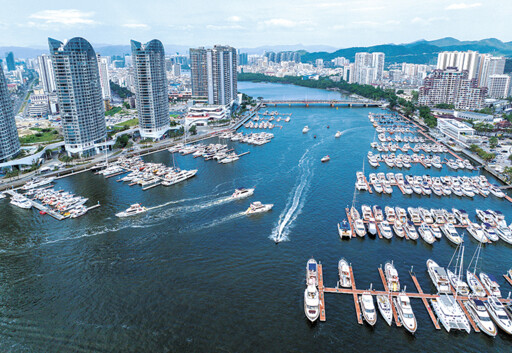
On Dec. 18, 2025, the Hainan Free Trade Port officially launched its island-wide special customs closure operation. The picture shows the Sanya Central Business District, where 9,678 enterprises had settled in as of Nov. 1, 2025, forming two 100-billion-yuan modern industrial clusters in the sectors of finance and commerce. Photo: IC
The 2025 Central Economic Work Conference called for the continued implementation of a more proactive fiscal policy and a moderately loose monetary policy, while also making important adjustments to policy priorities in response to new developments in macroeconomic performance.
More proactive macro policies
In 2025, China’s macroeconomic performance showed strong and steady improvements, with two particularly notable features. First, the pattern of general government expenditure growth lagging behind nominal GDP growth in recent years was reversed. China’s general fiscal expenditure rose 7.9% year-on-year in the first three quarters of 2025, playing a critical role in stabilizing domestic demand.
Second, the moderately loose monetary policy made a substantial contribution to stabilizing confidence. At the end of 2024, China adjusted its monetary policy stance to “moderately loose” and, for the first time, introduced the formulation of “strengthening unconventional counter-cyclical adjustments.” These moves had a positive effect on the capital market, notably helping to restore confidence among both domestic and international investors in China’s capital markets and in the medium- to long-term macroeconomic outlook.
New dynamics
Looking ahead to 2026, China’s economic development will still face a mix of long-standing issues and new challenges. Most of these, however, stem from development and transition, and do not alter the fundamental conditions underpinning the economy’s long-term positive trajectory. This makes it necessary to grasp two basic features of current macroeconomic performance and to continuously consolidate and extend the momentum of steady improvement.
The first is the emergence of a “pulse-like growth” pattern. In 2025, GDP grew 5.4% year-on-year in the first quarter, 5.2% in the second, and 4.8% in the third, creating some pressure to meet growth targets toward year-end. Similar patterns have appeared in recent years, indicating that maintaining stable growth still requires sustained and forceful policy support.
The second feature is the ample potential for economic growth. China’s current growth rate of around 5% is not low, but major price indices have not shown high inflation. It is therefore reasonable to infer that China’s potential growth rate remains above 5%, indicating considerable development space.
Leveraging integrated effects
On this basis, China is expected to maintain a deficit-to-GDP ratio of around 4% in 2026, with a deficit of roughly 5.8 to 6 trillion yuan—about 200 billion yuan more than in 2025. Issuance of ultra-long-term and special treasury bonds is projected at around 2 trillion yuan, while local government special-purpose bonds are expected to total about 5 trillion yuan. Taken together, new government debt is likely to exceed 13 trillion yuan, about 1.5 trillion yuan more than in 2025, resulting in a general deficit ratio of roughly 9%. Under this scale, general government expenditure is projected to grow 6% to 8% in 2026, likely continuing to outpace nominal GDP growth and providing effective support for moderate expansion of domestic demand.
The conference reiterated the principle of “combining investment in physical assets with investment in human capital,” and explicitly called for stabilizing investment growth, including increasing central government budgetary investment where appropriate. It is therefore reasonable to expect a moderate strengthening of fiscal investment in 2026.
China has long grappled with the challenge of strong supply but weak demand. Yet only equipment investment directly expands supply capacity. Most infrastructure investments can be either productive or consumption-oriented, and many are entirely consumption-based. In 2026, China is expected to accelerate the construction of consumption-oriented infrastructure such as parking facilities, charging stations, and tourism roads, while increasing the share of investment in public services including elder care, childcare, and healthcare. High-quality urban renewal projects will also move forward. Although these measures are framed as efforts to stabilize investment, they are ultimately directed toward expanding consumption.
Monetary policy is also assuming a more prominent role in the strategy to expand domestic demand. The conference reaffirmed the moderately loose monetary policy stance and highlighted the need to promote stable growth and a reasonable rebound in prices. This reflects a significant policy adjustment in response to persistently low inflation in recent years.
The conference also called for “guiding financial institutions to scale up support for domestic demand expansion, sci-tech innovation, micro, small, and medium enterprises, and other key areas,” signaling that monetary policy will play an even more critical role in supporting demand. This enhanced predictability of monetary policy, together with clearer forward guidance, is expected to strengthen market expectations and social confidence, thereby helping to activate the economy’s endogenous drivers of development.
Xu Chaoyang is a professor and vice dean of the School of Economics at the University of International Business and Economics.
Editor:Yu Hui
Copyright©2023 CSSN All Rights Reserved