


Sculpting music and dance at the Longmen Grottoes
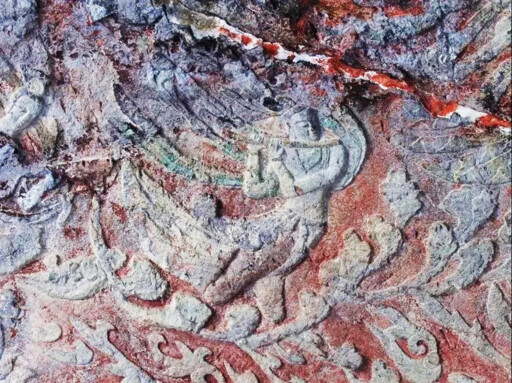
FILE PHOTO: Carving of a singing maiden playing the flute at the Longmen Grottoes
The Longmen Grottoes in Luoyang, central China’s Henan Province, bear witness to a 1,400-year saga of construction that began in the Northern Wei Dynasty (386–534), reached its height in the Tang Dynasty (618–907), and continued into the late Qing Dynasty (1644–1911). Over centuries, countless chisels and hammers carved more than a thousand grottoes and tens of thousands of Buddha statues into the cliffs. Among the many artistic forms preserved at Longmen, sculptures depicting music and dance occupy a distinctive position. Through the frozen rhythms of ancient melodies and the expressive grace of dancing figures, these images convey both the splendor of musical performance and the deep cultural integration of ancient Chinese society.
Musical instrument images in the grottoes
The Longmen Grottoes contain 21 caves with carvings of musical instruments, one stone pillar engraved with such imagery, and two Buddha pedestals featuring instrument motifs. In total, 176 surviving carvings representing 17 types of instruments can be identified, broadly categorized as percussion, wind, and plucked string instruments.
Among percussion instruments, qing (chime stones) and clappers are indigenous to China. Chimes appear twice, in the Middle Binyang Cave and the Southern Binyang Cave, both dating to the Northern Wei Dynasty, while clappers appear twice as well, in the Ten Thousand Buddha Cave and the cave housing the stone pillar base, both excavated during the Tang Dynasty.
Other percussion instruments—including bronze cymbals, waist drums, stick drums, and chicken-cage drums—were introduced from outside regions. Stick drums and chicken-cage drums are found exclusively in Tang Dynasty caves: Stick drums appear three times in caves such as the Bazuosi Cave and the Jinan Cave, while chicken-cage drums appear four times in caves including the Gunan Cave.
Bronze cymbals and waist drums are more common overall. Bronze cymbals appear five times in Northern Wei caves such as the Guyang Cave and the Yaofang Cave, and 12 times in Tang Dynasty caves including the Fengxian Temple and Longhua Temple. Waist drums fall into two types: narrow-waisted and broad-waisted. Narrow-waisted drums feature thick, hollow ends with a slender middle section, while broad-waisted drums have a thicker central body and comparatively slender ends. Northern Wei caves contain seven narrow-waisted drum carvings and three broad-waisted ones, while Tang Dynasty caves include 10 narrow-waisted examples and only a single broad-waisted drum.
The most frequently depicted wind instruments are native Central Plains instruments—the sheng, flute, and panpipes—along with the bili, which was introduced from the Western Regions. Flutes are the most numerous, appearing 30 times across different caves, and are divided into transverse and vertical types. Panpipes and sheng rank next in frequency among wind instruments: The sheng appears 10 times in both Northern Wei and Tang Dynasty caves, while 22 panpipe carvings survive, with a notable increase during the Tang period. By contrast, the bili, a foreign wind instrument, is relatively rare, with only 11 examples. In addition, the bei (conch), a ritual instrument used in ancient religious ceremonies to produce “Brahma sounds,” appears twice in Northern Wei caves.
Plucked string instrument carvings at Longmen include four types: the ruan, zheng, pipa, and konghou. The ruan and zheng, both well-known traditional Chinese instruments, appear frequently. The ruan is depicted seven times, while the zheng appears 17 times in total, with 11 examples dating to the Tang Dynasty—nearly twice as many as in the Northern Wei period. The pipa and konghou, introduced to the Central Plains from the Western Regions, are also present: The pipa appears 16 times, while the konghou appears only three times, all in its vertical form.
Although the number and types of instrument carvings vary from cave to cave, relatively complete orchestral formations can be identified, most arranged symmetrically. In Northern Wei caves, 70 identifiable instrument carvings representing 14 types form 16 orchestral groups of different scales. These ensembles are generally simple in instrumentation and small in size, typically comprising around five musicians playing no more than four types of instruments, all performed by jile tian (celestial musicians). The largest Northern Wei ensemble, located at the cave entrance on the front wall of the Lu Cave, includes 12 types of instruments.
Tang Dynasty caves contain 106 instrument carvings organized into 18 orchestral groups. Unlike the Northern Wei period, ensembles consisting of only a single instrument type disappear in the Tang Dynasty. Instead, Tang orchestras feature greater instrumental diversity and larger numbers of musicians—usually eight to ten performers—alongside celestial figures. Each orchestral group in a single Tang cave combines percussion, wind, and plucked string instruments, blending indigenous instruments with foreign imports, and reflecting the emergence of complete, large-scale orchestral systems.
Graceful singing and dancing figures
An ancient saying holds that “where there is music, there is dance; where there is dance, music must play.” Accordingly, images of dancing maidens appear frequently in the Longmen Grottoes, thriving in the Tang Dynasty. Most surviving carvings of dancing maidens are located on the main walls of caves and are usually arranged symmetrically; even when placed on side walls, they appear closest to the principal Buddha image. Dance scenes typically feature only a small number of maidens, most often solo or duet compositions. In some large-scale music-and-dance ensembles, however, dancing maidens occupy the central position—a testament to their important status.
Judging from body movements, Northern Wei dancing maiden carvings depict popular dances of the period, including the Baizhu Dance and the Zhezhi Dance. By the Tang Dynasty, the figures become markedly more vivid and fluid, closely reflecting the actual forms of Tang music and dance. In the Ten Thousand Buddha Cave, for example, the dancing maiden carved on the southern wall wears trousers and raises her hands forcefully above her head, with long silk scarves fluttering around her arms. She stands firmly on her right leg, with her left foot placed behind it. On the northern wall, another dancing maiden places her hands on either side of her hair bun, leans slightly forward, thrusts out her left hip, and lightly touches the ground with her right toe, with her upper body tilting sharply to the right. Her posture is elegant and restrained, embodying a distinctly feminine beauty. These dances can be stylistically divided into Jianwu (martial dance) and Ruanwu (soft dance). Both are typically performed as solos or duets with small casts. Jianwu is characterized by bold, forceful movements and a lively, clearly articulated rhythm.
Images of singing maidens also appear at Longmen, with six examples identified to date. Singing maidens, dancing maidens, and instrumental performers are arranged in coordinated roles with clearly differentiated positions, forming richly layered musical scenes that combine stylization with ritual elements.
Aesthetic and humanistic significance
The musical sculptures and performance scenes at the Longmen Grottoes are portrayed through both celestial musicians and jile ren (mortal musicians), bearing distinct hallmarks of Han ethnic culture. Early stylistic features inherited from the Yungang Grottoes, in Datong, north China’s Shanxi Province, evident in some early carvings at Longmen, gradually faded as religious art merged with everyday life and foreign influences blended with native forms, giving rise to a distinctive Central Plains humanistic style and a recognizably Chinese aesthetic. Apsaras and musical performers alike assumed new forms, while the expressions, facial features, and attire of Buddha figures grew increasingly reminiscent of ordinary people in society, lending them a more humanized and even feminized quality.
New stylistic characteristics also emerged in carving techniques. In Tang Dynasty caves, round-blade carving became the predominant technique, giving the sculptural art an air of greater elegance and grace. Craftsmen through the ages ventured bold innovations, breaking with earlier aesthetic constraints to infuse carvings with human emotion and scenes drawn from real life. By weaving romanticism into realistic representation, they endowed the carvings with heightened vitality and expressive power, achieving a profound unity of beauty and free expression.
Taken together, the music and dance images at the Longmen Grottoes record, in varying degrees, the prosperity and grandeur of ancient Chinese music and dance. They constitute invaluable and authentic historical materials for understanding the fusion of ethnic groups and the development of diverse cultures in ancient China. The evolution of court music systems—from the Seven Forms of Music to the Nine Forms and later the Ten Forms—is also reflected in the music-themed carvings at Longmen. The relatively complete orchestral formations and large-scale musical scenes reveal that musicians of the time possessed a developed sense of orchestration—attesting to their high levels of musical attainment—while also tracing the rise, decline, and evolution of individual instruments. Carvings of dancers and singing maidens in different costumes, poses, and styles across various scenes embody the imagination and creativity of sculptors across different eras, showcasing shifting social customs and intellectual currents, and the overall prosperity and vitality of ancient Chinese musical life.
The musical imagery at Longmen also reflects the cultural and character traits of ancient Chinese ethnic groups. The Tuoba clan of the Xianbei people—the ethnic group of Emperor Xiaowen of the Northern Wei Dynasty—originated as northern nomads. After the capital was moved to Luoyang, portable instruments suitable for Xianbei performance on horseback—such as the transverse flute, sheng, panpipes, and narrow-waisted drum—appear most frequently, vividly mirroring the bold and unrestrained character of Xianbei nomads. Numerous depictions of foreign instruments, including the bili from Central Asia and the konghou, narrow-waisted drum, and five-string pipa from the Western Regions, offer compelling visual evidence of cultural exchange and integration among different ethnic groups. These images also mark a shift in the functions and nature of ancient Chinese music. Bronze percussion instruments, common in remote antiquity, appear only twice in Northern Wei cliff carvings and disappear entirely in Tang Dynasty caves and niches. In their place, string and wind instruments, along with more portable percussion instruments such as waist drums, become dominant. Musical scenes in many caves further demonstrate the fusion of Buddhist ritual music with popular secular music.
As times changed, the music and dance carvings of the Longmen Grottoes absorbed elements of localization, nationalization, and popularization. Contemporary artists continue to draw creative inspiration from these artistic legacies. In recent years, performances such as the live-action “Emperor and Empress Worshiping Buddha” and the dance production “Dragon Gate Vajra” have reimagined grotto carvings and ancient musical scenes. The virtual reality film “Dragon Gate Vajra” was selected for the recommended program of the 2025 China Golden Rooster and Hundred Flowers Film Festival · Virtual Reality Film Season, and has since been showcased during the Chinese Film Week in the United Arab Emirates. Through such endeavors, the enduring value and appeal of this millennium-old cultural heritage have found new expression in the present day.
Guo Kejian is a professor and director of the Shi Guangnan Music Culture Research Institute at Zhejiang Normal University; Wang Yubo is a guest research fellow from the same institute.
Editor:Yu Hui
Copyright©2023 CSSN All Rights Reserved