


Family-centered ethics stay rooted in rural China amid village society changes
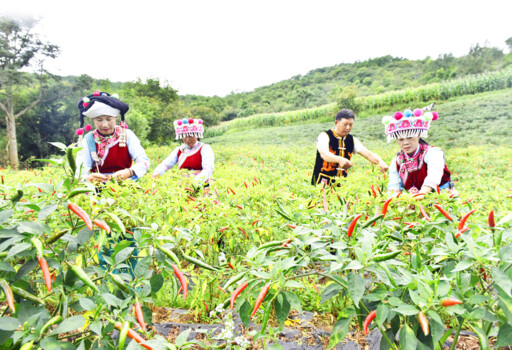
Yi ethnic people in Zhijie Village, Dali Bai Autonomous Prefecture, Yunnan Province, pick chilies in the mountain fields on Sept. 10, 2025. Photo: IC PHOTO
As a micro-level hub of the “Three Rural Issues” (agriculture, rural areas, and farmers), the rural household serves not only as the basic organizational unit of agricultural production but also as a crucial carrier of ethical practices in rural society. Examining the relationship between farmers and agriculture reveals that agricultural production is not merely an economic activity—it is deeply embedded in socio-cultural dynamics such as household work allocation and intergenerational divisions of labor. From the perspective of farmers and rural communities, family life and everyday social interaction constitute the foundation of rural social structure, and changes in these domains directly reflect deeper transformations in rural society.
Accordingly, changes in rural households’ production and living conditions offer a micro-level window through which village social transformation can be observed. Building on existing research that emphasizes institutional effects and structural characteristics, such a perspective is essential for understanding the processes and mechanisms through which village society changes. Empirically, neither the transformation of production modes driven by capital inflows into rural areas nor population migration triggered by farmers moving to cities has completely dismantled traditional village social structures. Instead, a new order has emerged through the interaction between a “transforming modernity” and a “living tradition.”
Taking rural households as the core analytical unit, this article examines both “change” and “continuity” in agricultural production, family life, and social interaction under the dual pressures of capital entering the countryside and farmers migrating to cities. Drawing on fieldwork conducted in Mi Village, Yunnan Province, the analysis proceeds through detailed case studies to explore these dynamics.
Capital influx into rural areas
As an external force, the inflow of capital into rural areas first disrupts traditional modes of agricultural production. Take Mi Village, located in a county of Dali Bai Autonomous Prefecture in Yunnan Province, as an example. The village comprises 324 households—with a population of 1,220—and in recent years, changes in local agricultural production have been primarily linked to two pivotal events.
The first notable change occurred in 2020, when Zhang Qinlao, a capable resident from a neighboring village, took over the “Diligent Farm” within Mi Village. The second involved a partnership between Mi Village and the local branch of Yunnan Yunguo Planting Industry Agricultural Development Co., Ltd., which acquired land to implement two core projects: a “Highland Specialty Fruit Demonstration Planting Base + Scientific Seedling Cultivation Base” and an ancillary “Specialty Fruit Picking & Agro-Cultural Tourism Service Area.” Together, these projects were collectively termed the “Modern Forestry and Fruit Industry.”
These developments transformed the livelihoods of some smallholder households, with Bai Zhibin’s family providing a representative example. When Zhang took over Diligent Farm in early 2020, the farm required a substantial amount of labor. Initially, Zhang enlisted Bai Zhibin to assist with ditch digging and land preparation. After several rounds of cooperation, Zhang began to regularly ask Bai and his wife, Pu Hanyi, to help recruit smallholder farmers to work there. The four or five households they mobilized gradually became a stable source of labor for the farm.
This arrangement not only established a stable agricultural partnership but also created a unique dynamic where Bai and his wife served as coordinators between the farm and local labor. This arrangement lasted for nearly two years, until the end of 2021, when all of Bai’s land was transferred to the Modern Forestry and Fruit Industry. To ensure a smooth land transfer, the company promised to appoint Bai as both “chief manager” and long-term employee. When labor was needed, he would first assign his wife to work, and if additional workers were required, he would contact villagers from smallholder land-leasing households with flexible schedules. Apart from the initial phase of land leveling and tree transplantation, this small group was generally sufficient to meet ongoing labor needs.
At this point, the agricultural production model of Bai Zhibin and similar smallholders had fundamentally changed. After land transfer, they no longer relied on traditional mutual hiring arrangements but instead formed flexible, task-based labor teams. With Bai and his wife at the center, this small group coordinated labor across multiple teams while Bai simultaneously fulfilled his role as chief manager, effectively weaving together a localized labor network.
Although traditional mutual aid and employment relationships among farmers no longer exist, their close ties remain intact. The only change lies in specific interaction patterns, while the foundation remains deeply rooted in the social networks and structures forged by key figures. When the Modern Forestry and Fruit Industry initiative began experiencing wage arrears in June 2022, Bai assumed yet another role. During disputes over unpaid wages, he not only led by example and formulated strategies but also mobilized key figures to protect team members. These actions fully demonstrated the capacity of rural ethical norms to reshape and constrain purely economic rules.
Farmers migrating to cities
As farmers migrate to cities, the range of social relations and shared affairs within villages gradually contracts. At the same time, household life shifts from being embedded solely in the village to spanning both urban and rural spaces. Mi Village consists of three natural villages: Mishang, Mixia, and Mixin. At present, household income in all three relies primarily on long-term migrant work, supplemented by occasional local wage labor or farming. More than 30% of Mi Village’s labor force works outside the village on a long-term basis, making it a typical “hollow village.”
Most long-term migrant workers enjoy relatively stable incomes, with monthly wages far exceeding returns from farming. On the surface, farmers’ migration to cities appears to be separating them from the village social system in ways that may gently weaken its foundational roots. Migrant workers—especially second-generation migrants—often find themselves torn between exposure to urban cultural influences and emotional attachment to rural traditions. As population migration accelerates, particularly through the outflow of young and middle-aged laborers, village economies lose vitality, and local social interactions become increasingly simplified and rationalized. Yet farmers moving to cities does not invariably lead to the disappearance of villages. In Mi Village, many migrant workers have attempted—and ultimately failed—to bring elderly parents to live with them in cities, even in cases where they earn high incomes or can afford urban housing.
Here, the experience of Yang Jiashi’s family is illustrative. Although Yang planned to bring his parents to live with him and even considered buying an apartment in Dongguan, Guangdong Province, his parents were unwilling to leave Mi Village for the city. In this case, although he could afford the full cost of urban living for the family, his parents’ long-term immersion in village life had fostered deep attachments to the local natural environment, lifestyle, and social relationships—which ultimately shaped their decision to stay. Moreover, rural communities continue to function as a fallback option for villagers, particularly in terms of old-age security.
Although the migration of farmers to cities has shaken the structural foundations of village society, it is noteworthy that despite the significant changes in farmers’ occupations and places of residence, their practical logic of acting as family units has not fundamentally changed. The existence of families spanning urban and rural areas reflects an active choice grounded in ethical responsibility: it sustains obligations of intergenerational support while adapting to the practical realities of urban–rural resource allocation.
‘Change’ and ‘continuity’
Research reveals that the influx of capital into rural areas and the migration of farmers to cities jointly shape the complex and unique social phenomena that emerge as rural society in China transforms. Capital entering the countryside introduces modern technologies and management models, altering agricultural production and, in turn, reshaping patterns of interaction in the production sphere. However, this external force has not fundamentally undermined the social foundations of village life, which remain anchored in deeply rooted cultural values, social networks, and interpersonal relationships.
By contrast, the migration of farmers to cities exerts a more direct impact on these foundations. As large numbers of young and middle-aged villagers leave, traditional social structures and interpersonal relationships have begun to loosen, leading to changes in the daily life and social order of rural areas. On one hand, the forms of social interaction between families have shifted markedly, gradually giving rise to two partially distinct social relationship networks: one centered on the young generation of family members working in cities, and the other centered on those who remain in or return to the village. Urban and rural cultures increasingly interact and merge. On the other hand, with the continuous advancement of agricultural transformation, family lifestyles have also changed. These changes are not incidental but reflect households’ active efforts to adapt to shifting agricultural production models. Through adjustments across multiple dimensions, rural families have arrived at new forms of equilibrium, demonstrating strategic choice and adaptive capacity.
This article argues that the social transformation observed in Chinese rural areas follows a concentric, three-tier model of “action ethics—social structure—economic system.” Specifically, with the continuous development of the social economy, transformations at the outermost economic system level manifest as innovations in agricultural production methods and the widespread adoption of mixed livelihood strategies combining wage work and farming. This institutional change simultaneously triggers shifts in social structure. At the macro level, large-scale out-migration loosens horizontal ties within rural areas, yet at the micro level, family members separated across urban and rural areas remain closely connected through intergenerational responsibilities, preserving strong vertical bonds. This structural transformation is essentially an active choice made by farmers based on family ethics and responsibilities.
As complete social units, rural households integrate resources through internal divisions of labor, drawing support from both villages and cities. The case of Mi Village demonstrates that despite ongoing industrial restructuring, innovations in production methods, and changes in social interactions, the proportion of residents who remain in the village has remained relatively stable, while migrant populations circulate dynamically between departure and return. This pattern underscores the enduring influence of family-centric logic in shaping rural social structure.
Deeply rooted in traditional culture, family-centered action ethics display strong continuity while exerting a resilient influence over economic and institutional change. Amid capital influx and farmers’ migration to cities, all transformations—from agricultural technology upgrades and industrial restructuring to rural social reorganization—must align with the family-centered ethical framework.
He Qifeng is from the School of Sociology at China University of Political Science and Law. This article has been edited and excerpted from Sociological Review of China, Issue 4, 2025.
Editor:Yu Hui
Copyright©2023 CSSN All Rights Reserved