


China Animal Resource Specimen Bank: Connecting the world and inspiring the future
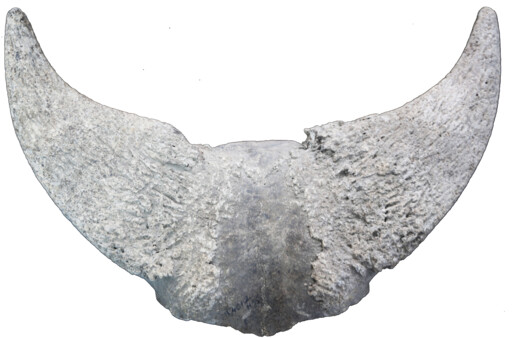
Bubalus mephistopheles specimen excavated from the Kuahuqiao Site, Zhejiang Province Photo: PROVIDED TO CSST
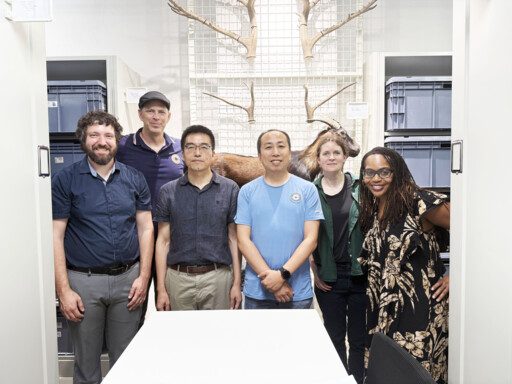
Havard professor Rowan Flad (back row) and his colleagues visit the China Animal Resource Specimen Bank. Photo: PROVIDED TO CSST
Stepping into the China Animal Resource Specimen Bank and encountering animal remains dating back thousands—even tens of thousands—of years feels like opening a gateway into the depths of history. Once silent, these ancient bones seem to speak. They carry the codes of natural evolution and human civilization, recounting the long epic of interaction between humans and their environment and prompting contemporary reflection on harmonious coexistence. The collection, preservation, and study of each specimen embody the perseverance and dedication that have shaped the discipline’s development. Those of us engaged in building and stewarding the bank are keenly aware of both the weight of this responsibility and the vast potential and long road that lie ahead.
Inheritance: A 60-year relay of wisdom across three generations of scholars
The establishment of the China Animal Resource Specimen Bank is a story of scholarly dedication passed down through generations. As early as the 1930s, Academician Liu Dongsheng of the Chinese Academy of Sciences, while researching animal remains from the Yinxu Ruins in Anyang, Henan Province, visited butcher shops to collect and compare bones, pioneering the use of modern animal specimens as archaeological reference materials in China.
In the early 1960s, Zhou Benxiong, a first-generation zooarchaeologist at the Institute of Archaeology under the Chinese Academy of Social Sciences (CASS), began deliberately collecting ancient animal specimens, though on a relatively small scale. It was not until the 1990s that the second generation of scholars, represented by Yuan Jing, initiated the systematic construction of a specimen repository at the Xibahe working area in Beijing.
In 2011, the launch of the CASS Innovation Project for Philosophy and Social Sciences created new opportunities for the repository’s development. Dedicated funding made it possible to acquire modern living animal specimens in a systematic and large-scale manner. In 2012, when the Center for Archaeological Science and Experimental Research relocated to the Wangfujing area in Beijing, Yuan Jing guided third-generation zooarchaeologists Lyu Peng and Li Zhipeng in methodically collecting, organizing, and centrally preserving both ancient and modern living specimens. Building on decades of accumulated materials, data, and research achievements, in 2019 the National Cultural Heritage Administration officially entrusted the CASS Institute of Archaeology, as a pilot institution, with establishing an animal remains specimen database.
In 2024, the CASS Key Laboratory of Archaeological Sciences and Cultural Heritage Protection was inaugurated at the Liangxiang campus of the University of Chinese Academy of Social Sciences, providing a historic opportunity for the accelerated development of the China Animal Resource Specimen Bank. As the cornerstone of this national-level key laboratory, the repository formally launched its comprehensive standardization program in February 2025 and was completed and put into operation in July of the same year.
Standards: A standardized, replicable, and shareable archaeological repository
The China Animal Resource Specimen Bank was established and operates in strict accordance with industry standards, including “A Guide to Collection, Preservation, Identification and Information Sharing of Animal Specimens” and “The Specification for the Collection and Laboratory Analysis of Archaeological Faunal Remains.” The storage facilities maintain a constant temperature (below 20°C) and controlled humidity (relative humidity below 30%), with protection from light and pests, ensuring the preservation of bioarchaeological materials. Taken together, these standards and design features offer a standardized, replicable model for the scientific development of similar repositories nationwide.
The repository system consists of two major components: the Ancient Chinese Animal Specimen Bank and the Living Chinese Animal Specimen Bank.
The Ancient Chinese Animal Specimen Bank collects animal skeletal remains from 121 archaeological sites across 26 provinces, autonomous regions and municipalities, spanning from the Neolithic period to the Ming (1368–1644) and Qing (1644–1911) dynasties. Specimens are organized according to seven major archaeological-geographical cultural regions: northeastern China and eastern Inner Mongolia; the upper Yellow River and northwestern region; the middle Yellow River; the lower Yellow River and Huai River; the upper Yangtze River and Xizang; the middle and lower Yangtze River; and Lingnan and surrounding areas. Each specimen is assigned a detailed “identity record” documenting site information, chronology, excavation context, and references to research findings. All specimens have been identified and studied by laboratory specialists.
The Living Chinese Animal Specimen Bank maintains an extensive collection of skeletal specimens from living species, including shellfish, fish, reptiles, birds, and mammals, covering diverse ecological regions across China. Primarily serving research, teaching, and collection purposes, each specimen is accompanied by a standardized record detailing its species classification, sex, age, place of collection, provenance, and preparation method.
From its modest, sporadic beginnings six decades ago to its current holdings of more than 100,000 specimens, the China Animal Resource Specimen Bank has grown into the country’s largest center for the preservation and study of zooarchaeological resources, distinguished by the broadest temporal and spatial coverage, the most comprehensive taxonomic system, and the most representative populations. As a core strategic resource of a national-level key laboratory and a key research base under the National Cultural Heritage Administration, it plays a central role in promoting greater standardization and professional practice in Chinese archaeological science.
Treasure: A chain of physical evidence preserving China’s fine traditional animal husbandry culture
The Ancient Chinese Animal Specimen Bank brings together numerous rare specimens that rank among the earliest and most significant in China and even worldwide, forming a living archive of the history of animal domestication. Among them, the 10,000-year-old domestic dog remains unearthed at the Nanzhuangtou site in Hebei Province represent the earliest confirmed domesticated animal in China. Together with the 9,000-year-old domestic pig bones discovered at the Jiahu site in Henan Province, these finds constitute an original Chinese contribution to the global history of animal domestication.
The 5,000-year-old domesticated sheep specimen from the Lajia site in Qinghai Province reveals key evidence for the origins of pastoral economies. The 4,500-year-old domesticated cattle remains from the Shantaisi site in Henan and the 3,300-year-old horse bones from the Yinxu Ruins in Henan further attest to the historical process of herbivore domestication in the Central Plains. Collectively, these discoveries highlight the inclusive, innovative, and enterprising trajectory of productivity development among ancient Chinese communities. Particularly noteworthy are the 8,000-year-old remains of Bubalus mephistopheles, a now-extinct species, unearthed at the Kuahuqiao site in Zhejiang Province, whose discovery not only provides crucial material for biodiversity research but also invites deeper reflection on the historical dimensions of ecological civilization.
The Ancient Chinese Animal Specimen Bank serves not only as the cornerstone of zooarchaeological research in China but also as a core support platform for cutting-edge archaeometric studies, including radiocarbon dating, ancient DNA analysis, isotope research, and proteomics. Through interdisciplinary collaboration, it provides key physical evidence for reconstructing ancient environmental change, resource utilization, technological development, and subsistence patterns. At the same time, as an important window for presenting the origins and development of Chinese civilization to the public, the bank plays a vital role in science communication and cultural dissemination.
To further enhance the research value and utilization of these collections, the laboratory is concurrently developing the China Animal Remains Specimen Database and a Visualization Platform for China’s Prehistoric Animal Husbandry. These initiatives integrate primary zooarchaeological data, identification standards, scholarly literature, 3D models, and archaeological geographic information, aiming to achieve deep integration and unified management of physical specimens and digital assets.
Looking ahead, we will continue to uphold the spirit of “unremitting efforts,” strengthening resource sharing and academic collaboration with colleagues at home and abroad. Centered on the overarching goal of building a standardized archaeometric resource bank for Chinese civilization, we will steadily advance six core tasks: consolidating the specimen collection system, improving digital resource-sharing platforms, exploring intelligent technologies, deepening academic research, expanding public outreach, and telling China’s story to the world. Through these efforts, we are committed to developing the China Animal Resource Specimen Bank into an internationally influential center for archaeological resource preservation, research, and innovation.
Lyu Peng is an associate research fellow from the Key Laboratory of Archaeological Sciences and Cultural Heritage Protection under the CASS.
Editor:Yu Hui
Copyright©2023 CSSN All Rights Reserved