


Bridging civilizations: Greek youth discover the real China
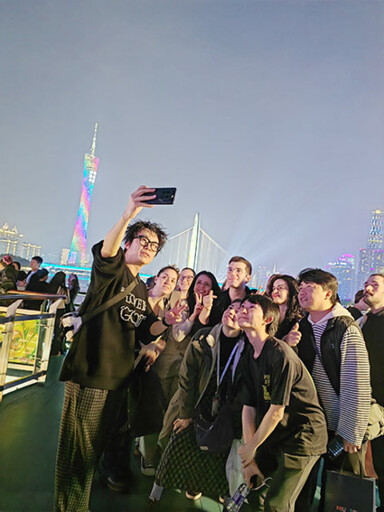
The study tour group visited Guangzhou. Photo: PROVIDED TO CSST
Winter sunlight filtered into a quiet office at the foot of the Acropolis, casting a pale glow over the marble and stone of the surrounding cityscape and the familiar city streets below. From this historic setting in Athens, Tina Kalantzopoulou spoke with CSST about her recent journey to China, recalling it with unmistakable warmth and animation.
The trip, she explained, offered her a direct encounter with authentic, everyday life in China—its aesthetic sensibilities, its long history, and its living culture. Such firsthand experience lies at the heart of the Young Envoys Scholarship Program (YES Program), which seeks to replace abstraction with immediacy. From December 15 to 24, 2025, more than 20 students from ten Greek universities traveled to Beijing, Xi’an, and Guangzhou for a ten-day study tour. Moving from archaeological sites and museums to university classrooms and contemporary urban spaces, they explored Chinese civilization in both its historical depth and present vitality.
The YES Program, guided by the Chinese Embassy in Greece and jointly organized by the Chinese School of Classical Studies at Athens (CSCSA) and the University of Chinese Academy of Social Sciences, brought the Greek delegation to China under the leadership of Tina Kalantzopoulou. Currently Assistant Director of the Belgian School at Athens, she participated in the program in her capacity as a senior researcher and instructor at the University of Athens.
Discovering China in public spaces
On their first day in Beijing, en route to the Forbidden City, Kalantzopoulou was struck by the sight of young people dressed in traditional attire, elaborately styled as though stepping out of another era. Her initial reaction was confusion. In Europe, she noted, similar scenes are often tied to commercial performances, with performers in rough costumes charging tourists for photographs—an approach she finds unappealing. Yet in Beijing, the garments were refined and meticulously crafted, creating an elegant atmosphere. When the guide explained that many visitors rent or even purchase these outfits for their own sightseeing experience, she was deeply moved.
As a scholar of archaeology and history, Kalantzopoulou has long reflected on the distance separating the public from cultural heritage in Greece and across Europe and, observing the contrast, remarked, “I saw Chinese people do visit their own sites. They travel within the country to visit archaeological or historical sites and even dress up for immersive experiences.” This kind of cultural consciousness at the societal level—not commonly encountered in Europe—was a new and powerful experience for her.
At the Chinese Archaeological Museum under the Chinese Academy of History, Kalantzopoulou gained further insight into the institutional and scholarly foundations underpinning this cultural engagement. The academic rigor behind the exhibitions, the curatorial vision, and the architectural and display design all impressed her as reaching an exceptionally high standard.
Maria Katsaouni, an undergraduate at the University of Athens, shared a similar impression, remarking that “at the Chinese Archaeological Museum, we observed how archaeological findings are not merely displayed as isolated artifacts but are contextualized within broader historical narratives.” Interactive digital screens, digital reconstructions, and glasses-free 3D displays animated the artifacts, rendering historical narratives more accessible to both domestic and international visitors. Hands-on experiences—such as striking bronze bells or handling pottery fragments from archaeological sites—left an especially vivid impression. In this setting, the museum appeared not as a static repository of relics but as a dynamic educational space that integrates scholarship, technology, and public participation.
Demystifying China through everyday interactions
For Kalantzopoulou, one of the program’s most significant contributions is promoting cultural exchange and mutual understanding between people. Before setting out, she had reflected on how little Europeans truly know about China. While Chinese products and technologies are widely available in Europe, she observed, Chinese cultural works circulate far less extensively, and public familiarity with Chinese aesthetics and literary traditions remains limited. She herself, for example, had not previously read Journey to the West, nor fully grasped its cultural resonance in China. Encountering the story during the visit, she found herself captivated and newly appreciative of its cultural appeal.
In fact, she returned to Greece with a suitcase full of Chinese books—a tangible reminder of the impressions she had formed during the trip. Although she cannot read the language, she spoke enthusiastically of their elegant bindings, thoughtful layouts, and imaginative illustrations. The visual experience, she suggested, softened the barrier of linguistic unfamiliarity and opened another path of appreciation.
Whether interacting with Chinese teachers and students in academic settings or meeting people on the streets and in shops, the delegation experienced firsthand the friendliness and openness of Chinese society, Kalantzopoulou added. “Despite language barriers, Chinese people were very willing to communicate with us. We often used our phones and translation apps to understand what they were saying.” The warmth, kindness, and patience they encountered in these everyday interactions left a lasting impression. When they tried simple Chinese phrases, such as xiexie (thank you), they were met with enthusiastic and encouraging responses, an exchange that left them genuinely touched.
By the end of the ten-day visit, many of the Greek students had begun reassessing prior assumptions about China shaped by incomplete or politicized narratives. Earlier impressions, they realized, did not capture the complexity of contemporary China. In Kalantzopoulou’s view, everyday interactions and face-to-face contact offer an effective means of dispelling misunderstanding.
Academic perspectives on civilizational exchange
Both Kalantzopoulou and her students described the visit as unforgettable. Though they represented diverse disciplines, each found the experience intellectually insightful. Klimentini Alexia Poulou, an undergraduate in International Relations at the Athens Panteion University of Social and Political Sciences, observed that the trip provided not only cultural exposure but also a rare opportunity to test classroom theories against lived reality. Concepts that once seemed abstract acquired concrete meaning through direct engagement with Chinese academic institutions and the broader public.
Kalantzopoulou, who teaches archaeology and therefore interacted most closely with students in her field, noted that they were especially engaged during the visit to the Terracotta Warriors of Qin Shi Huang. Discussions ranged from excavation phases and stratigraphic methods to conservation philosophy, revealing a keen interest in both technical practice and interpretive frameworks.
Beyond disciplinary insights, several students spoke of sensing the continuity of Chinese civilization in both history and contemporary life. Konstantina Konstantinou, a PhD student in philosophy at the University of Athens, reflected on the dynamic integration of heritage and daily life she observed. The ancient city wall of Xi’an, rather than standing apart as an isolated monument, remains woven into the rhythms of urban existence. At the Grand Canal Museum of Beijing, she saw how the historic waterway has been incorporated into modern planning, embodying a model of urban renewal attentive to preservation and revitalization.
Katsaouni added that China’s urban planning systematically integrates historical memory, infrastructure, and development concepts into a coherent whole, achieving a sense of continuity. Many of the historical buildings and heritage sites encountered during the tour, she argued, demonstrate that preservation and functionality need not be mutually exclusive and can coexist productively with contemporary urban life. Guangzhou offered yet another dimension, highlighting China’s emphasis on innovation, technology, and expanding global connectivity. As one of the country’s most dynamic cities, it exemplifies the successful integration of advanced technology, international trade, and modern urban planning.
Kalantzopoulou told CSST that Chinese history and civilization form part of world history curricula in Greek primary and secondary education. Although classical Greece and ancient China did not directly interact, China often appears in Greek scholarship as a “parallel civilization,” comparable in ideas and intellectual tradition. She emphasized that China should not be framed as a "neglected other," but as an integral participant in the shared history of world civilization. The more she examined China’s historical context, the more she discerned structural resonances between Chinese and Greek civilizational development. Setting aside differences in political and social structures, she argued, the fundamental driving force behind civilizational development is humanity’s basic needs.
Yan Hongwei, Chinese Director of the Business Confucius Institute at the Athens University of Economics and Business, concluded that the study tour enabled Greek students to engage meaningfully with Chinese language, culture, and contemporary society, broadening their academic and cultural horizons while contributing to their personal growth.
Editor:Yu Hui
Copyright©2023 CSSN All Rights Reserved