


Tang-era Silk Road artifacts as testimony to continuity, creativity of Chinese culture
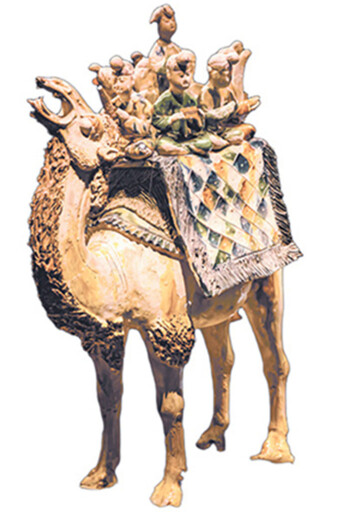
The “Tangsancai Glazed Pottery Camel Carrying Musicians and a Dancer,” the treasure of the Shaanxi History Museum Photo: IC PHOTO
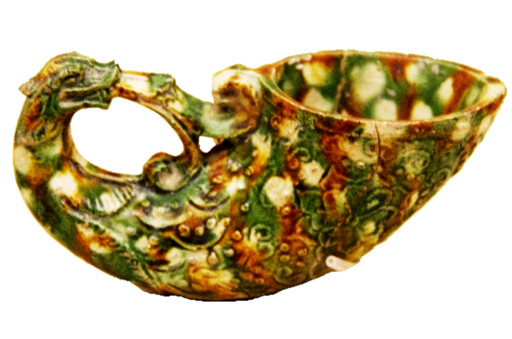
The “Tangsancai Glazed Pottery Dragon-Head Cup,” housed at the Shaanxi History Museum Photo: PROVIDED TO CSST
The Silk Road reached an unprecedented level of vitality during the Tang Dynasty (618–907), enabling the frequent movement of goods, people, and ideas across Eurasia. The goods that circulated along these routes—remarkable for their diversity of form and material, as well as their refined craftsmanship—embody the cultures of different nations, regions, and ethnic groups connected by the Silk Road. As material witnesses to exchange and mutual learning between Chinese civilization and other world civilizations, they exerted a profound and long-lasting influence on the creative transformation and innovative development of China’s cultural tradition.
Embodying cultural exchange
The “Tangsancai [Tang Dynasty Tri-colored] Glazed Pottery Camel Carrying Musicians and a Dancer,” now in the collection of the Shaanxi History Museum, was unearthed in 1959 from a Tang tomb in Zhongbao Village on the western outskirts of Xi’an, Shaanxi Province. Mounted on the camel’s back is a raised platform draped with a long checkered carpet, upon which eight figurines—seven male musicians and one female dancer—are arranged. The musicians sit around the platform playing seven different instruments, including the flute, konghou, pipa, sheng, xiao, clappers, and panpipes, each absorbed in performance. At the center stands the dancer, her hair styled in the Tang fashion and her body clad in a high-waisted long gown. With her head slightly raised and her long sleeves flowing, she sings and dances with graceful poise.
The scene clearly represents a small itinerant troupe, consisting of a principal performer accompanied by musicians. As a representative work of the flourishing Tang Dynasty, the figurines depict musicians dressed in Han-style attire while performing primarily on foreign instruments introduced via the Silk Road, vividly recreating the cosmopolitan music and dance culture of the time. By ingeniously placing the stage atop a camel, Tang artisans achieved a subtle yet striking artistic effect that conveys both movement and cultural hybridity.
A similar process of cultural integration can be seen in the “Tang Silver Stem Cup with a Plain Surface,” also housed in the Shaanxi History Museum. In form, it closely resembles Western-style silver stem cups, which were popular in Central Asia from the late 6th to the mid-7th century before entering Chang’an (present-day Xi’an), the capital of the Tang Dynasty, along the Silk Road. Favored by Tang nobles, such vessels helped spark a vogue for exotic objects. Today, stemmed glassware is commonplace, but its widespread use can be traced back to this period of exchange.
Another example is the “Tangsancai Glazed Pottery Dragon-Head Cup.” Although it belongs to the Chinese tradition of horn-shaped wine vessels, its form clearly draws on the rhyton, a horn-shaped drinking vessel popular across Eurasia. Unlike the Western rhyton, however, this cup has no spout and is decorated with a dragon motif distinctive to Chinese culture. Retaining an exotic outline while incorporating indigenous symbolism, it exemplifies the fusion of Silk Road material culture with Tang Chinese tradition.
Inspiration from artistic re-creation
The “Bronze Mirror with Sea Beast and Grape Patterns” was a popular mirror type during the reigns of Emperor Gaozong and Empress Wu Zetian of the Tang. An example of the dynasty now in the Palace Museum in Beijing features grapevines rendered in high relief as the primary decorative motif, interwoven with animated images of sea beasts, birds, butterflies, flowers, and foliage. The dense yet orderly composition produces an ornate and visually dynamic effect. By combining grape motifs from the Western Regions with auspicious beasts associated with the Central Plains, the mirror embodies the integration and mutual learning characteristic of Silk Road cultures.
A comparable synthesis appears in the “Tang Silver Vase with Beaver, Grape, and Scroll Grass Patterns” in the Henan Museum. The vessel is densely covered with grape clusters and scroll grass motifs, while a vividly carved beaver crouches on a grapevine at the center of its belly. Grape patterns are generally believed to have originated in ancient Egypt and Greece before spreading to West and Central Asia. Scroll grass patterns, with their twisting and winding vines, were introduced to the Central Plains and subsequently combined with motifs such as honeysuckle, lotus, orchid, and peony, eventually evolving into an S-shaped decorative form. Honeysuckle, an evergreen vine, gave its name to the honeysuckle pattern, which originated in Persia and was widely used during the Tang Dynasty, particularly in Buddhist aureoles and silk designs. This silver vase can be regarded as a representative example of the combination of Chinese and foreign cultures.
The creative transformation of foreign elements by Tang artisans offers enduring inspiration for contemporary cultural innovation. While upholding the core of Chinese culture, this process made it possible to realize a cross-temporal and cross-spatial dialogue between Chinese and foreign civilizations through the circulation of objects and artistic reference.
Silk itself—the most important commodity driving Silk Road trade—provides further evidence of this process. Among its most common decorative motifs were roundel patterns, also known as tuanhua or tuanke: circular designs composed of plants, animals, or auspicious characters, often enclosed by pearl borders. These patterns boast varied floral forms and richly layered compositions. Building on earlier traditions, Tang roundel designs absorbed elements from Persian and Byzantine textiles, creating an aesthetic characterized by natural balance, the interplay of movement and stillness, and restrained elegance. As a result, they enjoyed wide popularity among both the imperial court and the general populace.
Localized artifact-making techniques
Persian techniques of gilding and chasing silverware were transmitted to Chang’an via the Silk Road. Tang craftsmen not only mastered these methods but refined them further, infusing them with distinctly Chinese characteristics. The “Tang Gilded Silver Bowl with Twin Fish Patterns” in the Shaanxi History Museum offers a striking example. At the bottom of the bowl, two gilded fish are depicted with their heads and tails connected. When the vessel is filled with water, ripples animate the scene, making the fish appear to swim. The aquatic plants and fish were shaped using repoussé and chasing techniques, then highlighted with gilding—a decorative approach clearly influenced by Sasanian Persian silverware.
The motif of the makara, originally a water deity in Indian mythology, entered China with the eastward spread of Buddhism. During the Sui (581–618) and Tang periods, the makara gradually absorbed features of the Chinese dragon’s head. In ancient Indian art, the motif appeared widely in sculpture and painting and was especially common in the gateways of Buddhist temples.
This synthesis is evident in the “Tang Gilded Silver Multi-lobed Bowl with Makara Patterns” in the Xiamen Museum. The bowl’s body is fully gilded and was forged from base to rim using repoussé, then chased with pearl borders and long-tailed phoenix motifs. While employing Western metalworking techniques, the decoration reflects a localized visual language shaped by Chinese symbolism.
Large numbers of glass vessels from the Sasanian Persian and Arab worlds—including bowls, bottles, and stemmed cups—also entered China via the Silk Road. In the past, such items were luxury goods reserved for the imperial household and nobles. Today, however, Chinese artisans have fully mastered glass-making techniques, enabling mass production and transforming glassware into everyday household objects.
Close relationship between Silk Road artifacts and Chinese cultural traditions
As a strategic stronghold along the Silk Road, Jiuquan in Gansu Province has since ancient times been renowned for producing yeguang bei, or “night-shining cups.” Carved from jade sourced from the Qilian Mountains, these cups are richly colored, eggshell-thin, and translucent. Wang Han’s poem “Song of Liangzhou (I)” evokes a poignant Tang battlefield scene: “Fine grape wine in cups of night-shining jade / We wish to drink, but the pipa on horseback urges us on / If we lie drunk on the battlefield, do not laugh, sir— / Since ancient times, how many have ever returned from war?” The imagery of grape wine and luminous cups not only conjures an emotionally charged moment of frontier life but also implicitly situates the scene in the Hexi Corridor. Raising the radiant cup and draining its blood-red wine calls forth a heroic spirit of fearlessness in the face of sacrifice.
Ming-Dynasty (1368–1644) text Yiyuan Zhiyan (Casual Comments on Arts) states, “grape wine alone is a flawless gem; such excellence reflects the extraordinary status of the flourishing Tang Dynasty.” Could such resonance have been achieved without references to grape wine from the Western Regions, the night-shining cup, or the foreign pipa sounding from atop galloping warhorses? The aestheticization of material imagery illustrates the integration of Silk Road material culture with Chinese cultural traditions, playing a vital role in enriching the content of Tang poetry, generating novel imagery, and adding exotic charm.
Chinese cultural tradition is vast, profound, and enduring, shaped through continuous engagement with external cultures. Throughout history, the Silk Road functioned as a major conduit for exchange between China and the wider world, linking civilizations through commerce, diplomacy, warfare, and migration. Preserved today as artifacts, these objects stand as material testimony to the historical processes of exchange that enabled technological development, cultural inheritance, and creative self-renewal. They offer compelling evidence that a civilization sustains its vitality through opening up—advancing toward lasting achievement through openness, inclusiveness, interaction, and integration.
Gao Jianxin is a professor from the School of Literature, Journalism and Communication at Inner Mongolia University.
Editor:Yu Hui
Copyright©2023 CSSN All Rights Reserved