


Across millennia: China’s expansive archaeological landscape
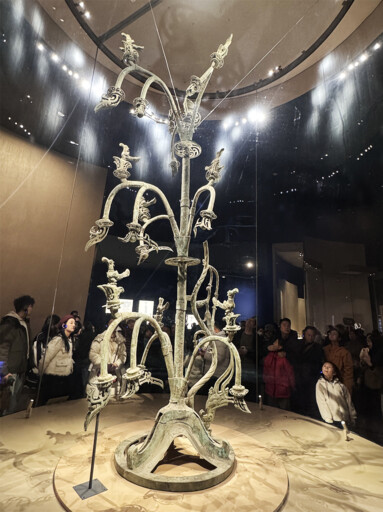
The Massive Bronze Sacred Tree, also known as the No. 1 Sacred Tree, at the Sanxingdui Museum in Sichuan Province Photo: Fang Ke/CSST
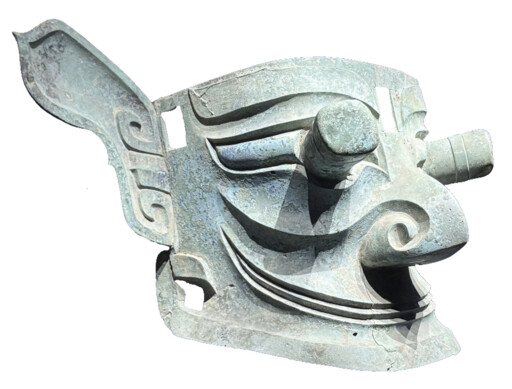
The big bronze mask at the Sanxingdui Museum in Sichuan province Photo: Fang Ke/CSST
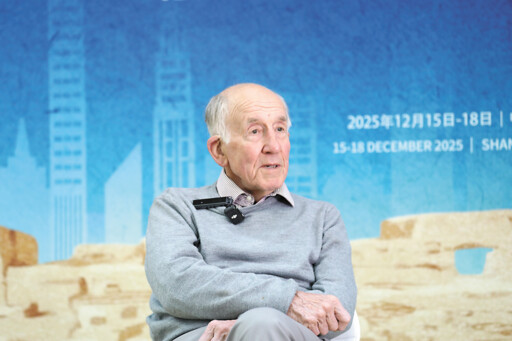
Charles Higham Photo: Wang Zhou/CSST
Charles Higham, professor emeritus of Archaeology at the University of Otago, New Zealand, is an international fellow of the British Academy and a fellow of the Royal Society of New Zealand. Over the course of his career, he has witnessed firsthand a series of paradigm-shifting advances in research methods—including radiocarbon dating, ancient DNA analysis, and ZooMS (Zooarchaeology by Mass Spectrometry)—that have steadily unlocked some of archaeology’s most enduring questions. Amid these sweeping changes in the discipline, he has retained the grounded humility and focus of a dedicated field excavator.In a recent interview with CSST, Higham observed that archaeology has moved well beyond the simple task of “discovering the past.” Today, he suggested, it offers a crucial lens for understanding how technology drives social change and how civilizations respond to global challenges such as climate change.
Interplay of technology, society and archaeology
CSST: In your decades of archaeological research, which fundamental methodological shifts have most profoundly reshaped the discipline?
Higham: Looking back, I can think of two major advances that completely transformed archaeology. The first is radiocarbon dating. When I began studying at Cambridge in 1957, there were very few dating samples and few laboratories. Now it’s expanded enormously, and the precision of dating has completely changed how we approach the discipline. In the old days, we dated things by artifact shape and type, how they evolved, and how they compared between regions. But now we can pinpoint directly by dating very small samples—as small as a grain of rice—what happened and when.
The second breakthrough is undoubtedly ancient DNA. In 1953, James Watson and Francis Crick discovered the double helix structure. This has had profound implications for archaeology. Now, by extracting ancient DNA from prehistoric remains, we can explore individual relationships, population origins, how groups were related, and even demographic trends, including whether a population was increasing or declining.
CSST: How does archaeology reveal the dynamic, mutually shaping relationship between technological change and social formation?
Higham: Technology and society have always been deeply integrated throughout human history. Just look at today’s headlines: emerging technologies like AI are already reshaping society, and archaeology is no exception.
When we look further back into prehistory, technology’s impact on society is equally clear. We can trace our lineage to a common ancestor with chimpanzees around 5 million years ago. For most of that immense span, we have no surviving evidence of technology. Our ancestors may have used wood or stone tools, but nothing remains. The first definitive technological evidence appears around 3.3 million years ago: stone tools made by striking one stone against another to create sharp edges. This breakthrough marks the beginning of our archaeological record, and stone technology remained our primary window into ancient societies’ adaptation and change for millions of years.
Then came other major innovations, particularly metallurgy. China’s Bronze Age began around 2000 BCE, when people learned to mine copper and tin ores and cast them using piece-mold technology. Bronze was fashioned into ritual vessels for feasting ceremonies, serving both as utensils for entertaining guests and as symbols of the holder’s social status and authority. The Bronze Age gave way to the Iron Age, with technology continuing to drive social transformation.
Throughout history, diverse technologies have propelled social change in different ways. Consider China’s Four Great Inventions, all emerging from this land’s deep civilizational soil before spreading outward and influencing other civilizations. China itself was constantly both receiving and exporting technological knowledge. The Silk Road stands as vivid testimony to this technological exchange and dialogue between civilizations.
Archaeological museum bridges past and present
CSST: Reflecting on your 2025 visit to Yuyao and Ningbo in Zhejiang Province, how have your perspectives on Chinese civilization and China’s approach to cultural heritage preservation changed?
Higham: This trip focused on a vital period, the origins of rice cultivation. Understanding when and why rice domestication began in the Yangtze River valley, alongside millet farming in the Yellow River valley, is key to understanding early Chinese civilization. We visited two sites.
The first was Jingtoushan site, which absolutely fascinated me. It’s an extraordinarily rich hunter-gatherer site, at the incipient stage of rice domestication. The deposits are deep, and crucially, they’re capped by a thick layer of anaerobic marine sediment that preserved organic remains that would normally have disappeared. We saw not only stone and shell artifacts, but also wooden objects, matting, fabric, and weaving: finds that simply don’t survive in most contexts.
Because these remains are so exceptional and fragile, the Chinese authorities have implemented careful protection: the site is completely covered, with a shelter built over it and thick concrete walls around the excavation to guard against flooding or collapse. And for years to come, anyone interested can walk down into the excavation and experience prehistoric life firsthand.
The other site was Hemudu, an early rice-farming village I first visited many years ago. A magnificent new museum now stands there. This is a pattern I’ve seen across China for decades, from Sanxingdui to Hemudu. The Chinese authorities consistently have the resources, will, and drive to build these world-class museums that attract thousands of visitors from China and overseas.
For me, visiting the Hemudu Site Museum was a fresh experience. One feature particularly impressed me: a virtual reality display. Step into a specific area, and you’re surrounded by a living, digital reconstruction of the village as it was 7,000 years ago. Chinese museums are not only of stunning international quality, literally the best in the world, but they also have a remarkable archaeological record to present.
CSST: How have China’s recent presentations of its archaeological discoveries and cultural heritage advanced global appreciation of its civilizational depth and continuity?
Higham: In New Zealand, I often see newspaper ads promoting tours to China. The itinerary typically includes Beijing—the National Museum, the Forbidden City—and Xi’an to see the Mausoleum of Qinshihuang with its stunning terracotta warriors, one of the world’s great archaeological sites. For international visitors, touring China’s archaeological and cultural heritage sites is not only a popular choice, but also an extremely informative experience.
In fact, Chinese civilization is known for its profound depth and remarkable continuity, forming the longest unbroken sequence of cultural achievement in the world. You don’t see this in America or Britain—a clear dynastic sequence with such continuity. And that continuity matters, because civilizations have ups and downs and cycles of rise and fall.
China has always cherished its rich, continuous cultural heritage as the root of its national identity. The authorities carefully balance excavation and preservation, working to uncover historical truths while safeguarding heritage for future generations. Through an evolving museum system and public education, China brings this heritage to life, helping people understand and appreciate the wisdom and values it embodies. These efforts look not only to the past, but increasingly to the innovations emerging from China for the future.
Addressing challenges and continuing legacy
CSST: How do you view the paradigm shift in archaeology from a focus on static preservation to adapting to climate change and strengthening global collaboration?
Higham: Climate change is one of the impending issues of our time. And if you want to understand its long-term impact on human societies, archaeology offers an indispensable perspective. In my research on Southeast Asia, the impact of climate fluctuations on human adaptability and civilizational change is particularly evident. The region’s agricultural systems are closely linked to the monsoon’s strength and rainfall patterns. As the monsoon is inherently variable, often abrupt and unpredictable, rainfall amounts directly govern rice field irrigation and, consequently, food production.
What I want to emphasize is that archaeology lets us trace the full arc of a civilization: its rise and fall. Take Angkor, centered in Cambodia, which I’ve worked on extensively. Its trajectory can be closely linked to long-term changes in monsoon intensity. Scholars have proposed various explanations for its collapse, such as deforestation, conflict with rival kingdoms. But recent research points to several severe droughts and erratic monsoon rainfall that likely disrupted water supplies, damaged agriculture, and undermined the irrigation system at the heart of its economy.
CSST: How can archaeology counter public misconceptions about how civilizations originated and evolved?
Higham: That’s a key question. Archaeological findings need to be communicated effectively to ordinary people. Public media, especially television, is extremely effective for this. Quality educational programs have always drawn wide audiences. I’ve made around 15 archaeological documentaries to present scientific discoveries and counter false theories about the human past.
We need to communicate clearly how each finding contributes to the larger human story. At least half of these were filmed in China—in Sichuan and Gansu, on sites like the Leshan Giant Buddha and the Great Wall. Good television brings archaeology out of reports and into people’s homes.
Museums are also an indispensable bridge. Visiting sites is like stepping into a time tunnel: you can walk the streets of Pompeii, frozen by Vesuvius 2,000 years ago, or encounter a Neolithic civilization at Hemudu. This immersive experience offers a form of public education that no text can replace. It is a powerful way to enlarge and enhance public perception of our ancestors’ achievements.
Editor:Yu Hui
Copyright©2023 CSSN All Rights Reserved