


Digital economy raises higher requirements for urban–rural integration
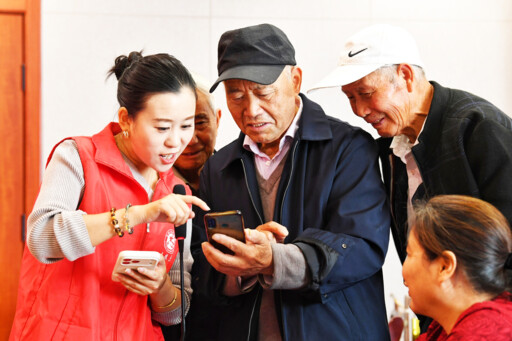
A volunteer (left) teaches senior residents of Shuodatang Village in Xiaomiao County, Hefei, Anhui Province, new skills such as how to start live-streaming, edit and post short videos, and sell agricultural products online, on Nov. 13, 2025. Photo: IC PHOTO
The Fourth Plenary Session of the 20th CPC Central Committee emphasized that “we must continue to place issues related to agriculture, rural areas, and rural residents at the top of our Party’s work agenda” and that “we need to promote integrated urban–rural development.” In the new era and on the new journey, advancing integrated urban–rural development hinges on promoting agricultural and rural modernization while achieving coordinated development between urban and rural areas. The digital economy, a new economic form emerging from the latest technological revolution, facilitates the circulation of factors and resources between urban and rural regions, enhances the connectivity of governance systems, and contributes to the equalization of public services, thereby creating new opportunities for integrated urban–rural development. At the same time, the digital economy may also introduce new challenges to such integration, given the persistence of problems such as the digital divide, digital monopolies, and digital barriers.
Addressing inadequacies in rural digital infrastructure
Digital infrastructure is a prerequisite for the operation and development of the digital economy. All activities within the digital economy rely on various forms of digital infrastructure for the collection, storage, transmission, and processing of data. The gap in digital infrastructure between urban and rural areas—manifested in disparities in internet coverage and usage costs—has become an impediment to integrated urban–rural development in the context of the digital economy.
In recent years, with the implementation of the Digital Countryside development strategy, digital infrastructure in China’s rural areas has steadily improved, providing strong support for comprehensively advancing rural revitalization and accelerating agricultural and rural modernization. By the end of 2025, the number of rural broadband users nationwide had reached 204 million households, while internet coverage in rural areas had risen to 69.2%, further narrowing the urban–rural gap.
Overall, however, inadequate digital infrastructure remains a major constraint on the development of the rural digital economy. Rural areas still lag behind in the deployment of new digital infrastructure such as 5G communications and the Internet of Things, while network speed and stability require further improvement. It is therefore necessary to strengthen top-level planning and design, expand investment and financing channels, and adhere to the principle of adapting measures to local conditions, so as to further advance the construction of intelligent and integrated digital information infrastructure in rural areas and address existing shortcomings.
Optimizing utilization of agricultural data resources
The effective use of data resources is central to the operation and development of the digital economy. Recognizing data as a key factor of production—and continually expanding the scope, depth, and effectiveness of its development and application—is essential for strengthening the vitality and competitiveness of the digital economy. Urban areas, supported by various databases, cloud computing systems, and technological platforms, occupy a dominant position across multiple stages of the data value chain—including production, utilization, and development. Rural areas, by contrast, remain in a relatively disadvantaged position, which has become a practical challenge to integrated urban–rural development in the digital economy era.
In recent years, China’s data resources have expanded rapidly in scale, while their overall quality has also steadily improved. In 2024, China’s annual data production reached 41.06 ZB, and its cumulative data storage volume reached 2.09 ZB. A total of 335 high-quality datasets were developed across sectors such as healthcare, industry, and education, helping drive the further growth of a range of emerging industries.
Nevertheless, overall, the enabling role of data as a production factor in industrial development is currently concentrated in manufacturing and services. In rural areas, where agricultural production predominates, the level of utilization of various digital resources still requires improvement. For the digital economy to truly support integrated urban–rural development, agriculture must undergo comprehensive digital transformation across the entire production chain, while the use of agricultural data resources should be further optimized under the principles of innovation-driven development, systems thinking, and shared development.
Enhancing farmers’ digital literacy
Digital literacy is central to the operation and development of the digital economy, as improvements across the population can stimulate a vast digital consumer market, attract high-quality investment in digital industries, and provide both talent pools and application scenarios for sustained technological innovation. The urban–rural gap in the application of digital technologies remains a major challenge to integrated urban–rural development. Compared with rural residents, urban residents generally make greater use of digital products and services and are more adept at using digital tools to improve decision-making efficiency.
In recent years, with the ongoing implementation of the National Strategic Action for Digital Education, China has established the world’s largest national smart education public service platform, contributing to steady improvements in digital literacy across the population. Data from 2024 show that 60.61% of adults and 64.69% of minors in China possessed basic or higher levels of digital literacy, while the workforce’s ability to meet the demands of the digital economy has also improved.
Even so, many rural residents—especially middle-aged and elderly individuals—are still only able to use digital tools for basic communication and entertainment, lacking the capacity to undertake more complex activities related to production and business operations. Therefore, if the digital economy is to promote integrated urban–rural development, a comprehensive, multi-level system of digital education and training should be established to enhance farmers’ digital literacy. This requires stimulating farmers’ internal motivation, aligning initiatives with their actual needs, and respecting their role as primary actors.
Jiang Yongmu is a professor and dean of the College of Marxism at Sichuan University.
Editor:Yu Hui
Copyright©2023 CSSN All Rights Reserved