


Int’l academics eye China’s ‘Two Sessions’ as signals of confidence and wisdom
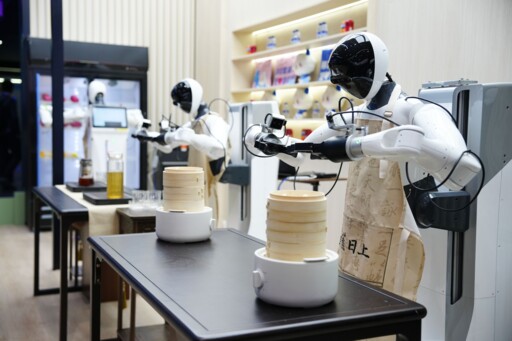
China-made humanoid robots demonstrate cooking functions at the Mobile World Congress, which was held in Barcelona, Spain, from March 2 to 5, 2026. Photo: IC PHOTO
The recently concluded “Two Sessions”—the annual meetings of the National People’s Congress (NPC) and the National Committee of the Chinese People’s Political Consultative Conference—mark a strategic juncture linking past achievements with future ambitions, drawing close attention from the international academic community. In interviews with CSST, several scholars noted that the “Two Sessions” not only represent a major event for the Chinese people but also carry exceptional global significance. Commending China’s sound planning and sustained commitment to modernization, they expressed expectations that the country will achieve new accomplishments during the 15th Five-Year Plan (FYP, 2026–30) period.
Holding domestic, global implications
“The successful completion of major development targets in 2025 marked a strong conclusion to the 14th FYP (2020-25) period. This has undoubtedly further cemented China’s role as a stabilizer and driver of growth in the face of unprecedented global changes,” said Nnanda Kizito Sseruwagi, a senior research fellow and head of the Development Watch Center in Uganda. “Moreover, during the 14th FYP period, China not only met but surpassed its urban employment creation target. This is a significant developmental achievement.”
“The ‘Two Sessions’ play an instrumental role in China’s whole-process people’s democracy,” stated Josef Gregory Mahoney, a professor from the School of Politics and International Relations at East China Normal University.
Scholars interpreted the profound significance of the “Two Sessions” through the interplay between domestic priorities and global dynamics. For Adetoro Olaniyi Banwo, deputy director of the Confucius Institute at the University of Lagos, Nigeria, and head of Chinese Studies in the university’s Department of Linguistics, African and Asian Studies, the “Two Sessions” are not only a major political event in China but also an important window through which the world can observe the country’s policy trajectory. Through this window, a consistent theme becomes clear: serving the people wholeheartedly.
“The CPC has always prioritized serving the people. Every policy and action plan is initiated for their benefit,” Banwo observed, adding that China’s efforts to boost employment and improve people’s well-being offer valuable reference points for African nations pursuing their own development goals.
Banwo further noted that this year’s “Two Sessions” go beyond setting annual targets and objectives to outline a macro-level blueprint for China’s economic and social development over the next five years. Such forward-looking and systematic planning, he said, provides a solid foundation for the steady advancement of Chinese modernization.
At the global level, Banwo pointed out that inconsistent governance and shifting policies remain persistent obstacles to development in many countries. In this context, China’s experience demonstrates the importance of development strategies tailored to national conditions.
New goals for new chapter
According to the government work report approved at the NPC session, China has set a GDP growth target of 4.5% to 5% for 2026, drawing positive responses from international observers. José Medeiros da Silva, a professor of Portuguese from the School of European Languages and Cultures and director of the Brazil Research Center at Zhejiang International Studies University, offered his perspective on the newly announced goals.
“While setting new economic growth targets, China has also made well-considered plans focused on building a robust domestic market,” da Silva noted. He emphasized that strong internal economic and social foundations constitute a vital element for navigating turbulence in the international environment. In this sense, China’s experience suggests that strengthening domestic fundamentals may offer an effective path not only for China but also for other developing countries coping with an increasingly uncertain global landscape.
Mahoney likened China’s 2026 targets to setting the rhythm for a “symphony of development,” bringing the nation’s diverse forces together in harmony. Establishing these goals at the beginning of the 15th FYP period, he said, provides crucial guidance for policymaking nationwide, shaping fiscal and monetary policy as well as the allocation of resources. He believes that China will continue prioritizing key areas, building on existing strengths while addressing remaining weaknesses.
Ronnie Lins, director of the China–Brazil Center for Research and Business, said that this year’s “Two Sessions” represent more than the continuation of macroeconomic targets; they also consolidate the strategic architecture guiding China’s next stage of development. Rather than pursuing short-term growth at any cost, Lins explained, Chinese policymakers are focusing on improving quality and efficiency, optimizing economic structures, and strengthening industrial resilience.
Chinese modernization reaches new heights
“China has achieved continuous breakthroughs in next-generation AI, drones, and space exploration, establishing itself as one of the world’s most dynamic innovation hubs,” said Banwo, praising the integration of technological innovation with industrial upgrading as a remarkable accomplishment.
Lins also noted that technological innovation has become a national priority in China’s development agenda. At the same time, the country is working to expand domestic demand and deepen the integration of domestic market factors, further strengthening the resilience of its economy.
Fiscal coordination and long-term planning discipline demonstrate clear continuity, Lins added, while the new development cycle reflects refined strategic planning. China is accelerating efforts to achieve greater self-reliance and strength in science and technology, promote industrial upgrading, and comprehensively enhance its capacity for independent innovation. This approach positions the country to seize development opportunities presented by emerging technologies and lay a solid foundation for high-quality growth.
Da Silva paid close attention to the key targets and strategic tasks China has set for the 15th FYP period, particularly those related to accelerating the creation of a new development paradigm. In his view, fostering emerging and future industries, advancing a comprehensive green transition in economic and social development, and achieving greater self-reliance and strength in science and technology are essential steps in driving high-quality development and advancing Chinese modernization.
Sseruwagi shared his perspective on the outcomes of the “Two Sessions” through the lens of China–Africa win-win cooperation. He noted that China’s fiscal spending now places greater emphasis on boosting consumption, investing in human capital, and strengthening social safety nets—a shift that reflects the growing maturity of China’s economy. In tandem, Chinese investment in industrial parks across several African countries is already supporting manufacturing and processing industries at scale, contributing to the structural transformation of African economies.
He also highlighted China’s plan to establish a national fund for low-carbon transition and foster new growth drivers such as hydrogen energy and green fuels, noting that this initiative demonstrates both strategic continuity and a deepening commitment to green development and opens broad prospects for renewable energy cooperation under the Forum on China–Africa Cooperation (FOCAC) framework.
The development blueprint outlined at the “Two Sessions,” Sseruwagi added, creates tangible opportunities for Global South countries, including those in Africa. In his view, China’s accelerated pursuit of greater self-reliance and strength in science and technology will promote international scientific exchanges and cooperation, providing an important platform for universities, research institutions, and high-tech enterprises to collaborate and share achievements.
Injecting more certainty into world
As the global landscape undergoes profound change, major events such as the “Two Sessions” give the world a clearer sense of China’s high-standard opening up and a deeper appreciation of the appeal of Chinese wisdom and solutions.
Banwo stressed that China is actively promoting the global reach of its cultural industries, bringing more high-quality cultural products to international audiences through film, sports, tourism, and traditional heritage. Acclaimed movies such as “Ne Zha: Demon Child Conquers the Sea” and “Monkey King: Hero Is Back” have showcased the unique allure of Chinese culture to audiences worldwide, deepening global understanding of and affinity for China.
He further observed that the “Two Sessions” present Africa with new opportunities to advance the 10 partnership initiatives under FOCAC and other multilateral platforms. Accordingly, African countries ought to participate more actively in high-quality Belt and Road cooperation, strengthen ties with China, and enhance their own development capacity.
Sseruwagi said that during the 15th FYP period, China’s role as a key hub for South–South Cooperation will become even more prominent. The country, he noted, will be better positioned to align with the development needs of Global South nations and contribute further to building a more just and equitable international order.
Da Silva added that the more turbulent and uncertain the global landscape becomes, the more countries need to strengthen cooperation and jointly explore effective pathways toward a predictable and stable international environment conducive to shared prosperity. For decades, China’s development has been an important factor supporting stability and economic prosperity in Latin America and the Caribbean (LAC). For this reason, deepening cooperation with China across economic, technological, and cultural spheres represents a pragmatic choice for countries in the region seeking to address current challenges.
“In a world of growing volatility and uncertainty, China stands as a stabilizing force through its strategic focus and development-oriented cooperation,” Lins remarked. In his view, China’s policy framework—emphasizing domestic demand expansion, technological innovation, and high-standard opening up—is creating new opportunities for deeper engagement between China and LAC. The cooperation China advocates, he said, is not transactional but rooted in long-term structural partnerships.
“Importantly, China anchors its international cooperation in development goals rather than ideological lines,” Lins observed. This approach helps reduce global trade uncertainties and strengthens confidence in multilateral economic cooperation. By prioritizing stability, investment, and innovation, China is encouraging Global South nations to pursue forward-looking development strategies—placing modernization, regional integration, and industrial upgrading at the core of their global competitiveness.
Editor:Yu Hui
Copyright©2023 CSSN All Rights Reserved