


Celebrating Spring Festival in China fuels cross-cultural exchange
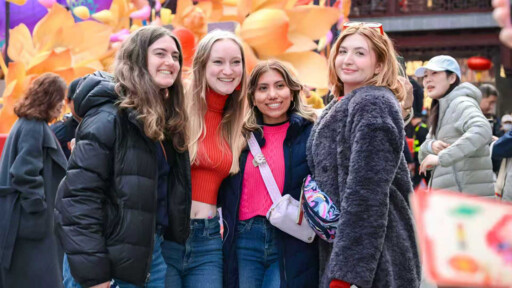
International scholars pose for photos at the Yuyuan Garden in Shanghai during the 2026 Spring Festival. Photo: PROVIDED TO CSST
During the 2026 Spring Festival holiday, the Shanghai Yuyuan Garden Lantern Show—an event with more than 400 years of history—drew large numbers of overseas visitors. With its theme “Adventure of Mountains and Seas” and its immersive presentation of the aesthetics of traditional Chinese life, foreign tourists accounted for more than 10% of all visitors. Major temple fairs in Beijing also introduced more displays and interactive activities centered on intangible cultural heritage (ICH), leading to a notable rise in the number of foreign visitors experiencing old Beijing folk customs firsthand.
A series of regional events likewise blended local cultural characteristics with Spring Festival traditions. These included Chengdu’s “Flowers Blooming in Splendid Chengdu” garden and flower-viewing festival, Harbin Ice and Snow World’s “Inspiring Dreams with Ice Lanterns,” and Xi’an Datang Everbright City’s immersive “A Thousand Lights Illuminate Chang’an, Auspicious Horses Welcome Spring” experience.
Explosive growth in inbound tourism
In the Bingwu Year of the Horse, the global enthusiasm for “celebrating the Spring Festival in China” has become a vivid window through which the international community observes contemporary China, reflected in the remarkable surge of inbound tourism. This boom is far from a simple economic phenomenon. Since February 2024, when “Spring Festival—social practices of the Chinese people in celebration of the traditional New Year” was inscribed on UNESCO’s Representative List of the Intangible Cultural Heritage of Humanity, the festival—the most important traditional holiday of the Chinese nation—has resonated globally with unprecedented breadth and depth. Its universal values and enduring charm vividly demonstrate the vitality and appeal of fine traditional Chinese culture in today’s world.
The growing global recognition of Spring Festival culture has quickly translated into tangible action, as international travelers quite literally “vote with their feet.” In recent years, this has driven explosive growth in China’s inbound tourism market during the Spring Festival, with multiple indicators reaching record highs in 2026. Forecasts from the National Immigration Administration indicate that the average daily number of people entering and leaving China during the holiday will exceed 2.05 million, representing a year-on-year increase of 14.1%. Booking data from the cultural and tourism market reflects this enthusiasm even more directly: In the two weeks before the festival, overseas flight bookings to China surged by more than 400% compared with the previous year.
This growth exhibits new characteristics of globalization, diversification, and deepening development. The distribution of overseas source markets has become more extensive than ever, with emerging markets performing particularly well. The South American market has emerged as a standout, with bookings by Argentine tourists skyrocketing ninefold year-on-year. Bookings from European countries such as the Netherlands, Spain, and the United Kingdom have more than doubled, while bookings by Russian tourists surged by 471%. Traditional source markets—including Singapore, Australia, and Canada—have also maintained strong momentum.
At the same time, overseas visitors’ cultural tourism consumption has begun shifting from general sightseeing toward deeper cultural engagement. Their travel footprints are no longer confined to major gateway cities such as Shanghai, Beijing, Guangzhou, and Chengdu. Instead, many visitors are venturing into culturally distinctive “hidden gem” destinations such as Chongqing, Zhangjiajie, Guilin, and Harbin. This shift—from casual sightseeing to deeper cultural engagement—signals that inbound tourism during the Spring Festival has entered a new stage centered on in-depth experiences of local folklore and regional culture.
Lowered barriers, innovative narratives
None of this has happened by chance. In recent years, China has continued expanding its circle of openness while significantly lowering barriers to entry. By the 2026 Spring Festival, China had introduced unilateral visa-free access for citizens of 50 countries, including major source markets such as Canada, the United Kingdom, France, Germany, Italy, Russia, Argentina, and Brazil. The 240-hour transit visa-free policy has also been extended to travelers from 55 countries.
According to the National Immigration Administration, 30.08 million foreign nationals entered China visa-free in 2025, accounting for 73.1% of all foreign arrivals. For many global travelers, the idea of taking a spontaneous trip to China without lengthy advance planning has now become a reality.
At the same time, the “soft” visitor experience has steadily improved. Streamlined customs procedures, expanded departure tax refunds, and enhanced multilingual services have all contributed to making visits easier and more convenient. Alipay and WeChat Pay now fully support international credit cards, effectively addressing long-standing concerns about payment, transportation, and daily convenience for overseas tourists.
Innovative and multi-layered contemporary narratives have made Spring Festival culture more vivid and emotionally engaging. One important driver has been the spontaneous spread of “digital word-of-mouth.” Topics such as “China Travel” and “Becoming Chinese” have trended on overseas social media platforms. Foreign content creators frequently share immersive experiences firsthand through short videos and livestreams—learning to make dumplings, writing Spring Festival couplets, or visiting temple fairs. These authentic, down-to-earth narratives have helped overcome information barriers once shaped by traditional media while presenting a lively and approachable image of contemporary China.
Official cultural branding has also expanded globally. After more than two decades of development, the “Happy Chinese New Year” campaign has grown into a comprehensive cultural brand spanning more than 100 countries and reaching over 100 million people annually. In 2026, synchronized global events—including a Spring Festival light show at the Burj Khalifa in Dubai and a Spring Festival concert in Brussels—helped bring the festive spirit of the Chinese New Year to audiences around the world.
Cultural communication has also grown more innovative in form. The 2026 CCTV Spring Festival Gala was broadcast live in 85 languages in cooperation with nearly 4,000 media organizations worldwide, reaching more than 2.4 billion viewers overseas. During the Spring Festival parade on the Champs-élysées in Paris, a formation of Chinese robots performed alongside traditional dragon and lion dances. Popular games such as “Genshin Impact” and “Justice Online” have incorporated elements of ICH—including Peking Opera and shadow puppetry—allowing players around the world to experience certain aspects of Spring Festival culture online. These creative approaches have lowered the barriers to cultural participation while enhancing both interactivity and appeal.
Promoting inter-civilizational exchange
The global “Celebrating the Spring Festival in China” boom carries significance far beyond cultural tourism. It offers a vivid example of the Global Civilization Initiative proposed by China and serves as an important window for exchanges and mutual learning among civilizations. When foreign visitors pick up a brush to write the character “福” (fu, meaning blessing), watch shadow puppetry in Xi’an, or learn to dot the eyes of a lion dance costume in Foshan, they are engaging in more than distinctive rituals. They are experiencing Chinese cultural ideals such as “harmony without conformity” and “respecting and treasuring others’ culture.” Such life-centered, immersive exchanges promote mutual respect and emotional connections among civilizations in subtle but transformative ways.
Meanwhile, overseas tourists’ consumption—across catering, accommodation, transportation, shopping, and other sectors—has injected strong growth momentum into the Chinese service industry, reflecting a mutually reinforcing relationship between inbound tourism and the vitality of China’s economic and social development.
Growing interest among overseas tourists in third- and fourth-tier cities and county-level destinations has further boosted cultural consumption and tourism development across a broader range of regions. Expanding inbound consumption has become an important tool for advancing high-level opening up as well as the “dual-circulation” development pattern, in which the domestic market serves as the mainstay while domestic and international markets reinforce one another. The boom in celebrating the Spring Festival in China has thus become an effective bridge linking China’s cultural soft power with its economic hard power.
At the same time, the global rise of a new generation of Chinese technology, industrial, cultural, and consumer brands—including TikTok, Xiaohongshu, DeepSeek, new energy vehicles, and new Chinese-style cuisine—has helped shape a vibrant and innovative image of China. This multidimensional appeal has encouraged many foreign visitors to place experiencing China firsthand on their travel wish lists, and the Spring Festival—the country’s most important traditional festival—naturally provides the ideal opportunity.
In summary, the successful inscription of the Spring Festival on UNESCO’s Representative List of the Intangible Cultural Heritage of Humanity and the cultural enthusiasm it has generated highlight China’s role as a responsible major country committed to protecting cultural diversity and fostering dialogue among civilizations on an equal footing. In today’s world, where political and cultural conservatism often runs rampant, the Spring Festival—with its themes of reunion, harmony, and hope—offers invaluable emotional resonance and spiritual comfort to people across the globe, echoing the shared aspiration for peace and development.
Today, roughly one-fifth of the world’s population participates in Spring Festival celebrations in various forms, and nearly 20 countries and regions have designated it as an official public holiday. Such widespread participation underscores just how widely the Spring Festival has been embraced and appreciated as a cultural symbol of China.
Rooted in a profound historical tradition and carrying shared values of humanity, the Spring Festival transcends national borders and resonates with people around the world. In the new era, it offers an inspiring Chinese cultural pathway for strengthening friendships among peoples, promoting exchanges and mutual learning among civilizations, and advancing the vision of a community with a shared future for humanity.
As a vivid representation of fine traditional Chinese culture, the Spring Festival is increasingly cherished and shared globally, becoming a festive occasion through which people pursue a better life and opening a new chapter in exchanges and mutual learning between Chinese civilization and civilizations around the world.
Sun Jiashan is a research fellow from the Department of Chinese Culture Teaching and Research at the Central Institute of Socialism.
Editor:Yu Hui
Copyright©2023 CSSN All Rights Reserved