


Rooted in the field: Tracing veins of Chinese civilization
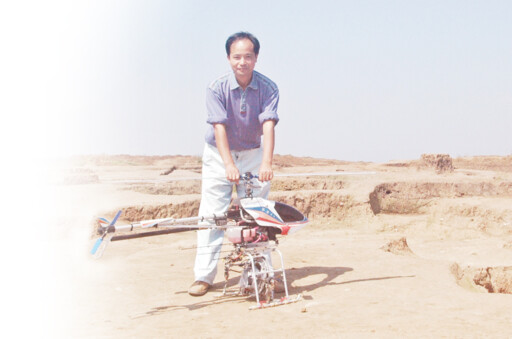
Archaeological work at the Maling site utilized early drone technology. Photo: PROVIDED TO CSST
Early spring in Wuhan swings between warm spells and sudden chills. At the foot of Luojia Mountain, the afternoon sunlight slants across the facade of Zhenhua Building. Pushing open the office door of Yu Xiyun, vice dean of the Archaeological Institute for Yangtze Civilization at Wuhan University, one is greeted by a wall of bookshelves. Between the desk and the shelves, several unopened bundles of books are neatly stacked.
Since joining Wuhan University in 1990, Yu has devoted 36 years to teaching, mentoring, and serving society, grounded in fieldwork—from Nanmuyuan in Badong to Maling in Xichuan, from Zoumaling in Shishou to Fenghuangzui in Xiangyang, and from Shaishutai in Anlu to Wangguliu.
Rooted in fieldwork
“The vitality of archaeology lies in fieldwork; without it, academic pursuits lose their foundation.” For more than three decades, this conviction has guided Yu’s work. At 26, he earned his master’s degree from Jilin University and joined Wuhan University. His first two years on the job profoundly shaped his academic approach. In his first year, he led the students in a field excavation at the Guojiagang site in Yichang. The excavation uncovered clearly stratified remains of Eastern Zhou (770–221 BCE) Chu culture, which continue to serve as an important reference for the periodization of Chu culture. The following year, he took the students to the Zhujiatai site in Jiangling for field practice, where they discovered the crucial “three-tier stratigraphy.” This finding separated the “Guanmiaoshan Phase I Culture” from the Daxi Culture and advanced the prehistoric cultural sequence of the Jianghan region. The results of these two excavations strengthened his original academic commitment to being “rooted in the field.”
In the spring of 1994, to support the construction of the Three Gorges Project, Yu took part in archaeological surveys in the Badong stretch of the Three Gorges. At the time, travel was arduous: the journey by boat to Badong took two to three days, and once there, they often remained cut off from home for months. Amid these difficult conditions, Yu recalled discovering cord-marked pottery shards dating back around 7,000 years at the Nanmuyuan site, confirming the earliest Neolithic cultural remains in the Three Gorges region. From the autumn of 2000 to the summer of 2003, he and his team excavated the Nanmuyuan site seven times. In 2010, he published his monograph The History of Ba: Evidence from Three Gorges Archaeology, which for the first time systematically reconstructed the early history of the ancient Ba people based on archaeological data.
Maling in Xichuan proved the most challenging archaeological site Yu ever undertook, yet it was there that he began experimenting with the open-area excavation method. In traditional excavation, a one-meter-wide baulk is typically left in place. Open-area excavation, by contrast, removes these baulks when features or cultural layers emerge, allowing the full layout of features and their relationships to come into view. This, in turn, makes it possible to reconstruct the lived environments of ancient families and settlements with greater clarity.
During the summer of 2008, at the Maling excavation site, doubts emerged over what some saw as “slow progress.” Yu nonetheless instructed his students not to rush the dig. Instead, they carefully scraped the surface, distinguishing subtle variations in soil texture, color, and inclusions to identify features and trace their interconnections.
Over four years, the team carried out open-area excavation across 30,000 square meters. The work not only refined a methodological approach for settlement archaeology at soft sites with complex cultural deposits in the Central Plains, but also brought into unusually comprehensive view the multi-period settlement landscape of the Maling site.
Seeing people through artifacts
Archaeology’s appeal lies in restoring wholeness from fragments and piecing together truth from broken remains. Throughout his fieldwork, Yu has consistently pursued the ideal of “seeing people through artifacts.”
At the Maling site, a peculiar phenomenon gave Yu a pause. The cemetery of the Hougang I Culture, dating back approximately 7,000 years, was clearly divided into two sections, each with distinctly different assemblages of burial goods. Similarly, houses of the Zhujiatai Culture from around 5,000 years ago were separated into eastern and western zones—clearly divided yet coexisting within a single settlement. “This could not be mere coincidence!” Yu thought.
As he delved deeper into the literature, he found that this “binary structure” closely paralleled the “moiety” systems of South American indigenous peoples and the “clan” divisions of North American indigenous groups. He ultimately concluded that what he was observing represented an even earlier form of kinship organization: the “surname clan”—two surname groups bound by stable marital ties and coexisting within a single settlement. This insight offered a new perspective on the longstanding puzzle of ancient kinship structures.
During his doctoral studies, Yu spent his days in a kiln dwelling at the Yangshao Culture site in Xishan, Zhengzhou, accompanied by drawing boards and data cards, meticulously sorting out the periodization of the excavated remains. He keenly observed that in the early stage of the Xiyin Culture, single-room houses were prevalent across various regions. By the late stage, however, multi-room houses began to appear in both the Central Plains and the middle reaches of the Yangtze River. Drawing on comparative anthropological analysis, he proposed that this evolution in architectural forms reflected a transformation in family structure—from “monogamous nuclear families” to “extended families and lineages.” This seemingly subtle change, he argued, was a key indicator of the emergence of private property and the dawn of civilization.
Over the past decade, Yu has led excavations at two prehistoric city sites in Hubei Province: Zoumaling in Shishou and Fenghuangzui in Xiangyang. In the summer of 2017, at a trial excavation at the Fenghuangzui site, a section exposed by his students drew his attention. Closer inspection revealed clearly stratified rammed earth layers, unmistakably indicating the remains of a prehistoric city wall. This unexpected discovery led to Fenghuangzui being designated a National Key Cultural Relics Protection Unit in 2019 and paved the way for Wuhan University to establish a field archaeology internship base there the following year. Today, as the outlines of this prehistoric city gradually come into sharper focus, Yu has gained a deeper understanding of the civilizational process in the middle reaches of the Yangtze River.
Theoretical breakthroughs and methodological innovation
“Chinese archaeology has a unique theoretical system rooted in its own practice,” Yu argues, responding to claims by some foreign scholars that “Chinese archaeology has no theory” and drawing on decades of sustained research to make his case.
Building on his sustained research into Ba history, Yu proposed the concept of cultural “agency.” He suggests that the forces driving cultural change may arise from technological developments within a culture, shifts in social organization, or external influences such as environmental change or interaction with other cultures. Moreover, he argues that agency at the level of consciousness—including emotions—can also serve as a powerful impetus for cultural transformation.
To illustrate this, he cited the Ba folk idiom “walking at night in splendid robes.” After the Ba people were enfeoffed for military merit, their leader reportedly stated, “If I do not return to my hometown, my folks will not know I have become a high official; there is no point in wearing these fine robes.” This deeply rooted cultural identity helped the Ba people maintain their distinctiveness during the Qin (221–207 BCE) and Han (202 BCE–220 CE) dynasties, rather than being absorbed into Han culture. Over time, they evolved into the Tujia ethnic group—a vivid example of cultural continuity. For Yu, this case underscored that “agency” at the level of consciousness can shape cultural change as profoundly as objective forces such as environment or technology.
In the past, archaeology was often limited to the study of physical remains. Today, more scholars are turning their attention to the spiritual and conscious dimensions of ancient societies. To illustrate this shift, Yu notes that the study of painted pottery can be approached at four levels: formal classification, techniques of expression or production methods, symbolic meaning, and interpretation of connotation. “The first two levels of research serve as the foundation. The third level falls within the domain of cognitive archaeology, while the fourth belongs to the realm of agency archaeology—that is, understanding painted pottery as an active factor in cultural change.”
On this basis, Yu systematically traced the theoretical context of Chinese archaeology: from Xia Nai’s “archaeological culture,” to Su Bingqi’s “cultural regional system theory” and Zhang Zhongpei’s “genealogy theory,” and finally to his own “agency theory.” Together, these developments point toward a theoretical system rooted in Chinese archaeological practice.
In 2021, his paper “Historical Materialism and the Theoretical System of Chinese Archaeology” was published in Social Sciences in China, attracting wide academic attention.
Passing the torch
Fieldwork internships are crucial for training archaeological talent. The “Field Archaeology” course directed by Yu has been recognized as a National First-Class Undergraduate Course, its success grounded in the principle of “unity of knowledge and action.” At the “mobile classroom” at the Fenghuangzui site, he teaches students hands-on—how to identify soil colors, draw sections, clean pottery shards, restore artifacts, record data, and compile reports. Every step is carefully demonstrated.
“Archaeology has a vast disciplinary system, and stratigraphy and typology are two key thresholds,” Yu explained. In his field-based talent cultivation practice, Yu requires students to build a solid foundation in two areas: stratigraphy—accurately identifying features and feature groups on-site and sorting out complete settlement surfaces; and typology—sorting and dating unearthed relics to construct a temporal and spatial framework.
In Yu’s experience, “Theories are simple to explain, but the essence of archaeology ultimately lies in fieldwork. Students must explore and experience it firsthand in the field to truly transform knowledge into practical ability.”
Now in his sixties, Yu continues to travel frequently between the university and the Fenghuangzui site. He is currently completing three books—A Textbook on Field Archaeology Methods, A Monograph on Chinese Archaeological Theory, and A Study on the Civilizational Process in the Jianghan Region—all of which have already reached draft form, marking the latest stage of his ongoing scholarly work.
Editor:Yu Hui
Copyright©2023 CSSN All Rights Reserved